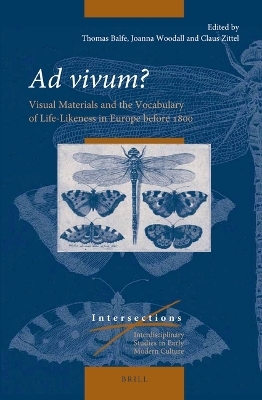
Ad vivum?
Brill (Verlag)
978-90-04-32994-2 (ISBN)
The term ad vivum and its cognates al vivo, au vif, nach dem Leben and naer het leven have been applied since the thirteenth century to depictions designated as from, to or after (the) life. This book explores the issues raised by this vocabulary and related terminology with reference to visual materials produced and used in Europe before 1800, including portraiture, botanical, zoological, medical and topographical images, images of novel and newly discovered phenomena, and likenesses created through direct contact with the object being depicted. The designation ad vivum was not restricted to depictions made directly after the living model, and was often used to advertise the claim of an image to be a faithful likeness or a bearer of reliable information. Viewed as an assertion of accuracy or truth, ad vivum raises a number of fundamental questions in the area of early modern epistemology – questions about the value and prestige of visual and/or physical contiguity between image and original, about the kinds of information which were thought important and dependably transmissible in material form, and about the roles of the artist in that transmission. The recent interest of historians of early modern art in how value and meaning are produced and reproduced by visual materials which do not conform to the definition of art as unique invention, and of historians of science and of art in the visualisation of knowledge, has placed the questions surrounding ad vivum at the centre of their common concerns.
Contributors: Thomas Balfe, José Beltrán, Carla Benzan, Eleanor Chan, Robert Felfe, Mechthild Fend, Sachiko Kusukawa, Pieter Martens, Richard Mulholland, Noa Turel, Joanna Woodall, and Daan Van Heesch.
Thomas Balfe, Ph.D. (2014), is Teaching Fellow at the University of Edinburgh. His research focuses on animal, hunting, fable, food, and human-animal inversion imagery. His most recent publication is “Hunting, Inversion and Anthropomorphism in Two Scenes from the Upside-Down World”, in Saß M. (ed.), Hunting Without Weapons: On the Pursuit of Images (2017). Joanna Woodall is a Professor at The Courtauld Institute of Art, University of London, where she teaches a research-led MA entitled ‘Bodies of Knowledge in the Early Modern Netherlands, ca. 1550–1670’. Her most recent publication is “For Love and Money. The Circulation of Value and Desire in Abraham Ortelius’s Album amicorum”, in Melion W. – Zell M. – Woodall J. (eds.), Ut Pictura Amor: The Reflexive Imagery of Love in Artistic Theory and Practice, 1500–1700 , (2017). Claus Zittel teaches German literature and philosophy at the Universities of Stuttgart (Germany) and Olsztyn (Poland), and is since 2014 Deputy Director of the Stuttgart Research Centre for Text Studies. He is the author of Theatrum philosophicum: Descartes und die Rolle ästhetischer Formen in der Wissenschaft (2009), editor of Nietzsche-Studien, and has co-edited some thirty-four volumes, including (with C. Lüthy, C. Swan, P. Bakker) Image, Imagination and Cognition: Medieval and Early Modern Theory and Practice (2018).
Acknowledgements
List of Illustrations
Notes on the Editors
Notes on the Contributors
1 Introduction: From Living Presence to Lively Likeness – the Lives of ad vivum
Thomas Balfe and Joanna Woodall
2 Naer het leven: between Image-Generating Techniques and Aesthetic Mediation
Robert Felfe
3 Ad vivum Images and Knowledge of Nature in Early Modern Europe
Sachiko Kusukawa
4 Paintworks au vif to Paintings from Life: Early Netherlandish Paintings in the Round and the Invention of Indexicality
Noa Turel
5 Cities under Siege Portrayed ad vivum in Early Netherlandish Prints (1520–1565)
Pieter Martens
6 ‘Jerusalem naert Leven’? Envisioning the Holy City in the Low Countries (1525–1575)
Daan van Heesch
7 Coming to Life at the Sacro Monte of Varallo: the Sacred Image al vivo in Post-Tridentine Italy
Carla Benzan
8 The Vital Breath: Mathematical Visualizations in England and the Netherlands around 1600
Eleanor Chan
9 Nature au naturel in Late-Seventeenth-Century France
José Beltrán
10 Drawing the Cadaver ad vivum: Gérard de Lairesse’s Illustrations for Govard Bidloo’s Anatomia Humani Corporis
Mechthild Fend
11 The Mechanism and Materials of Painting Colour ad vivum in the Eighteenth Century
Richard Mulholland
Index Nominum
| Erscheinungsdatum | 19.07.2019 |
|---|---|
| Reihe/Serie | Intersections ; 61 |
| Verlagsort | Leiden |
| Sprache | englisch |
| Maße | 155 x 235 mm |
| Gewicht | 820 g |
| Themenwelt | Kunst / Musik / Theater ► Kunstgeschichte / Kunststile |
| Geisteswissenschaften ► Philosophie | |
| ISBN-10 | 90-04-32994-3 / 9004329943 |
| ISBN-13 | 978-90-04-32994-2 / 9789004329942 |
| Zustand | Neuware |
| Informationen gemäß Produktsicherheitsverordnung (GPSR) | |
| Haben Sie eine Frage zum Produkt? |
aus dem Bereich