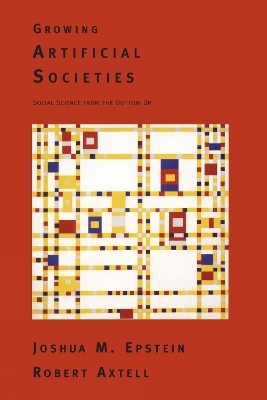
Growing Artificial Societies
MIT Press (Verlag)
978-0-262-55025-3 (ISBN)
- Lieferbar
- Versandkostenfrei
- Auch auf Rechnung
- Artikel merken
How do social structures and group behaviors arise from the interaction of individuals? Growing Artificial Societies approaches this question with cutting-edge computer simulation techniques. Fundamental collective behaviors such as group formation, cultural transmission, combat, and trade are seen to "emerge" from the interaction of individual agents following a few simple rules.
In their program, named Sugarscape, Epstein and Axtell begin the development of a "bottom up" social science that is capturing the attention of researchers and commentators alike.
The study is part of the 2050 Project, a joint venture of the Santa Fe Institute, the World Resources Institute, and the Brookings Institution. The project is an international effort to identify conditions for a sustainable global system in the next century and to design policies to help achieve such a system.
Copublished with the Brookings Institution
Robert L. Axtell was formerly research associate in the Brookings Foreign Policy Studies program.
Part 1 Introduction: "artificial society" models; life and death on the sugarscape; sex, culture and conflict - the emergence of history; sugar and spice - trade comes to the sugarscape; disease agents; a society is born; artificial societies versus traditional models; artificial societies versus ALife; toward generative social science - can you grow it?. Part 2 Life and death on the sugarscape: in the beginning ... there was sugar; the agents; artificial society on the sugarscape; wealth and its distribution in the agent population; social networks of neighbours; migration; summary. Part 3 Sex, culture and conflict - the emergence of history: sexual reproduction; cultural processes; combat; the proto-history. Part 4 Sugar and spice - trade comes to the sugarscape: spice - a second commodity; trade rules; markets of bilateral traders; emergent economic networks; social computation, emergent computation; summary and conclusions. Part 5 Disease processes: models of disease transmission and immune response; immune system response; disease transmission; digital diseases on the sugarscape; disease transmission networks. Part 6 Conclusions: summary; some extensions of the current model; other artificial societies; formal analysis of artificial societies; generative social science; looking ahead...; appendices.
| Sprache | englisch |
|---|---|
| Maße | 150 x 228 mm |
| Gewicht | 304 g |
| Themenwelt | Geisteswissenschaften ► Psychologie ► Sozialpsychologie |
| Geisteswissenschaften ► Psychologie ► Verhaltenstherapie | |
| ISBN-10 | 0-262-55025-3 / 0262550253 |
| ISBN-13 | 978-0-262-55025-3 / 9780262550253 |
| Zustand | Neuware |
| Informationen gemäß Produktsicherheitsverordnung (GPSR) | |
| Haben Sie eine Frage zum Produkt? |
aus dem Bereich