
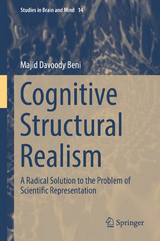
Cognitive Structural Realism (eBook)
188 Seiten
Springer International Publishing (Verlag)
978-3-030-05114-3 (ISBN)
Majid D. Beni obtained his PhD. at Tehran, Iranian Institute of Philosophy. He wrote greater part of his dissertation when he was visiting the School of Life Science, at ASU, where he worked on the history of philosophy of science under the supervision of Rick Creath. For the past few years he taught courses on the philosophy of science, philosophy of cognitive science, and mathematical logic. Through his career he attempted drawing connection between his work on Structural Realism and the philosophy of science on the one hand and recent developments in computational neuroscience and empirical and theoretical psychology on the other hand. He has developed Epistemic Informational Structural Realism and Structural Realist theory of Self in his previous publications.
Chapter 1. Introduction.- Chapter 2. The Parting of the Ways.- Chapter 3. The Grounding Problem: Why Worry?.- Chapter 4. Churchland’s Extension of Cognitive Models of Science.- Chapter 5. The Brain’s Predictive Processing.- Chapter 6. An Ecological Solution to the Grounding Problem.- Chapter 7. Cognitive Structural Realism.- Chapter 8. Conclusion: Meeting of the Ways.
| Erscheint lt. Verlag | 29.1.2019 |
|---|---|
| Reihe/Serie | Studies in Brain and Mind | Studies in Brain and Mind |
| Zusatzinfo | XI, 188 p. 1 illus. |
| Verlagsort | Cham |
| Sprache | englisch |
| Themenwelt | Geisteswissenschaften ► Philosophie ► Allgemeines / Lexika |
| Geisteswissenschaften ► Philosophie ► Erkenntnistheorie / Wissenschaftstheorie | |
| Schlagworte | activation patterns and connectionist networks • Churchland’s Extension of Cognitive Models of Science • Cognitive Models of Science • Cognitive Structural Realism • enactivism • Epistemic Informational Structural Realism • Neural Structural Realism • Predictive Error Minimization Theory • Ronald Giere • Semantic View of Theories • Structural Realism • The Grounding Problem |
| ISBN-10 | 3-030-05114-5 / 3030051145 |
| ISBN-13 | 978-3-030-05114-3 / 9783030051143 |
| Informationen gemäß Produktsicherheitsverordnung (GPSR) | |
| Haben Sie eine Frage zum Produkt? |
 PDF (Wasserzeichen)
DRM: Digitales Wasserzeichen
Dieses eBook enthält ein digitales Wasserzeichen und ist damit für Sie personalisiert. Bei einer missbräuchlichen Weitergabe des eBooks an Dritte ist eine Rückverfolgung an die Quelle möglich.
Dateiformat: PDF (Portable Document Format)
Mit einem festen Seitenlayout eignet sich die PDF besonders für Fachbücher mit Spalten, Tabellen und Abbildungen. Eine PDF kann auf fast allen Geräten angezeigt werden, ist aber für kleine Displays (Smartphone, eReader) nur eingeschränkt geeignet.
Systemvoraussetzungen:
PC/Mac: Mit einem PC oder Mac können Sie dieses eBook lesen. Sie benötigen dafür einen PDF-Viewer - z.B. den Adobe Reader oder Adobe Digital Editions.
eReader: Dieses eBook kann mit (fast) allen eBook-Readern gelesen werden. Mit dem amazon-Kindle ist es aber nicht kompatibel.
Smartphone/Tablet: Egal ob Apple oder Android, dieses eBook können Sie lesen. Sie benötigen dafür einen PDF-Viewer - z.B. die kostenlose Adobe Digital Editions-App.
Buying eBooks from abroad
For tax law reasons we can sell eBooks just within Germany and Switzerland. Regrettably we cannot fulfill eBook-orders from other countries.
aus dem Bereich