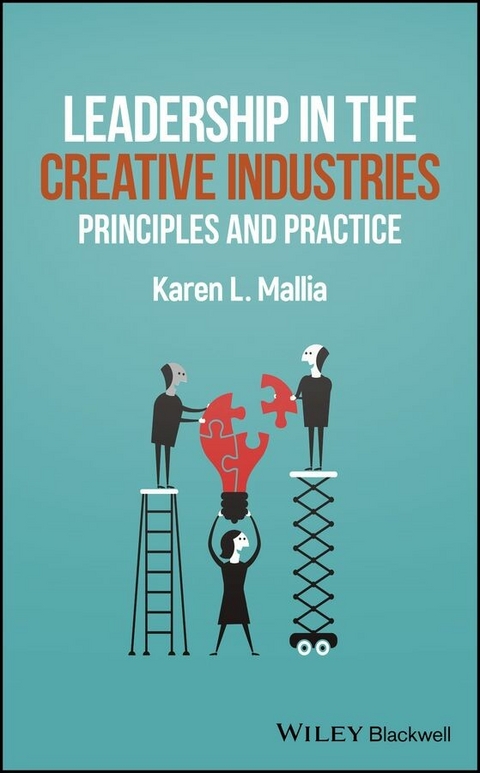
Leadership in the Creative Industries (eBook)
John Wiley & Sons (Verlag)
978-1-119-33579-5 (ISBN)
A groundbreaking book that explores the theory and practice of leading in the creative workplace
Leadership in the Creative Industries is a much-needed guide to the theory and practice of the creative leadership skills that are essential to lead effectively in creative fields. As the growth of creative industries continues to surge and 'noncreative' businesses put increasing emphasis on creativity and innovation, this book offers a practical resource that explores how to confidently lead a workforce, creatively.
In order to lead creative people it is essential to understand the creative process, creativity, and the range of variables that affect it. This book fills a gap in the literature by exploring the creative leadership practices that are solidly grounded in evidenced-based research. The author includes suggestions for overcoming the challenges associated with leading creative people, and puts to rest many of the current industry misconceptions about leading creatively. This vital resource:
- Is the first book that highlights the theory and practice of creative leadership skills in the creative industries
- Includes best practices of leading for creativity, and reveals what encourages creativity and what suppresses it
- Debunks commonly held myths about leading a creative workforce with evidence-based guidance
- Contains a wealth of helpful tips, visualizations, callouts from primary research, and anecdotes from recognized thought leaders, to highlight and underscore important principles.
Written for academics and students of leadership, those working or aspiring to work in the creative industries, Leadership in the Creative Industries puts the focuses directly on theory and practice of creative leadership in creative fields.
Karen L. Mallia is professor at the University of South Carolina School of Journalism and Mass Communications, where she has been awarded for outstanding teaching, research and professional service. She is a creativity and marketing communication expert with more than 20 years as an award-winning copywriter and creative director, and consultant in creative strategy in advertising, and more than a decade as an advertising professor.
Karen L. Mallia is professor at the University of South Carolina School of Journalism and Mass Communications, where she has been awarded for outstanding teaching, research and professional service. She is a creativity and marketing communication expert with more than 20 years as an award-winning copywriter and creative director, and consultant in creative strategy in advertising, and more than a decade as an advertising professor.
1
Creativity and the Creative Industries
There is no doubt that creativity is the most important human resource of all. Without creativity, there would be no progress, and we would forever be repeating the same patterns.
Edward de Bono
Creativity is celebrated. Envied. Exalted. Since people first etched on the walls of caves and chiseled a stone wheel, our world has been filled with evidence of human creativity in art and architecture and music and breakthrough inventions. We see it in buildings and monuments, from the terracotta army of Qin Shi Huang to Sydney Opera House; in everyday objects and technological wonders, in Google glass, in virtual reality, and driverless vehicles. Innovators like Walt Disney, Steve Jobs, and Richard Branson are held up as cultural icons – written and talked about until they take on a larger‐than‐life place in society. In recent decades, new technologies have emerged, adding a plethora of new creative job opportunities to those that already existed in media and design and entertainment.
Since Richard Florida first announced “The Rise of the Creative Class” (Florida, 2002), talk of creativity and innovation has exploded in almost every field – far beyond those directly associated with cultural and creative production. Why? Because in the twenty‐first century, more than ever before, creative thinking is what fuels economic growth.
The creative industries are hugely important. But even outside the borders of the so‐called “knowledge economy,” many economists see creative industries exerting a broader, dynamic impact on culture and prosperity. There's a surge in what are considered creative occupations – those where people apply themselves to a creative process that yields novel ideas or products or solutions that had not been envisioned before. Today, even in “noncreative” enterprises success is largely driven by ideas and innovation, making creativity both a precious resource and a hot commodity.
Bright, creative minds are both highly valued and in great demand – as are the people who know how to make creativity blossom and flourish, and can lead others in creative endeavors. Leaders. Creative leaders.
Small wonder that the study of creativity and creative careers and leadership have all exploded. Many colleges and universities have recognized that they cannot simply prepare students for their first job. They need to share the knowledge and skills to prepare students for a career, for leadership, and for the multiple career changes now considered inevitable over a lifetime.
Learning to lead creative people is critical to the career success of those entering the creative industries – and to the future success of all the businesses that compete for a finite pool of creative talent. Software programs will come and go, communication channels will emerge and disappear, but the fundamentals of creativity, and leadership that promotes it, will endure and provide lasting value.
Leading for creativity is no small task. Because the very essence of creativity is to “zig” when others “zag,” to bend rules, and to question everything. In case it isn't glaringly obvious, that way of working doesn't square very well with the traditional leadership model, where the leader makes the rules and followers follow. We'll discuss that matter in detail in Chapter 2.
For now, suffice it to say that before you can learn to lead for creativity, you need to understand the concept of creativity from every angle: what it is, how the creative process operates, and how creative people think and work. This gossamer substance we call creativity is elusive, difficult to identify, harness, and quantify. You may be creative, but even that doesn't mean you have a clue about where your ideas come from – or prepare you to lead others in creativity.
In this chapter you will learn:
- What creativity is, who is creative, and who is “a creative”
- What “the creative industries” are, and why they are so important
- Some fundamentals of applied creativity – creativity applied to work
- A bit about how creativity impacts creative leadership
- Why leadership in a creative enterprise is unlike any other
Most of us have some concept or mental image of what creativity is and could produce a definition if pressed. But few understand the power, the breadth, the ubiquity, or the incredible depth and complexity of human creativity. The more you learn about creativity, the more amazed you will be. The more you will want to know. Thanks to dozens of scholars doing decades of research, and most recently using neuroimaging to further enhance our knowledge, quite a bit is known on the subject of creativity. But before we proceed, let's define our terms.
1.1 What Is Creativity?
Some say it is applying imagination to problem solving. Creativity is usually defined as “the capacity to develop novel and useful ideas, behaviors, or products” (Runco, 2004).
To be considered “creative,” an idea or product must meet two essential criteria: it must be both novel and useful (or appropriate). Novel means original, unexpected – that which has not been seen or done before. However, an idea that is original or novel is not enough. To be considered creative, an idea or object must also have inherent value – be relevant or useful.
Who decides? Who says what is “creative,” and what is not? It depends. In the fine arts, the measure of value is looser than in the creative industries – sometimes, novelty is enough to consider a painting or composition creative. In creative industries, however, the value of a creative work is tied to fulfilling a strategic objective – and that is judged in a variety of ways, often on numerous levels.
For example, in advertising and design, once a concept meets the bar of being novel, it is measured against the agreed‐upon strategic communication objectives or creative brief. It is judged by its creator, again by a creative director (sometimes a hierarchy of creative directors), then by agency management and finally, by clients. Then it gets produced, and an audience weighs in. In the fashion industry, a design has to sell through levels in the house, catch the eye of the trade press and influencers in shows, meet fashion buyers' needs, attract the eye of the ultimate purchaser – and then, fit and flatter the wearer. Across the creative industries, the stakeholders and specifics may vary somewhat, but the hurdles a creative idea must soar past are always numerous.
Those whose livelihood comes from their ideas are engaging in applied creativity. That is a deliberate, staged process of problem solving in search of fresh answers. Creative occupations require being creative on demand, on time, with a novel approach that satisfies a given assignment – and doing that again and again, with every new project. Thus, some have argued that can be more challenging than being creative in artistic expression.
If delivering something entirely new, earth shattering, never‐ever‐been‐seen‐before, on deadline seems daunting, relax. Being creative doesn't mean coming up with a statue of David every pass. Creativity often arises simply from a new combination of, or association between, existing elements or ideas. This is why being adept at divergent and associative thinking is an important part of being able to be creative. Essentially, being creative is simply thinking and solving problems in new ways.
1.1.1 Who Is Creative? And Who Is “a Creative?”
You are. Everyone can be. Every human being is born with the capacity to be creative. But not everyone uses it. Creativity is an ability that converges and interacts with a host of individual variables: personality traits, motivation, thinking styles, intelligence – especially divergent thinking (Barron and Harrington, 1981; Csikszentmihalyi and Getzels, 1973; Dellas and Gaier, 1970; Lubart, 1994; Mumford and Gustafson, 1988) and abilities and knowledge and how all these variables interact (Lubart and Sternberg, 1995; Sternberg and Lubart, 1991).
Are artists more creative than those in other disciplines? Can scientists or coders be creative? (Think about Leonardo da Vinci before you dismiss scientists.) While most people tend to associate artists and the arts with creativity, no group owns it. Creativity is a way of being, a way of approaching life and work that can be applied to any discipline. It is how products are invented, breakthroughs in medicine occur, and how humankind makes leaps.
In 1997, Apple launched an advertising campaign with a commercial called “The Crazy Ones.” (You might have seen the revised version that was done as an internet eulogy to Steve Jobs when he died in 2011.) The one‐minute spot is tribute to visionaries from wide‐ranging fields, those who “Think different”: Bob Dylan, Martin Luther King, John Lennon, Martha Graham, Albert Einstein, Thomas Edison, Buckminster Fuller, Muhammad Ali, Alfred Hitchcock, Mahatma Gandhi, Jim Henson, Maria Callas, Pablo Picasso, Frank Lloyd Wright, Amelia Earhart, Richard Branson, Ted Turner.
The commercial is a beautiful, poetic homage to audacity and creativity, featuring the human penultimate...
| Erscheint lt. Verlag | 9.1.2019 |
|---|---|
| Sprache | englisch |
| Themenwelt | Geisteswissenschaften ► Psychologie |
| Sozialwissenschaften ► Kommunikation / Medien ► Medienwissenschaft | |
| Sozialwissenschaften ► Politik / Verwaltung | |
| Schlagworte | building an creative environment • Business & Management • collaboration with creative staff • Communication • Communication & Media Studies • Communication & Media Studies Special Topics • creative leadership style • Creativity & Innovation Management • encouraging creative staff’s strengths • feedback for creative staff • freelance economy creativity • Guide to Leadership in Creative Industries • how to become a creative leader • Innovations- u. Kreativitätsmanagement • Kommunikation u. Medienforschung • leading creative people • leading for better creative work • leading for creativity • leading the creative organization • mentoring creative staff • motivating a creative staff • Organizational & Industrial Psychology • overcoming creative staff weaknesses • overcoming resistance to leading • personality traits of creative people • Psychologie • Psychologie i. d. Arbeitswelt • Psychology • resource to leading in the creative industries • skill diversity and creativity • Spezialthemen Kommunikation u. Medienforschung • text on leading in the creative industries • understanding how the creative mind works • understanding how to lead in the creative industries • Wirtschaft u. Management |
| ISBN-10 | 1-119-33579-5 / 1119335795 |
| ISBN-13 | 978-1-119-33579-5 / 9781119335795 |
| Informationen gemäß Produktsicherheitsverordnung (GPSR) | |
| Haben Sie eine Frage zum Produkt? |
 EPUB (Adobe DRM)
Kopierschutz: Adobe-DRM
Adobe-DRM ist ein Kopierschutz, der das eBook vor Mißbrauch schützen soll. Dabei wird das eBook bereits beim Download auf Ihre persönliche Adobe-ID autorisiert. Lesen können Sie das eBook dann nur auf den Geräten, welche ebenfalls auf Ihre Adobe-ID registriert sind.
Details zum Adobe-DRM
Dateiformat: EPUB (Electronic Publication)
EPUB ist ein offener Standard für eBooks und eignet sich besonders zur Darstellung von Belletristik und Sachbüchern. Der Fließtext wird dynamisch an die Display- und Schriftgröße angepasst. Auch für mobile Lesegeräte ist EPUB daher gut geeignet.
Systemvoraussetzungen:
PC/Mac: Mit einem PC oder Mac können Sie dieses eBook lesen. Sie benötigen eine
eReader: Dieses eBook kann mit (fast) allen eBook-Readern gelesen werden. Mit dem amazon-Kindle ist es aber nicht kompatibel.
Smartphone/Tablet: Egal ob Apple oder Android, dieses eBook können Sie lesen. Sie benötigen eine
Geräteliste und zusätzliche Hinweise
Buying eBooks from abroad
For tax law reasons we can sell eBooks just within Germany and Switzerland. Regrettably we cannot fulfill eBook-orders from other countries.
aus dem Bereich