


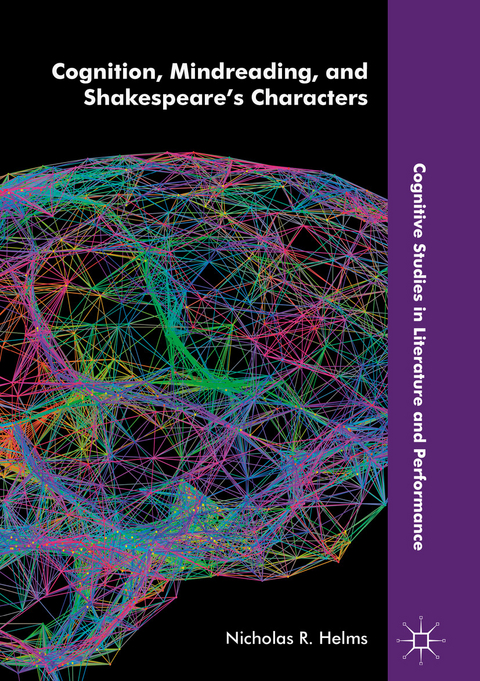
Cognition, Mindreading, and Shakespeare's Characters (eBook)
X, 229 Seiten
Springer International Publishing (Verlag)
978-3-030-03565-5 (ISBN)
Cognition, Mindreading, and Shakespeare's Characters brings cognitive science to Shakespeare, applying contemporary theories of mindreading to Shakespeare's construction of character. Building on the work of the philosopher Alvin Goldman and cognitive literary critics such as Bruce McConachie and Lisa Zunshine, Nicholas Helms uses the language of mindreading to analyze inference and imagination throughout Shakespeare's plays, dwelling at length on misread minds in King Lear, Much Ado About Nothing, Othello, and Romeo and Juliet. Shakespeare manipulates the mechanics of misreading to cultivate an early modern audience of adept mindreaders, an audience that continues to contemplate the moral ramifications of Shakespeare's characters even after leaving the playhouse. Using this cognitive literary approach, Helms reveals how misreading fuels Shakespeare's enduring popular appeal and investigates the ways in which Shakespeare's characters can both corroborate and challenge contemporary cognitive theories of the human mind.
Nicholas R. Helms is Instructor of English at the Hudson Strode Program in Renaissance Studies at The University of Alabama, USA. His research applies cognitive science to early modern drama and poetry. He also acts as artistic director of the Improbable Fictions staged reading series.
Nicholas R. Helms is Instructor of English at the Hudson Strode Program in Renaissance Studies at The University of Alabama, USA. His research applies cognitive science to early modern drama and poetry. He also acts as artistic director of the Improbable Fictions staged reading series.
1. The Mind’s Construction: An Introduction to Mindreading in Shakespeare
I: Mindreading in Shakespeare’s Macbeth
II: Overview of the Chapters
2. Reading the Mind: Cognitive Science and Close Reading
I: Character Criticism and the Importance of Lady Macbeth’s Children
II: Contemporary Theories of Mindreading
III: The Rape of Lucrece as a Primer in the Mind’s Construction
3. Inferring the Mind: Parasites and the Breakdown of Inference in Othello
I: Parasiting Levels of Intentionality
II: Anxious Static in La Mandragola, Volpone, and The Duchess of Malfi
III: Iago’s Chain of Inference
4. Imagining the Mind: Empathy and Misreading in Much Ado About Nothing
I. Epistemology of the Blush
II: Imagination as Contagion
III: Extended Mind and the Ecology of Emotion
IV: Overconfidence in Empathy
5. Integrating Minds: Blending Methods in The King Is Alive and Twelfth Night
I: Characters of the Desert in Kristian Levring’s The King is Alive
II: Conceiving Ambiguity in Twelfth Night
6. Finding the Frame: Inference in Romeo and Juliet
I: Seeing Death on Shakespeare’s Stage
II: Spontaneous Generation as a Frame for Mindreading
III: Decaying Matter and Cognitive Ecology
IV: Thinking Through Corpses in Romeo and Juliet
7. Reading Incoherence: How Shakespeare Speaks Back to Cognitive Science
I: The Glass Delusion as a Model for Transparency
II: Hamlet’s Finite Space of Solitary Confinement
III: Opaque Melancholy in The Two Noble Kinsmen
IV: Cognitive Science and Deficit Models of Disability
V: Shakespeare’s Use of Incoherence in King Lear
VI: Balancing Inference and Imagination
8: Mindreading as Engagement: Active Spectators and “The Strangers’ Case”
| Erscheint lt. Verlag | 16.1.2019 |
|---|---|
| Reihe/Serie | Cognitive Studies in Literature and Performance | Cognitive Studies in Literature and Performance |
| Zusatzinfo | X, 229 p. |
| Verlagsort | Cham |
| Sprache | englisch |
| Themenwelt | Geisteswissenschaften ► Sprach- / Literaturwissenschaft ► Anglistik / Amerikanistik |
| Geisteswissenschaften ► Sprach- / Literaturwissenschaft ► Literaturwissenschaft | |
| Schlagworte | Age Studies • character criticism • Character Study • Cognitive Literary Studies • cognitive pyschology • Ecocriticism • Literary Animal Studies • literary disability studies • mindreading • Shakespeare |
| ISBN-10 | 3-030-03565-4 / 3030035654 |
| ISBN-13 | 978-3-030-03565-5 / 9783030035655 |
| Informationen gemäß Produktsicherheitsverordnung (GPSR) | |
| Haben Sie eine Frage zum Produkt? |
 PDF (Wasserzeichen)
DRM: Digitales Wasserzeichen
Dieses eBook enthält ein digitales Wasserzeichen und ist damit für Sie personalisiert. Bei einer missbräuchlichen Weitergabe des eBooks an Dritte ist eine Rückverfolgung an die Quelle möglich.
Dateiformat: PDF (Portable Document Format)
Mit einem festen Seitenlayout eignet sich die PDF besonders für Fachbücher mit Spalten, Tabellen und Abbildungen. Eine PDF kann auf fast allen Geräten angezeigt werden, ist aber für kleine Displays (Smartphone, eReader) nur eingeschränkt geeignet.
Systemvoraussetzungen:
PC/Mac: Mit einem PC oder Mac können Sie dieses eBook lesen. Sie benötigen dafür einen PDF-Viewer - z.B. den Adobe Reader oder Adobe Digital Editions.
eReader: Dieses eBook kann mit (fast) allen eBook-Readern gelesen werden. Mit dem amazon-Kindle ist es aber nicht kompatibel.
Smartphone/Tablet: Egal ob Apple oder Android, dieses eBook können Sie lesen. Sie benötigen dafür einen PDF-Viewer - z.B. die kostenlose Adobe Digital Editions-App.
Buying eBooks from abroad
For tax law reasons we can sell eBooks just within Germany and Switzerland. Regrettably we cannot fulfill eBook-orders from other countries.
aus dem Bereich


