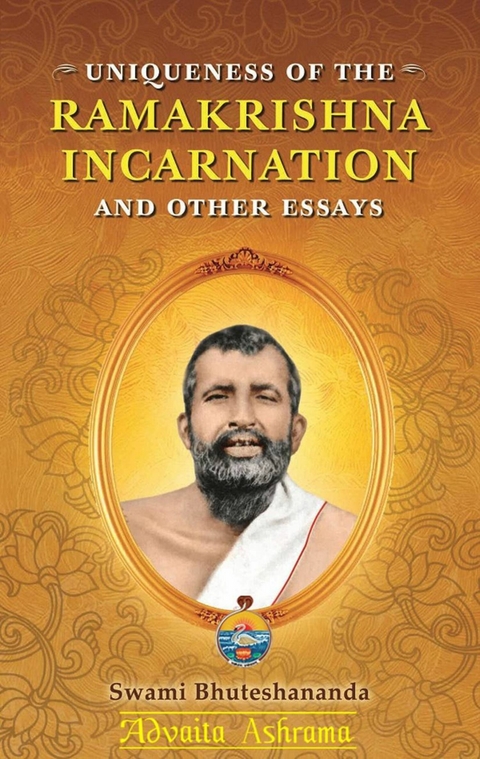
Uniqueness of the Ramakrishna Incarnation and Other Essays (eBook)
520 Seiten
Advaita Ashrama (Verlag)
9788175059184 (ISBN)
During the long tenure of his spiritual ministry, Swami Bhuteshananda, the 12th President of the Ramakrishna Math and Mission, delivered discourses at various places both in India and abroad in response to the earnest requests of spiritual seekers.
Published by Advaita Ashrama, a publication house of Ramakrishna Math, Belur Math, this book is a compilation of forty-one of these discourses classified under the following major headings:
- Sri Ramakrishna
- Vedanta and Spiritual Life
- Religion
- Miscellaneous
- Reminiscences
THE MESSAGE OF SRI RAMAKRISHNA
(Talk delivered at the Ramakrishna Ashrama,
Bangalore, on 16 February 1986)
The message of Sri Ramakrishna is so vast and deep that it is impossible to expound it in detail. I can only touch upon a few salient points. Whatever fell from the lips of Sri Ramakrishna and whatever he did was for the good of the world. Therefore I believe that all of his teachings that I share with you will be helpful to you.
From the early days of his life, Sri Ramakrishna was mad after God. God-realisation was his only concern in life; other things were absolutely secondary. He said, “Verily, I tell you, I know nothing but God.” He lived for God-realisation; however, he wished to have this realisation not for his own enjoyment, but for the joy of sharing it with others. Let me give you an illustration. One day he was in deep samadhi. It persisted, but he was trying to keep it under control. When a man enters samadhi and gets completely absorbed in God, it is impossible for him to communicate with others. So Sri Ramakrishna prayed to the Divine Mother of the universe thus: “O Mother, do not make me forgetful of the external world. I want to talk to the devotees.”
Ordinary people cannot understand the deep significance of this utterance. Samadhi is a state which all spiritual aspirants aspire to; it is the culmination of the pursuit of spiritual life. For the Master, samadhi had become natural and habitual. But when he was in the company of devotees, he tried to avoid getting absorbed in samadhi lest he should forget the world and thereby deprive the people assembled before him of the great truth which he was eager to share with them. He was an unending fountain of the eternal wisdom derived from his various experiences of the ultimate Reality. At the same time, he was also a keen observer of the external world when he was not absorbed in samadhi.
There are some points that Sri Ramakrishna particularly emphasised. First, according to him, God-realisation is the only aim of human life. Without God-realisation, everything is incomplete; with God-realisation, nothing more remains to be attained here or hereafter. Now, what did the Master mean by God-realisation? To put it briefly, it means an intuitive experience of the Ultimate Ground of all existence in which the seer and the seen become one. God-realisation does not mean merely the vision of various divine forms or having some higher feelings which may be described by different people in different ways. Complete absorption of the individual self in the Absolute: that is what the Master meant by God-realisation. As it has been beautifully described in the Upanishads: “Just as pure water falling into a vast sheet of pure water becomes one with it, so also becomes the self of a contemplative man who has realised God.” (1) That is to say, in that state the individual ceases to be an individual. He is not lost; rather, he becomes the Absolute Itself. This experience of unity is the real meaning of God-realisation. However, there are various other forms of spiritual realisation, and the Master accepted all of them. That was the catholicity and breadth of vision that he had about God-realisation.
The second salient message of Sri Ramakrishna is that not only should we have that realisation, but should also share it with others. The Master used to say that there were some people who, when they got any good thing to eat, would eat it themselves, wipe their lips, and remain mum. They had no wish to share it with others. the Master condemned such an attitude. The great realisation that one achieves on the spiritual path has to be shared with others. Only then will life attain full maturity. By sharing that realisation with others, by helping others reach the same experience, our experience becomes fulfilled in the real sense of the term.
One day Sri Ramakrishna asked his dearest disciple Narendra (who later on became Swami Vivekananda) about his goal in life. Narendra replied, “It is my desire to remain absorbed in samadhi continually for three or four days, only once in a while coming down to the sense plane to eat a little food.” Hearing this, the Master said: “You are a small-minded person. There is a state higher even than that. It is you who sing the song, ‘All that exists art Thou.’” (2) The Master further said that he wanted Narendra to be like a banyan tree, with its branches spread all around giving shelter to thousands of weary travellers.
This incident shows the general trend of Sri Ramakrishna’s mind. He himself took great pains to disseminate spiritual ideas among people and to help them in pursuing the highest goal. If the first half of his life was spent in gathering the treasures of spiritual experience, its second half was spent in sharing that wealth with other people.
We now come to the third message of Sri Ramakrishna. As he put it, “As many minds, so many paths.” All paths lead to the ultimate goal of God-realisation. This was not a mere intellectual conviction, but a fact that he himself had experienced through the pursuit of different religious paths. He was a great experimenter in this respect. After he had attained God-realisation by following one path, he wanted to know how other people followed their paths, how they reached the goal, and what that goal might be. So he followed each path, paying scrupulous attention to all the injunctions and traditions associated with it. And he invariably found that every path led to the same goal: namely, God-realisation. Realisation itself is something incommunicable, because it is one’s innermost experience, which is beyond the reach of words. But as far as words would go, he tried to describe his experiences in his own unique way, being endowed with all the knowledge of the different paths. He can thus be of immense help to the followers of different paths. That is the unique feature of Sri Ramakrishna.
In the history of world religions we never find any teacher doing spiritual experiments in the manner Sri Ramakrishna did. We find expressions of great catholicity in the scriptures of Hinduism, and perhaps of other religions as well. The ancient Vedas declare: “Truth is one: sages call It by various names”. Divine Incarnations and prophets have made similar statements. But history has no record that any of these great teachers actually practised the different paths and ultimately realised the same goal through each of them. As far as we know, Sri Ramakrishna alone did it, and this is what makes his life unique.
The catholicity that he taught was not just an expression of a broad mind or philosophical outlook, but had a deep experiential content. It was one of the most valuable experiences that he gained through his experiments. When he spoke of other paths, it was about his own experiences of those paths that he spoke. He respected every path and never criticised any path.
Tremendous faith is necessary for strict adherence to a particular path to the end. We must have unflinching faith in the goal. But if we can have equal respect for the paths that others are following, it is so much better. Sri Ramakrishna did not ask us to accept the truth of the harmony of all paths even on the basis of his own experiments. Rather, he asked us to go on experimenting on our own path as well as on other paths. He has taught us not to talk of the superiority or inferiority of any path before we are in a position to evaluate properly the value of those paths. If we can follow the teachings of the Master, we can look upon the followers of different paths as fellow-travellers to the same goal as ours.
This message of Sri Ramakrishna is of utmost importance, particularly in these days of communal hatred and conflict. It is usually the lack of proper understanding of our own religion that makes us pass judgement on other religions. Have respect for other faiths if you can; otherwise, do not pass judgement. What is really important is sincerity. Regarding this, the Master said: “Whatever path you follow—whether you are a Hindu, a Mussalman, a Christian, a Shakta, a Vaishnava or a Brahmo—the vital point is aspiration. God is our inner Guide. It doesn’t matter if you take a wrong path—only you must have longing for Him. God Himself will put you on the right path.” (3)
“The grace of God falls alike on all His children, learned and illiterate—whoever longs for Him. The father has the same love for all his children. Suppose a father has five children. One calls him ‘Baba’, another ‘Ba’, and another ‘Pa’. The last mentioned cannot pronounce the whole word. Does the father love those who address him as ‘Baba’ more than those who call him ‘Pa’? The father knows that the last child is simply too young to say ‘Baba’ correctly.” (4)
Suppose a person is not able to follow the right path. If he is sincere to the backbone, God will guide him along that path until he reaches the goal. This is the Master’s view of different faiths. The differences between different religions can be eliminated, and all communal conflicts can be resolved, if we take this teaching of Sri Ramakrishna seriously. Only then can we really be humble and tolerant and able to accept the different paths as equally valid. This kind of humility, born of introspection, is of utmost importance in our lives today.
For God-realisation we must identify ourselves with spiritual life only, and everything else should be regarded as secondary. We should concentrate all our energies in a systematic manner towards that goal which is God. This earnestness, this one-pointedness born of living faith in one’s goal, is absolutely necessary for progress in spiritual life. Sri...
| Erscheint lt. Verlag | 31.12.2018 |
|---|---|
| Übersetzer | Vimohananda Swami |
| Sprache | englisch |
| Themenwelt | Geisteswissenschaften ► Religion / Theologie ► Hinduismus |
| ISBN-13 | 9788175059184 / 9788175059184 |
| Informationen gemäß Produktsicherheitsverordnung (GPSR) | |
| Haben Sie eine Frage zum Produkt? |
 EPUB (Adobe DRM)
Größe: 977 KB
Kopierschutz: Adobe-DRM
Adobe-DRM ist ein Kopierschutz, der das eBook vor Mißbrauch schützen soll. Dabei wird das eBook bereits beim Download auf Ihre persönliche Adobe-ID autorisiert. Lesen können Sie das eBook dann nur auf den Geräten, welche ebenfalls auf Ihre Adobe-ID registriert sind.
Details zum Adobe-DRM
Dateiformat: EPUB (Electronic Publication)
EPUB ist ein offener Standard für eBooks und eignet sich besonders zur Darstellung von Belletristik und Sachbüchern. Der Fließtext wird dynamisch an die Display- und Schriftgröße angepasst. Auch für mobile Lesegeräte ist EPUB daher gut geeignet.
Systemvoraussetzungen:
PC/Mac: Mit einem PC oder Mac können Sie dieses eBook lesen. Sie benötigen eine
eReader: Dieses eBook kann mit (fast) allen eBook-Readern gelesen werden. Mit dem amazon-Kindle ist es aber nicht kompatibel.
Smartphone/Tablet: Egal ob Apple oder Android, dieses eBook können Sie lesen. Sie benötigen eine
Geräteliste und zusätzliche Hinweise
Buying eBooks from abroad
For tax law reasons we can sell eBooks just within Germany and Switzerland. Regrettably we cannot fulfill eBook-orders from other countries.
aus dem Bereich