


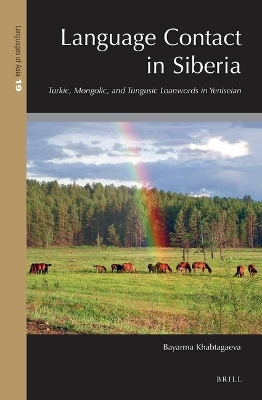
Language Contact in Siberia
Turkic, Mongolic, and Tungusic Loanwords in Yeniseian
Seiten
2019
Brill (Verlag)
9789004385948 (ISBN)
Brill (Verlag)
9789004385948 (ISBN)
This monograph dicsusses phonetic, morphological and semantic features of Altaic elements in Yeniseian, a rather heterogeneous language family traditionally classified as one of the ‘Paleo-Siberian’ language groups, that are not related to each other.
This monograph dicsusses phonetic, morphological and semantic features of the ‘Altaic’ Sprachbund (i.e. Turkic, Mongolic and Tungusic) elements in Yeniseian languages (Kott, Assan, Arin, Pumpokol, Yugh and Ket), a rather heterogeneous language family traditionally classified as one of the ‘Paleo-Siberian’ language groups, that are not related to each other or to any other languages on the face of the planet.
The present work is based on a database of approximately 230 Turkic and 70 Tungusic loanwords. A smaller number of loanwords are of Mongolic origin, which came through either the Siberian Turkic languages or the Tungusic Ewenki languages. There are clear linguistic criteria, which help to distinguish loanwords borrowed via Turkic or Tungusic and not directly from Mongolic languages.
One of the main outcomes of this research is the establishment of the Yeniseian peculiar features in the Altaic loanwords. The phonetic criteria comprise the regular disappearance of vowel harmony, syncope, amalgamation, aphaeresis and metathesis. Besides, a separate group of lexemes represents hybrid words, i.e. the lexical elements where one element is Altaic and the other one is Yeniseian.
This book presents a historical-etymological survey of a part of the Yeniseian lexicon, which provides an important part of the comparative database of Proto-Yeniseian reconstructions.
This monograph dicsusses phonetic, morphological and semantic features of the ‘Altaic’ Sprachbund (i.e. Turkic, Mongolic and Tungusic) elements in Yeniseian languages (Kott, Assan, Arin, Pumpokol, Yugh and Ket), a rather heterogeneous language family traditionally classified as one of the ‘Paleo-Siberian’ language groups, that are not related to each other or to any other languages on the face of the planet.
The present work is based on a database of approximately 230 Turkic and 70 Tungusic loanwords. A smaller number of loanwords are of Mongolic origin, which came through either the Siberian Turkic languages or the Tungusic Ewenki languages. There are clear linguistic criteria, which help to distinguish loanwords borrowed via Turkic or Tungusic and not directly from Mongolic languages.
One of the main outcomes of this research is the establishment of the Yeniseian peculiar features in the Altaic loanwords. The phonetic criteria comprise the regular disappearance of vowel harmony, syncope, amalgamation, aphaeresis and metathesis. Besides, a separate group of lexemes represents hybrid words, i.e. the lexical elements where one element is Altaic and the other one is Yeniseian.
This book presents a historical-etymological survey of a part of the Yeniseian lexicon, which provides an important part of the comparative database of Proto-Yeniseian reconstructions.
Bayarma Khabtagaeva, Ph.D., Department of Altaic Studies, Szeged University (Hungary), specializes in Altaic Studies. She has published two monographs by Harrassowitz: Mongolic Elements in Tuvan(2009), and Ewenki Dialects of Buryatia (2017).
| Erscheinungsdatum | 21.07.2019 |
|---|---|
| Reihe/Serie | Languages of Asia ; 19 |
| Verlagsort | Leiden |
| Sprache | englisch |
| Maße | 155 x 235 mm |
| Gewicht | 783 g |
| Themenwelt | Geisteswissenschaften ► Sprach- / Literaturwissenschaft ► Sprachwissenschaft |
| ISBN-13 | 9789004385948 / 9789004385948 |
| Zustand | Neuware |
| Informationen gemäß Produktsicherheitsverordnung (GPSR) | |
| Haben Sie eine Frage zum Produkt? |
Mehr entdecken
aus dem Bereich


aus dem Bereich
Eine Wiederentdeckung
Buch | Softcover (2025)
Piper (Verlag)
CHF 19,55


