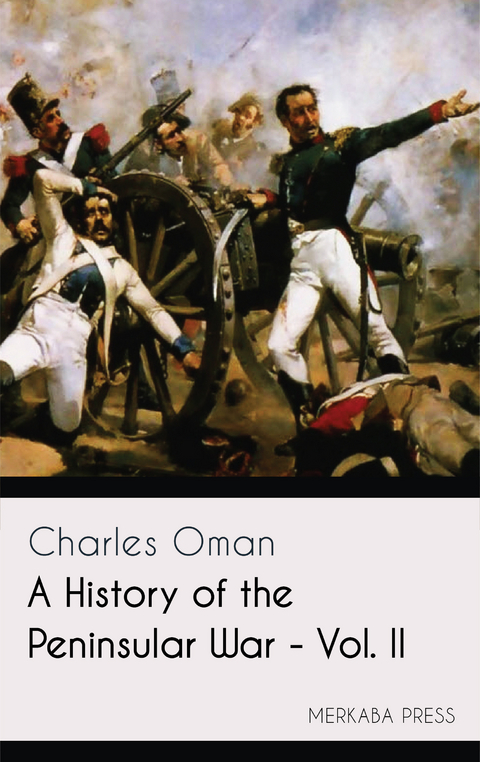
A History of the Peninsular War - Vol. II (eBook)
435 Seiten
Merkaba Press (Verlag)
9780000024749 (ISBN)
The second volume of this work has swelled to an even greater bulk than its predecessor. Its size must be attributed to two main causes: the first is the fact that a much greater number of original sources, both printed and unprinted, are available for the campaigns of 1809 than for those of 1808. The second is that the war in its second year had lost the character of comparative unity which it had possessed in its first. Napoleon, on quitting Spain in January, left behind him as a legacy to his brother a comprehensive plan for the conquest of the whole Peninsula. But that plan was, from the first, impracticable: and when it had miscarried, the fighting in every region of the theatre of war became local and isolated. Neither the harassed and distracted French King at Madrid, nor the impotent Spanish Junta at Seville, knew how to combine and co-ordinate the operations of their various armies into a single logical scheme. Ere long, six or seven campaigns were taking place simultaneously in different corners of the Peninsula, each of which was practically independent of the others. Every French and Spanish general fought for his own hand, with little care for what his colleagues were doing: their only unanimity was that all alike kept urging on their central governments the plea that their own particular section of the war was more critical and important than any other. If we look at the month of May, 1809, we find that the following six disconnected series of operations were all in progress at once, and that each has to be treated as a separate unit, rather than as a part of one great general scheme of strategy-(1) Soult's campaign against Wellesley in Northern Portugal, (2) Ney's invasion of the Asturias, (3) Victor's and Cuesta's movements in Estremadura, (4) Sebastiani's demonstrations against Venegas in La Mancha, (5) Suchet's contest with Blake in Aragon, (6) St. Cyr's attempt to subdue Catalonia. When a war has broken up into so many fractions, it becomes not only hard to follow but very lengthy to narrate. Fortunately for the historian and the student, a certain amount of unity is restored in July, mainly owing to the fact that the master-mind of Wellesley has been brought to bear upon the situation. When the British general attempted to combine with the Spanish armies of Estremadura and La Mancha for a common march upon Madrid, the whole of the hostile forces in the Peninsula [with the exception of those in Aragon and Catalonia] were once more drawn into a single scheme of operations. Hence the Talavera campaign is the central fact in the annals of the Peninsular War for the year 1809. I trust that it will not be considered that I have devoted a disproportionate amount of space to the setting forth and discussion of the various problems which it involved...
SECTION X
THE AUTUMN AND WINTER CAMPAIGN IN CATALONIA
CHAPTER I
THE SIEGE OF ROSAS
Before we follow further the fortunes of Southern Spain, it is necessary to turn back and to take up the tale of the war on the Eastern coast at the point where it was left in Section V.
The same torpor which was notable in the operations of the main armies of the Spaniards and the French during the months of September and October was to be observed in Catalonia also. On the Ter and the Llobregat the inability of the French to move was much more real, and the slackness of the Spaniards even more inexplicable, than on the Ebro and the Aragon.
In the early days of September the situation of the invaders was most perilous. After the disastrous failure of the second siege of Gerona, it will be remembered that Reille had withdrawn to Figueras, close to the French frontier, while Duhesme had cut his way back to Barcelona, after sacrificing all his artillery and his baggage on the way. Both commanders proceeded to report to the Emperor that there was need for ample reinforcements of veteran troops, or a catastrophe must inevitably ensue. Meanwhile Reille preserved a defensive attitude at the foot of the Pyrenees; while Duhesme could do no more than hold Barcelona, and as much of its suburban plain as he could safely occupy without risking overmuch his outlying detachments. He foresaw a famine in the winter, and devoted all his energies to seizing and sending into the town all foodstuffs that he could find in the neighbourhood. His position was most uncomfortable: the late expedition had reduced his force from 13,000 to 10,000 sabres and bayonets. The men were demoralized, and when sent out to forage saw somatenes behind every bush and rock. The populace of Barcelona was awaiting a good opportunity for an émeute, and was in constant communication with the insurgents outside.
The blockade was not as yet kept up by any large section of the Captain-General’s regular troops, nor had any attempt been made to run lines around the place. It was conducted by an elastic cordon of four or five thousand miqueletes, supported by no more than 2,000 infantry of the regular army and possessing five or six field-guns. The charge of the whole line was given to the Conde de Caldagues, who had so much distinguished himself in the previous month by his relief of Gerona. He had been entrusted with a force too small to man a circuit of twelve or fifteen miles, so that Duhesme had no difficulty in pushing sorties through the line of Spanish posts, whenever he chose to send out a sufficiently strong column. But any body that pressed out too far in pursuit of corn or forage, risked being beset and mishandled on its return march by the whole of the somatenes of the country-side. Hence there was a limit to the power to roam of even the largest expeditions that Duhesme could spare from his depleted garrison. The fighting along the blockading cordon was incessant, but never conclusive. On September 2 a strong column of six Italian battalions swept aside the Spaniards for a moment in the direction of San Boy, but a smaller expedition against the bridge of Molins de Rey was repulsed. The moment that the Italians returned to Barcelona, with the food that they had scraped together in the villages, Caldagues reoccupied his old positions. There were many skirmishes but no large sorties between September 2 and October 12, when Milosewitz took out 2,000 men for a cattle-hunt in the valley of the Besos. He pierced the blockading line, routing the miqueletes of Milans at San Jeronimo de la Murtra, and penetrated as far as Granollers, twenty miles from Barcelona, where he made an invaluable seizure, the food dépôt of the eastern section of the investing force. But he was now dangerously distant from his base, and as he was returning with his captures, Caldagues fell upon him at San Culgat with troops brought from other parts of the blockading line. The Italians were routed with a loss of 300 men, and their convoy was recaptured. After this Duhesme made no more attempts to send expeditions far afield: in spite of a growing scarcity of food, he could not afford to risk the loss of any more men by pushing his sorties into the inland.
Meanwhile Reille at Figueras was in wellnigh as forlorn a situation. His communications with Perpignan were open, so that he had not, like Duhesme, the fear of starvation before his eyes. But in other respects he was almost as badly off: the somatenes were always worrying his outposts, but this was only a secondary trial. The main trouble was the want of clothing, transport, and equipment: the heterogeneous mob of bataillons de marche, of Swiss and Tuscan conscripts, had been hurried to the frontier without any proper preparations: this mattered comparatively little during the summer; but when the autumn cold began Reille found that troops, who had neither tents nor greatcoats, and whose original summer uniforms were now worn out, could not keep the field. His ranks were so thinned by dysentery and rheumatic affections that he had to put the men under cover in Figueras and the neighbouring towns, and even to withdraw to Perpignan some of his battalions, whose clothing was absolutely dropping to pieces. His cavalry, for want of forage in the Pyrenees, were sent back into Languedoc, where occupation was found for them by Lord Cochrane who was conducting a series of daring raids on the coast villages between the mouth of the Rhone and that of the Tech. Reille continued to solicit the war minister at Paris for clothing and transport, but could get nothing from him: all the resources of the empire were being strained in September and October to fit out the main army, which was about to enter Spain on the side of Biscay, and Napoleon refused to trouble himself about such a minor force as the corps at Figueras.
The Spaniards, therefore, had in the autumn months a unique opportunity for striking at the two isolated French forces in Catalonia. Two courses were open to them: they might have turned their main army against Barcelona, and attempted to besiege instead of merely to blockade Duhesme: or on the other hand they might have left a mere cordon of somatenesaround Duhesme, and have sent all their regulars to join the levies of the north and sweep Reille across the Pyrenees. The resources at their disposition were far from contemptible: almost the whole garrison of the Balearic Isles having disembarked in Catalonia, there were now some 12,000 regulars in the Principality, and the local Junta had put so much energy into the equipment of the numerous tercios of miqueletes which it had raised, that the larger half of them, at least 20,000 men, were more or less ready for the field. Moreover they were aware that large reinforcements were at hand. Reding’s Granadan division, 10,000 strong, was marching up from the south, and was due to arrive early in November. The Aragonese division under the Marquis of Lazan, which had been detached from the army of Palafox, was already at Lerida. Valencia had sent up a line regiment, and the remains of the division of Caraffa from Portugal were being brought round by sea to the mouth of the Ebro. Altogether 20,000 men of new troops were on the way to Catalonia, and the first of them had already come on the scene.
Unfortunately the Marquis Del Palacio, the new Captain-General of Catalonia, though well-intentioned, was slow and undecided to the verge of absolute torpidity. Beyond allowing his energetic subordinate Caldagues to keep up the blockade of Barcelona he did practically nothing. A couple of thousand of his regulars, based on Gerona and Rosas, lay opposite Reille, but were far too weak to attack him. About 3,000 under Caldagues were engaged in the operations around Barcelona. The rest the Captain-General held back and did not use. All through September he lay idle at Tarragona, to the great disgust of the local Junta, who at last sent such angry complaints to Aranjuez that the Central Junta recalled him, and replaced him by Vives the old Captain-General of the Balearic Islands, who took over the command on October 28.
This gave a change of commander but not of policy, for Vives was as slow and incapable as his predecessor. We have already had occasion to mention the trouble that he gave in August, when he refused to send his troops to the mainland till actually compelled to yield by their mutiny. When he took over the charge of operations he found 20,000 foot and 1,000 horse at his disposition, and the French still on the defensive both at Barcelona and at Figueras. He had a splendid opportunity, and it was not yet too late to strike hard. But all that he chose to attempt was to turn the blockade of Barcelona into an investment, by tightening the cordon round the place. To lay siege to the city does not seem to have been within the scope of his intentions, but on November 6 he moved up to the line of the Llobregat with 12,000 infantry and 700 horse, mostly regulars. He had opened negotiations with secret friends within the walls, and had arranged that when the whole forces of Duhesme were sufficiently occupied in resisting the assault from outside, the populace should take arms and endeavour to seize and throw open one of the gates. But matters never got to this point: on November 8 several Spanish columns moved in nearer to Barcelona, and began to skirmish with the outposts of the garrison. But the attack was incoherent, and never pressed home. Vives then waited till the 26th, when he had received more reinforcements, the first brigade of Reding’s long-expected Granadan division. On that day another general assault on Duhesme’s outlying posts was delivered, and this time with considerable success:...
| Erscheint lt. Verlag | 4.8.2017 |
|---|---|
| Sprache | englisch |
| Themenwelt | Geisteswissenschaften ► Geschichte |
| ISBN-13 | 9780000024749 / 9780000024749 |
| Informationen gemäß Produktsicherheitsverordnung (GPSR) | |
| Haben Sie eine Frage zum Produkt? |
 EPUB (Adobe DRM)
Größe: 1,6 MB
Kopierschutz: Adobe-DRM
Adobe-DRM ist ein Kopierschutz, der das eBook vor Mißbrauch schützen soll. Dabei wird das eBook bereits beim Download auf Ihre persönliche Adobe-ID autorisiert. Lesen können Sie das eBook dann nur auf den Geräten, welche ebenfalls auf Ihre Adobe-ID registriert sind.
Details zum Adobe-DRM
Dateiformat: EPUB (Electronic Publication)
EPUB ist ein offener Standard für eBooks und eignet sich besonders zur Darstellung von Belletristik und Sachbüchern. Der Fließtext wird dynamisch an die Display- und Schriftgröße angepasst. Auch für mobile Lesegeräte ist EPUB daher gut geeignet.
Systemvoraussetzungen:
PC/Mac: Mit einem PC oder Mac können Sie dieses eBook lesen. Sie benötigen eine
eReader: Dieses eBook kann mit (fast) allen eBook-Readern gelesen werden. Mit dem amazon-Kindle ist es aber nicht kompatibel.
Smartphone/Tablet: Egal ob Apple oder Android, dieses eBook können Sie lesen. Sie benötigen eine
Geräteliste und zusätzliche Hinweise
Buying eBooks from abroad
For tax law reasons we can sell eBooks just within Germany and Switzerland. Regrettably we cannot fulfill eBook-orders from other countries.
aus dem Bereich