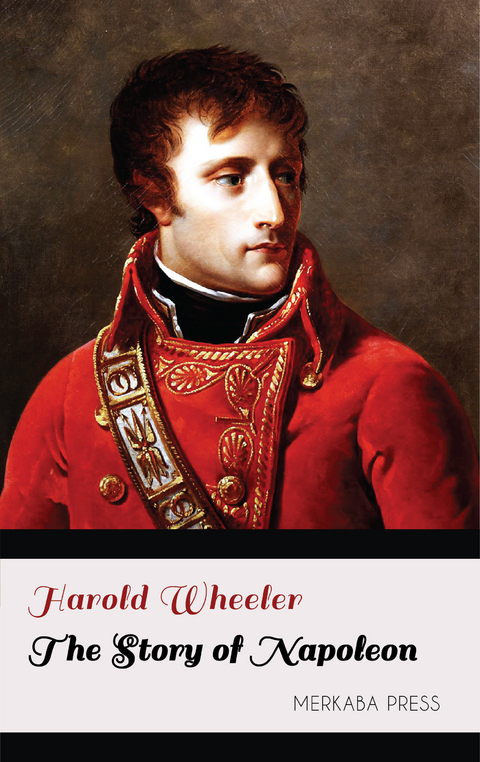
The Story of Napoleon (eBook)
141 Seiten
Merkaba Press (Verlag)
9780000019790 (ISBN)
Whenever we hear the name of Napoleon mentioned, or see it printed in a book, it is usually in connection with a hard-fought victory on the battlefield. He certainly spent most of his life in the camp, and enjoyed the society of soldiers more than that of courtiers. The thunder of guns, the charge of cavalry, and the flash of bayonets as they glittered in the sun, appealed to him with much the same force as music to more ordinary folk. Indeed, he himself tells us that 'the cries of the dying, the tears of the hopeless, surrounded my cradle from the moment of my birth.'
We are apt to forget that this mighty conqueror, whom Carlyle calls 'our last great man,' had a childhood at all. He was born nearly a century and a half ago, on the 15th August 1769 to be exact, in the little town of Ajaccio, the capital of picturesque Corsica. This miniature island rises a bold tree-covered rock in the blue waters of the Mediterranean, fifty miles west of the coast of Italy. It had been sold to France by the Republic of Genoa the previous year, but the inhabitants had fought for their independence with praiseworthy determination. Then civil war broke out, and the struggle finally ended three months before the birth of the boy who was to become the ruler of the conquering nation. The Corsicans had their revenge in time, although in a way very different from what they could have expected.
Napoleon as Officer and Author(1784–1791)
Without waiting to see if he would like the school and the tutors at Paris, or making the hundred and one excuses which usually crowd a schoolboy’s brain before definitely settling down to work, Napoleon applied himself to the various subjects necessary to enable him to enter the artillery. This branch of the service held out most possibilities from the point of view of sheer merit, and he chose wisely. At the examination held in September 1785, his name appears as forty-second on the list of candidates, which is neither particularly good nor particularly bad, and would suggest that a certain portion of his time was devoted to studies outside the immediate radius of the official course.
Napoleon had the good fortune to find a friend in Alexandre Desmazis, who shared his room with him and became Administrator of the Crown Buildings during the Consulate. Many other instances might be given of Napoleon’s kindness of heart to those who were not so successful in the race of life as was their benefactor. It is a point, and an important one, lost sight of by many of his biographers. There was certainly a better side of the mighty Corsican—he was not all blood and iron.
Apparently the studies of the chums at the École Militaire were successful, for they were appointed in the succeeding October, to the regiment of La Fere, stationed at Valence, Napoleon as second lieutenant. The two newly-fledged officers had so little money that they were forced to tramp a considerable distance on foot. It was very ignominious and humiliating, but pride is best swallowed quickly and forgotten, like a blue pill. Napoleon was now fatherless, and he felt his responsible position very keenly. Although not the head of the family in reality, he was nominally, for Joseph was far behind his brother in every material respect.
Besides his ordinary military duties Napoleon had to attend lectures on many subjects connected with his profession, including fortifications, chemistry, and mathematics. He seems to have worn off some of the rugged corners of his character. We find him with many friends, including one or two members of the fair sex. Upon one lady in particular, namely Mme. Grégoire de Colombier, he made a most favourable impression, and he received many invitations to her country house at Basseaux. She flattered him, but also tendered much practical advice. Napoleon was too young to fall in love seriously, but he passed many bright hours with Caroline, the daughter of his hostess, and a warm attachment sprang up between them. He ate fruit with her in the garden, and afterwards remarked that those days were some of the happiest in his triumphant but pathetic life. “We were the most innocent creatures imaginable,” he says, “we contrived little meetings together; I well remember one which took place on a midsummer morning, just as daylight was beginning to dawn. It will scarcely be believed that all our happiness consisted in eating cherries together.”
Bonaparte also visited the Permons; and Madame Junot, afterwards Duchess of Abrantès, has left us a witty pen-picture of him as he appeared in full regimentals at the age of sixteen.
“There was one part of his dress,” she writes, “which had a very droll appearance—that was his boots. They were so high and wide that his thin little legs seemed buried in their amplitude. Young people are always ready to observe anything ridiculous, and as soon as my sister and I saw Napoleon enter the drawing-room, we burst into a loud fit of laughter. Buonaparte could not relish a joke; and when he found himself the object of merriment he grew angry. My sister, who was some years older than I, told him that since he wore a sword he ought to be gallant to ladies, and, instead of being angry, should be happy that they joked with him. ‘You are nothing but a child, a little school-girl,’ said Napoleon, in a tone of contempt. Cécile, who was twelve or thirteen years of age, was highly indignant at being called a child, and she hastily resented the affront by replying to Bonaparte, ‘And you are nothing but a Puss in Boots!’ This excited a general laugh among all present except Napoleon, whose rage I will not attempt to describe.” A few days later the young officer went to a bookseller’s shop, purchased a dainty edition of “Puss in Boots,” and presented it to the culprit. This was his way of apologising.
For a time he relaxed his close application to study without neglecting his books altogether, and turned author. There is a pessimistic strain in all his literary efforts at this period, due no doubt to home-sickness, overwork, and perhaps lack of means, his income certainly never totalling more than twenty shillings a week. He even contemplated suicide, evidence of which is found in a manuscript dated the 3rd May, 1786.
“Always alone in the midst of men,” he complains, “I come back to my rooms to dream with myself, and to surrender myself to all the vivacity of my melancholy. Towards which side is it turned to-day? To the side of death. In the dawn of my days I can still hope to live a long time, but I have been away from my country for about six or seven years. What pleasures shall I not enjoy when in four months’ time I see once more my compatriots and my relations? From the tender sensations with which the recollections of the pleasures of my childhood now fill me, may I not infer that my happiness will be complete? What madness leads me, then, to wish my death? Doubtless the thought: What is there to do in this world?”
This makes strange reading, but it shows that even the greatest men have periods of depression like ordinary folk. He continues in this strain, passes sentence on France for having humiliated his beloved Corsica, and says scarcely less hard things of his own countrymen: “They are no longer those Corsicans, whom a hero inspired with his virtues, enemies of tyrants, of luxury, of demoralized towns.” Towards the end he shows a tinge of enthusiasm; his fighting instinct gets the better of him: “A good patriot ought to die when his Fatherland has ceased to exist. If the deliverance of my fellow-countrymen depended upon the death of a single man, I would go immediately and plunge the sword which would avenge my country and its violated laws into the breast of tyrants.” He again lapses into melancholy, concluding with a disgust for everything.
The second lieutenant did not take his own life; he lived down his troubles instead. Indeed his favourite motto, and one well worthy of note by every reader of this volume, was “The truest wisdom is a resolute determination.” In August 1786, a rift in the cloud showed the proverbial silver lining, and the chance of a little excitement, which was bread and meat to him, came along. A miniature rebellion had broken out at Lyons, and it was deemed necessary to call out the military. The company at Valence to which Napoleon belonged was marched to the seat of the trouble. Before it arrived the insurrection had blown over, thereby shattering the officer’s hope of distinguishing himself.
From Lyons he proceeded northward to Douay, in Flanders, where he contracted malarial fever which tended to undermine his constitution for several years afterwards. Bad news also reached him from Corsica. His mother appealed to him to come home and give her the benefits of his advice and assistance. Archdeacon Lucien—Napoleon’s great-uncle, who had hitherto acted as head of the family—was daily growing more feeble: the good Letizia feared the worst. Her means were distressingly small, her family inordinately large for the scanty resources at her disposal. On the 1st of September 1786, he set out for his beloved island. Passing through Aix, he was cheered by a visit to his uncle Fesch and his brother Lucien, both of whom were studying at the Seminary with a view to entering the priesthood. Exactly a fortnight afterwards, Napoleon landed at Ajaccio with a small trunk of clothes and a larger one of books. The works of Plutarch, Plato, Cicero, Nepos, Livy, Tacitus, Montaigne, Montesquieu, Raynal, Corneille, Racine, Voltaire, and the poems of Ossian were all represented.
Napoleon applied himself with his usual industry to straightening out the tangled skein of family troubles. He found it by no means an easy matter, especially as the French Government was involved. The latter had been anxious to introduce the silk industry in their new dependency, and Charles Bonaparte had been one of the first to seize upon the idea because he thought there was “money in it.” In 1782 he had made a plantation of young mulberry trees for the purpose of rearing silkworms, but instead of handing over the whole of the money which had been agreed upon in advance, 2700 livres still remained to be paid by the State. On the strength of a certificate of ill-health, Napoleon’s leave was extended from the end of March 1787, to the beginning of December, and later until the 1st June 1788. He wandered about the island, visiting his old haunts and companions, but more often finding his greatest consolation in lonely communion with Nature. Sometimes he would turn to his literary pursuits, adding a few paragraphs to a “History of Corsica,” which was occupying some of his leisure moments. He also composed a short story dealing with English history, entitled “The Count of Essex.” A novel having its setting in Corsica followed, and another attempt at fiction, which he called “The Masked Prophet,” perhaps the best of the three as regards literary style.
On the 12th September 1787, he left Corsica for Paris, in order to clear up the matter of the mulberry trees. He found it impossible to exact money from a bankrupt exchequer,...
| Erscheint lt. Verlag | 10.7.2017 |
|---|---|
| Sprache | englisch |
| Themenwelt | Geisteswissenschaften ► Geschichte |
| ISBN-13 | 9780000019790 / 9780000019790 |
| Informationen gemäß Produktsicherheitsverordnung (GPSR) | |
| Haben Sie eine Frage zum Produkt? |
 EPUB (Adobe DRM)
Größe: 279 KB
Kopierschutz: Adobe-DRM
Adobe-DRM ist ein Kopierschutz, der das eBook vor Mißbrauch schützen soll. Dabei wird das eBook bereits beim Download auf Ihre persönliche Adobe-ID autorisiert. Lesen können Sie das eBook dann nur auf den Geräten, welche ebenfalls auf Ihre Adobe-ID registriert sind.
Details zum Adobe-DRM
Dateiformat: EPUB (Electronic Publication)
EPUB ist ein offener Standard für eBooks und eignet sich besonders zur Darstellung von Belletristik und Sachbüchern. Der Fließtext wird dynamisch an die Display- und Schriftgröße angepasst. Auch für mobile Lesegeräte ist EPUB daher gut geeignet.
Systemvoraussetzungen:
PC/Mac: Mit einem PC oder Mac können Sie dieses eBook lesen. Sie benötigen eine
eReader: Dieses eBook kann mit (fast) allen eBook-Readern gelesen werden. Mit dem amazon-Kindle ist es aber nicht kompatibel.
Smartphone/Tablet: Egal ob Apple oder Android, dieses eBook können Sie lesen. Sie benötigen eine
Geräteliste und zusätzliche Hinweise
Buying eBooks from abroad
For tax law reasons we can sell eBooks just within Germany and Switzerland. Regrettably we cannot fulfill eBook-orders from other countries.
aus dem Bereich