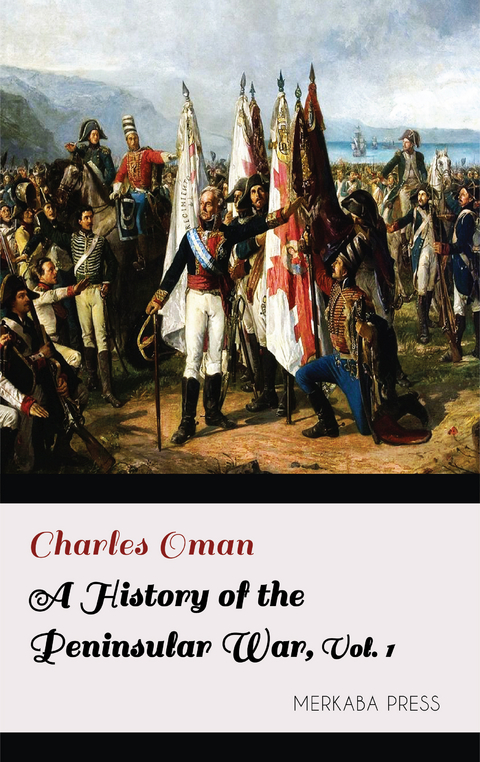
A History of the Peninsular War Volume I (eBook)
401 Seiten
Merkaba Press (Verlag)
9780000018373 (ISBN)
'I am not the heir of Louis XIV, I am the heir of Charlemagne,' wrote Napoleon, in one of those moments of epigrammatic self-revelation which are so precious to the students of the most interesting epoch and the most interesting personality of modern history. There are historians who have sought for the origins of the Peninsular War far back in the eternal and inevitable conflict between democracy and privilege: there are others who-accepting the Emperor's own version of the facts-have represented it as a fortuitous development arising from his plan of forcing the Continental System upon every state in Europe. To us it seems that the moment beyond which we need not search backward was that in which Bonaparte formulated to himself the idea that he was not the successor of the greatest of the Bourbons, but of the founder of the Holy Roman Empire. It is a different thing to claim to be the first of European monarchs, and to claim to be the king of kings. Louis XIV had wide-reaching ambitions for himself and for his family: but it was from his not very deep or accurate knowledge of Charlemagne that Napoleon had derived his idea of a single imperial power bestriding Europe, of a monarch whose writ ran alike at Paris and at Mainz, at Milan and at Hamburg, at Rome and at Barcelona, and whose vassal-princes brought him the tribute of all the lands of the Oder, the Elbe, and the middle Danube...
SECTION I: CHAPTER I
THE TREATY OF FONTAINEBLEAU
‘I am not the heir of Louis XIV, I am the heir of Charlemagne,’ wrote Napoleon, in one of those moments of epigrammatic self-revelation which are so precious to the students of the most interesting epoch and the most interesting personality of modern history. There are historians who have sought for the origins of the Peninsular War far back in the eternal and inevitable conflict between democracy and privilege: there are others who—accepting the Emperor’s own version of the facts—have represented it as a fortuitous development arising from his plan of forcing the Continental System upon every state in Europe. To us it seems that the moment beyond which we need not search backward was that in which Bonaparte formulated to himself the idea that he was not the successor of the greatest of the Bourbons, but of the founder of the Holy Roman Empire. It is a different thing to claim to be the first of European monarchs, and to claim to be the king of kings. Louis XIV had wide-reaching ambitions for himself and for his family: but it was from his not very deep or accurate knowledge of Charlemagne that Napoleon had derived his idea of a single imperial power bestriding Europe, of a monarch whose writ ran alike at Paris and at Mainz, at Milan and at Hamburg, at Rome and at Barcelona, and whose vassal-princes brought him the tribute of all the lands of the Oder, the Elbe, and the middle Danube.
There is no need for us to trace back the growth of Napoleon’s conception of himself as the successor of Charlemagne beyond the winter of 1805-6, the moment when victorious at Austerlitz and master for the first time of Central Europe, he began to put into execution his grandiose scheme for enfeoffing all the realms of the Continent as vassal states of the French Empire. He had extorted from Francis of Austria the renunciation of his meagre and time-worn rights as head of the Holy Roman Empire, because he intended to replace the ancient shadow by a new reality. The idea that he might be Emperor of Europe and not merely Emperor of the French was already developed, though Prussia still needed to be chastised, and Russia to be checked and turned back on to the ways of the East. It was after Austerlitz but before Jena that the foundations of the Confederation of the Rhine were laid[5], and that the Emperor took in hand the erection of that series of subject realms under princes of his own house, which was to culminate in the new kingdom of Spain ruled by ‘Joseph Napoleon the First.’ By the summer of 1806 the system was already well developed: the first modest experiment, the planting out of his sister Eliza and her insignificant husband in the duchy of Lucca and Piombino was now twelve months old. There had followed the gift of the old Bourbon kingdom of Naples to Joseph Bonaparte in February, 1806, and the transformation of the Batavian Republic into Louis Bonaparte’s kingdom of Holland in June. The Emperor’s brother-in-law, Joachim Murat, had been made Grand-Duke of Berg in March, his sister, Pauline, Duchess of Guastalla in the same month. It cannot be doubted that his eye was already roving all round Europe, marking out every region in which the system of feudatory states could be further extended.
At the ill-governed realms of Spain and Portugal it is certain that he must have taken a specially long glance. He had against the house of the Bourbons the grudge that men always feel against those whom they have injured. He knew that they could never forgive the disappointed hopes of 1799, nor the murder of the Duc d’Enghien, however much they might disguise their sentiments by base servility. What their real feelings were might be guessed from the treacherous conduct of their kinsmen of Naples, whom he had just expelled from the Continent. The Bourbons of Spain were at this moment the most subservient and the most ill-used of his allies. Under the imbecile guidance of his favourite Godoy, Charles IV had consistently held to the league with France since 1795, and had thereby brought down untold calamities upon his realm. Nevertheless Napoleon was profoundly dissatisfied with him as an ally. The seventy-two million francs of subsidies which he was annually wringing from his impoverished neighbour seemed to him a trifle. The chief gain that he had hoped to secure, when he goaded Spain into war with England in 1804, had been the assistance of her fleet, by whose aid he had intended to gain the control of the narrow seas, and to dominate the Channel long enough to enable him to launch his projected invasion against the shores of Kent and Sussex. But the Spanish navy, always more formidable on paper than in battle, had proved a broken reed. The flower of its vessels had been destroyed at Trafalgar. There only remained in 1806 a few ships rotting in harbour at Cadiz, Cartagena, and Ferrol, unable even to concentrate on account of the strictness of Collingwood’s blockade. Napoleon was angry at his ally’s impotence, and was already reflecting that in hands more able and energetic than those of Charles IV Spain might give aid of a very different kind. In after years men remembered that as early as 1805 he had muttered to his confidants that a Bourbon on the Spanish throne was a tiresome neighbour—too weak as an ally, yet dangerous as a possible enemy. For in spite of all the subservience of Charles IV the Emperor believed, and believed quite rightly, that a Bourbon prince must in his heart loathe the unnatural alliance with the child of the Revolution. But in 1806 Bonaparte had an impending war with Prussia on his hands, and there was no leisure for interfering in the affairs of the Peninsula. Spain, he thought, could wait, and it is improbable that he had formulated in his brain any definite plan for dealing with her.
The determining factor in his subsequent action was undoubtedly supplied in the autumn of 1806 by the conduct of the Spanish government during the campaign of Jena. There was a moment, just before that decisive battle had been fought, during which European public opinion was expecting a check to the French arms. The military prestige of Prussia was still very great, and it was well known that Russia had not been able to put forth her full strength at Austerlitz. Combined it was believed that they would be too much for Napoleon. While this idea was still current, the Spanish king, or rather his favourite Godoy, put forth a strange proclamation which showed how slight was the bond of allegiance that united them to France, and how hollow their much vaunted loyalty to the emperor. It was an impassioned appeal to the people of Spain to take arms en masse, and to help the government with liberal gifts of men, horses and money. ‘Come,’ it said, ‘dear fellow countrymen, come and swear loyalty beneath the banners of the most benevolent of sovereigns.’ The God of Victories was to smile on a people which helped itself, and a happy and enduring peace was to be the result of a vigorous effort. It might have been pleaded in defence of Charles IV that all this was very vague, and that the anonymous enemy who was to be crushed might be England. But unfortunately for this interpretation, three whole sentences of the document are filled with demands for horses and an instant increase in the cavalry arm of the Spanish military establishment. It could hardly be urged with seriousness that horsemen were intended to be employed against the English fleet. And of naval armaments there was not one word in the proclamation.
This document was issued on Oct. 5, 1806: not long after there arrived in Madrid the news of the battle of Jena and the capture of Berlin. The Prince of the Peace was thunderstruck at the non-fulfilment of his expectations and the complete triumph of Napoleon. He hastened to countermand his armaments, and to shower letters of explanation and apology on the Emperor, pointing out that his respected ally could not possibly have been the ‘enemy’ referred to in the proclamation. That document had reached Napoleon on the very battle-field of Jena, and had caused a violent paroxysm of rage in the august reader. But, having Russia still to fight, he repressed his wrath for a moment, affecting to regard as satisfactory Godoy’s servile letters of explanation. Yet we can hardly doubt that this was the moment at which he made up his mind that the House of Bourbon must cease to reign in Spain. He must have reflected on the danger that southern France had escaped; a hundred thousand Spaniards might have marched on Bordeaux or Toulouse at the moment of Jena, and there would have been no army whatever on the unguarded frontier of the Pyrenees to hold them in check. Supposing that Jena had been deferred a month, or that no decisive battle at all had been fought in the first stage of the struggle with Prussia, it was clear that Godoy would have committed himself to open war. A stab in the back, even if dealt with no better weapon than the disorganized Spanish army, must have deranged all Napoleon’s plans, and forced him to turn southward the reserves destined to feed the ‘Grand Army.’ It was clear that such a condition of affairs must never be allowed to recur, and we should naturally expect to find that, the moment the war of 1806-7 was ended, Napoleon would turn against Spain, either to dethrone Charles IV, or at least to demand the dismissal from office of Godoy. He acknowledged this himself at St. Helena: the right thing to have done, as he then conceded, would have been to declare open war on Spain immediately after Tilsit.
After eight years of experience of Bonaparte as an ally, the rulers of Spain ought to have known that his silence during the campaigns of Eylau and Friedland boded them no good. But his present intentions escaped them, and they hastened...
| Erscheint lt. Verlag | 5.7.2017 |
|---|---|
| Sprache | englisch |
| Themenwelt | Geisteswissenschaften ► Geschichte |
| ISBN-13 | 9780000018373 / 9780000018373 |
| Informationen gemäß Produktsicherheitsverordnung (GPSR) | |
| Haben Sie eine Frage zum Produkt? |
 EPUB (Adobe DRM)
Größe: 662 KB
Kopierschutz: Adobe-DRM
Adobe-DRM ist ein Kopierschutz, der das eBook vor Mißbrauch schützen soll. Dabei wird das eBook bereits beim Download auf Ihre persönliche Adobe-ID autorisiert. Lesen können Sie das eBook dann nur auf den Geräten, welche ebenfalls auf Ihre Adobe-ID registriert sind.
Details zum Adobe-DRM
Dateiformat: EPUB (Electronic Publication)
EPUB ist ein offener Standard für eBooks und eignet sich besonders zur Darstellung von Belletristik und Sachbüchern. Der Fließtext wird dynamisch an die Display- und Schriftgröße angepasst. Auch für mobile Lesegeräte ist EPUB daher gut geeignet.
Systemvoraussetzungen:
PC/Mac: Mit einem PC oder Mac können Sie dieses eBook lesen. Sie benötigen eine
eReader: Dieses eBook kann mit (fast) allen eBook-Readern gelesen werden. Mit dem amazon-Kindle ist es aber nicht kompatibel.
Smartphone/Tablet: Egal ob Apple oder Android, dieses eBook können Sie lesen. Sie benötigen eine
Geräteliste und zusätzliche Hinweise
Buying eBooks from abroad
For tax law reasons we can sell eBooks just within Germany and Switzerland. Regrettably we cannot fulfill eBook-orders from other countries.
aus dem Bereich