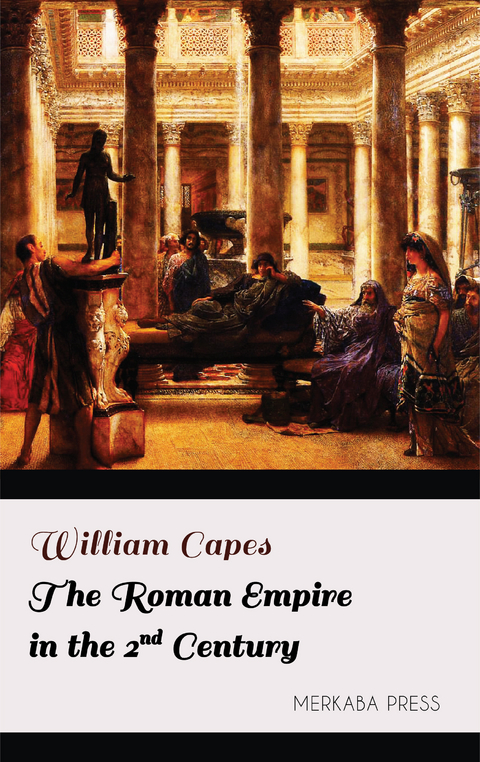
The Roman Empire in the 2nd Century (eBook)
221 Seiten
Merkaba Press (Verlag)
9780000018946 (ISBN)
Before the murderers of Domitian raised their hands to strike the fatal blow, they looked around, we read, to find a successor to replace him. Others whom they sounded on the subject shrunk away in fear or in suspicion, till they thought of M. Cocceius Nerva, who was likely to fill worthily the office that would soon be vacant.
Little is known of his career for more than sixty years, till after he had twice been consul, and when his work seemed almost done, he rose for a little while to take the highest place on earth. The tyrant on the throne had eyed him darkly, had banished him because he heard that the stars pointed in his case to the signs of sovereign power, and indeed only spared his life because other dabblers in the mystic lore said that he was fated soon to die. The sense of his danger, heightened by his knowledge of the plot, made Nerva bold when others flinched; so he lent the conspirators his name, and rose by their help to the imperial seat. He had dallied with the Muses, and courted poetry in earlier years; but he showed no creative aims as ruler, and no genius for heroic measures. The fancy or the sanguine confidence of youth was chequered perhaps by waning strength and feeble health, or more probably a natural kindliness of temper made him more careful of his people's wants. After the long nightmare of oppression caused by the caprices of a moody despot, Rome woke again to find herself at rest under a sovereign who indulged no wanton fancies, but was gentle and calm and unassuming, homely in his personal bearing, and thrifty with the coffers of the state. He had few expensive tastes, it seemed, and little love for grand parade, refusing commonly the proffered statues and gaudy trappings of official rank. As an old senator, he felt a pride in the dignity of the august assembly, consulted it in all concerns of moment, and pledged himself to look upon its members' lives as sacred. A short while since and they were cowering before Domitian's sullen frown, or shut up in the senate house by men-at-arms while the noblest of their number were dragged out before their eyes to death. But now they had an Emperor who treated them as his peers, who listened patiently to their debates, and met them on an easy footing in the courtesies of social life. He rose above the petty jealousy which looks askant at brilliant powers or great historic names, and chose even as his colleague in the consulship the old Verginius Rufus, in whose hands once lay the imperial power had he only cared to grasp it. Nor was he haunted by suspicious fears, such as sometimes give the timid a fierce appetite for blood. For when he learnt that a noble of old family had formed a plot against his life, he took no steps to punish him, but kept him close beside him in his train, talked to him at the theatre with calm composure, and even handed him a sword to try its edge and temper, as if intent to prove that he had no mistrustful or revengeful thought...
TRAJAN. A.D. 97-117.
Marcus Ulpius Trajanus, a native of Italica in Spain, had been trained from early youth in the hard discipline of Roman warfare, and by long service in the camps had earned a title to the round of civil honours, and to a place among the senators of Rome. Summoned by Domitian from Spain at the head of a legion to the Rhine, he had come probably too late to help in quelling a revolt; but he had won by his promptitude the honour of a consulship, and was advanced by Nerva to the command of upper Germany, then the most important, of provincial offices, in which his energy was being proved when the unlooked for news arrived that he was chosen for the imperial succession; and the tidings of Nerva's death found him still busy with his military duties on the Rhine. He was yet in the full vigour of his manhood when the cares of state fell with the purple mantle on his shoulders; the changing scenes of his laborious life had taught him experience of men and manners, and it was with no wavering hands that he took up the reins of office, and he grasped them firmly to the end. Mutiny and discontent seemed to have vanished already at his name; but he had not forgotten the outrage done to Nerva, nor the parting charge in which he prayed him, like the aged Chryses in the words of Homer, 'to avenge the suppliant's unavailing tears.' Trajan was prompt and secret. The ringleaders of the riot were called away to Germany on various pleas, and none came back to tell how they were treated there.
But though he could enforce discipline with needful rigour, he had no lack of reverence for constitutional forms. One of his earliest official acts was a letter to the senate, full of regard for its august traditions, in the course of which he promised to respect the life of every man of worth. The credulous fancy of the age, as reported in the history of Dion Cassius, saw the motive for the promise in a dream, in which a venerable figure came before him, clad in purple robe and with a garland on his head—such as was the painter's symbol for the senate—and laid his finger upon Trajan's neck, leaving his signet stamp first on one side and then upon the other. Whatever we may think the cause, whether sense of justice or mysterious warning prompted him to write that letter, he tried certainly to make good the promise it contained, and trod the dizzy heights of absolute power with the calmness of a serene and balanced temper. He was in no haste to enter Rome or receive the homage of the senate and the people. Perhaps he breathed more freely in the camp, where he lived as simply as his ancient comrades, and mistrusted the parade and insincerity of the great city. Perhaps he waited till he felt his throne secure, and till he knew that the far-off legions had ratified the choice of Nerva.
At length, after a year's delay, he quietly set out upon the journey, without any stately train of followers to burden with exactions the towns through which they passed. The only trace of ostentation which he showed was in publishing the items of his travelling expenses side by side with the accounts of the processions of Domitian.
At his first entry into Rome there was the same absence of parade. He eschewed the white horses and triumphal car of the imperial pageants; no numerous body-guard kept the people at a distance, but as his manly figure moved along the streets, men saw him interchange a hearty greeting with the senators he met, and pass no old acquaintance unobserved. They marked also the same simple earnestness in the bearing of his wife Plotina, who walked calmly by his side, and as she passed into the palace that was now to be her home, prayed with a quiet emphasis, in the hearing of the crowd, that she might leave it in the same temper that she entered it.
A like unassuming spirit was shown in Trajan's dealings with the senate. He called upon it to resume its work as in an age of freedom, and to acknowledge the responsibilities of power. He honestly respected its traditions, and wished the government to be carried forward in its name.
The holders of official rank were encouraged to look upon themselves as ministers of state and not as servants of the Caesar; and the new generals of the imperial guards had their swords given them with the words, 'Use this in my defence while I rule justly, but against me if I prove to be unworthy.' For there was little danger now that the old constitutional forms should be misused.
The senate was no longer an assembly of great nobles, proudly reliant on the traditions of the past, and on the energy which had laid the world prostrate at their feet. Many of the old families had passed away; their wealth, their eminence, their historic glories had made them victims to a tyrant's jealousy or greed. Their places had been taken by new comers from the provinces or creatures of imperial favour, and a century had passed away since the senate of the commonwealth had claimed or had deserved to rule. The ancient offices, even the consulship itself, were little more than empty honours, and therefore passed rapidly from hand to hand; and even Pliny, full as he was of sentimental reverence for the past, asked himself if the tribunate which he held awhile had indeed any meaning for his days, or was only a venerable sham. Hence Trajan, strong and self-reliant though he was, had no jealousy of names and titles, and cared little for the outer forms, so the work was done as he would have it. He had little interest in meddling with the mere machinery of government, and though some parts were chiefly ornamental, and others seemed rusty and outworn, yet he would not pull the whole to pieces for the sake of symmetry and finish, if there were only working wheels enough to bear the necessary strain. He knew that from the force of habit men loved the venerable forms, and that vital changes soon grew crusted over with the fanciful associations of the past, till all seemed old while all was really new. So new coins came from his mints with the symbols of the old republic; his courtiers were allowed to guard with reverent care their statues of Brutus and Cassius and the Catos, and the once dreaded name of liberty came freely to the pen of every writer of his day.
He shrank with instinctive modesty from the naked assertion of his power; not like Augustus from fear or hypocritic craft, and therefore with the sense of life-long self-restraint, but with the frankness of a soldier who disliked high airs and stiff parade. He went about the streets almost unguarded, allowed suitors of every class an easy access to his chamber, and took part with genial courtesy in the social gatherings of Rome.
Flattering phrases had no music for his ear, and made him feel none of the divinity of kingship; so he delayed as long as possible the customary honours for his kinsmen, and flatly refused to pose himself as a deity before the time. It was therefore only natural for him to rebuke the officious zeal of the informers who reported words or acts of seeming disrespect, and the old laws of treason which had covered charges, so fatal because so ill-defined, dropped for a while at least into abeyance. After the morbid suspicions of Domitian men could hardly understand at first the fearless trustfulness of the present ruler, and they still told him of their fears and whispered their misgivings of many a possible malcontent and traitor.
One case of this kind may be singled out to throw light upon the Emperor's temper. Licinius Sura was one of the wealthiest of living Romans, and a marked figure in the social circles in which the intimates of Trajan moved. He had won his sovereign's confidence, who owed his throne, as it was said, to Sura's influence when Nerva was looking round for a successor. Yet sinister rumours of disloyal plots were coupled with his name, and zealous friends soon brought the stories to the Emperor's ear, and wearied him with their repeated warnings. At last he started on a visit to Licinius himself, sent his guards home, and chatted freely with his host then asked to see the servant who acted as the doctor of the house, and had himself dosed for some slight ailment. After this he begged to have his friend's own barber sent to him to trim his beard as he sat talking on; and that done, he stayed to dinner, took his leave, and went away without one word or symptom of suspicion. Ever afterwards he said to those who came to him with any ugly tale about Licinius, 'Why did he spare me then, when he had me in his power, and his servant's hand was on my throat?'
But probably his special merit in the eyes of all classes in Italy save the very poorest was his frugal thrift. Augustus had husbanded with care the resources of the state and restored the financial credit of the empire; but he drew largely from the purses of his subjects, had recourse at first to proscriptions and forced loans, and in spite of angry clamour had imposed succession duties which were odious to all the wealthy Romans. Vespasian had ruled with wise economy and replenished his exhausted coffers; but then his name recalled the memory of a mean and sordid parsimony that trafficked and haggled for the pettiest...
| Erscheint lt. Verlag | 6.7.2017 |
|---|---|
| Sprache | englisch |
| Themenwelt | Geisteswissenschaften ► Geschichte |
| ISBN-13 | 9780000018946 / 9780000018946 |
| Informationen gemäß Produktsicherheitsverordnung (GPSR) | |
| Haben Sie eine Frage zum Produkt? |
 EPUB (Adobe DRM)
Größe: 259 KB
Kopierschutz: Adobe-DRM
Adobe-DRM ist ein Kopierschutz, der das eBook vor Mißbrauch schützen soll. Dabei wird das eBook bereits beim Download auf Ihre persönliche Adobe-ID autorisiert. Lesen können Sie das eBook dann nur auf den Geräten, welche ebenfalls auf Ihre Adobe-ID registriert sind.
Details zum Adobe-DRM
Dateiformat: EPUB (Electronic Publication)
EPUB ist ein offener Standard für eBooks und eignet sich besonders zur Darstellung von Belletristik und Sachbüchern. Der Fließtext wird dynamisch an die Display- und Schriftgröße angepasst. Auch für mobile Lesegeräte ist EPUB daher gut geeignet.
Systemvoraussetzungen:
PC/Mac: Mit einem PC oder Mac können Sie dieses eBook lesen. Sie benötigen eine
eReader: Dieses eBook kann mit (fast) allen eBook-Readern gelesen werden. Mit dem amazon-Kindle ist es aber nicht kompatibel.
Smartphone/Tablet: Egal ob Apple oder Android, dieses eBook können Sie lesen. Sie benötigen eine
Geräteliste und zusätzliche Hinweise
Buying eBooks from abroad
For tax law reasons we can sell eBooks just within Germany and Switzerland. Regrettably we cannot fulfill eBook-orders from other countries.
aus dem Bereich