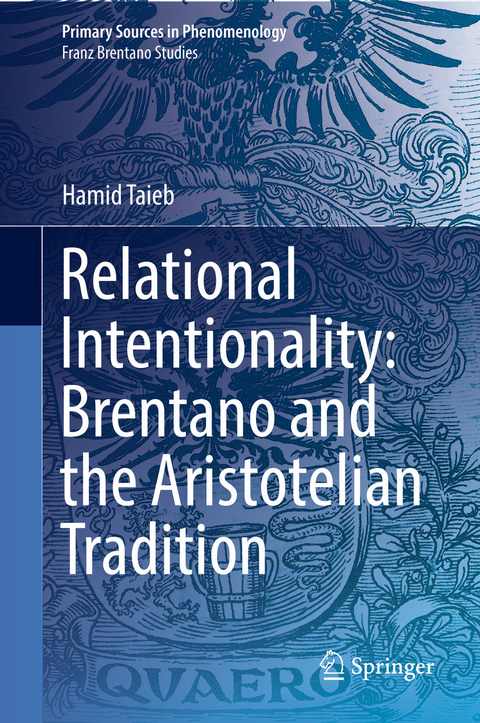
Relational Intentionality: Brentano and the Aristotelian Tradition (eBook)
XII, 213 Seiten
Springer International Publishing (Verlag)
978-3-319-98887-0 (ISBN)

This book sheds new light on the history of the philosophically crucial notion of intentionality, which accounts for one of the most distinctive aspects of our mental life: the fact that our thoughts are about objects. Intentionality is often described as a certain kind of relation. Focusing on Franz Brentano, who introduced the notion into contemporary philosophy, and on the Aristotelian tradition, which was Brentano's main source of inspiration, the book reveals a rich history of debate on precisely the relational nature of intentionality. It shows that Brentano and the Aristotelian authors from which he drew not only addressed the question whether intentionality is a relation, but also devoted extensive discussions to what kind of relation it is, if any.
The book aims to show that Brentano distinguishes the intentional relation from two other relations with which it might be confused, namely, causality and reference, which also hold between thoughts and their objects. Intentionality accounts for the aboutness of a thought; causality, by contrast, explains how the thought is generated, and reference, understood as a sort of similarity, occurs when the object towards which the thought is directed exists. Brentano claims to find some anticipation of his views in Aristotle. This book argues that, whether or not Brentano's interpretation of Aristotle is correct, his claim is true of the Aristotelian tradition as a whole, since followers of Aristotle more or less explicitly made some or all of Brentano's distinctions. This is demonstrated through examination of some major figures of the Aristotelian tradition (broadly understood), including Alexander of Aphrodisias, the Neoplatonic commentators, Thomas Aquinas, Duns Scotus, and Francisco Suárez.
Hamid Taieb is a postdoctoral researcher at the University of Salzburg. He works on Austro-German philosophy, mostly on the school of Brentano. His research interests also include the Aristotelian tradition, especially Latin scholasticism.
Hamid Taieb is a postdoctoral researcher at the University of Salzburg. He works on Austro-German philosophy, mostly on the school of Brentano. His research interests also include the Aristotelian tradition, especially Latin scholasticism.
Chapter1. Introduction: Is Intentionality a Relation.- Chapter2. Psychic Causality.- Chapter3. Intentionality as a Relation.- Chapter4. Reference.- Chapter5.Conclusion: Intentionality and History.
| Erscheint lt. Verlag | 28.12.2018 |
|---|---|
| Reihe/Serie | Franz Brentano Studies |
| Franz Brentano Studies | |
| Primary Sources in Phenomenology | |
| Primary Sources in Phenomenology | Primary Sources in Phenomenology |
| Zusatzinfo | XII, 213 p. 1 illus. |
| Verlagsort | Cham |
| Sprache | englisch |
| Original-Titel | Intentionnalité et κρίσις dans la réception de Métaphysique Δ, 15 |
| Themenwelt | Geisteswissenschaften ► Philosophie ► Allgemeines / Lexika |
| Schlagworte | Aristotelian Tradition • Brentano on intentionality • Duns Scotus on intentionality • Intentionality and relations • Intentional objects • Medieval Philosophy • Psychic causality • Reference to reality • Relation to objects • Thomas Aquinas on intentionality |
| ISBN-10 | 3-319-98887-5 / 3319988875 |
| ISBN-13 | 978-3-319-98887-0 / 9783319988870 |
| Informationen gemäß Produktsicherheitsverordnung (GPSR) | |
| Haben Sie eine Frage zum Produkt? |
 PDF (Wasserzeichen)
DRM: Digitales Wasserzeichen
Dieses eBook enthält ein digitales Wasserzeichen und ist damit für Sie personalisiert. Bei einer missbräuchlichen Weitergabe des eBooks an Dritte ist eine Rückverfolgung an die Quelle möglich.
Dateiformat: PDF (Portable Document Format)
Mit einem festen Seitenlayout eignet sich die PDF besonders für Fachbücher mit Spalten, Tabellen und Abbildungen. Eine PDF kann auf fast allen Geräten angezeigt werden, ist aber für kleine Displays (Smartphone, eReader) nur eingeschränkt geeignet.
Systemvoraussetzungen:
PC/Mac: Mit einem PC oder Mac können Sie dieses eBook lesen. Sie benötigen dafür einen PDF-Viewer - z.B. den Adobe Reader oder Adobe Digital Editions.
eReader: Dieses eBook kann mit (fast) allen eBook-Readern gelesen werden. Mit dem amazon-Kindle ist es aber nicht kompatibel.
Smartphone/Tablet: Egal ob Apple oder Android, dieses eBook können Sie lesen. Sie benötigen dafür einen PDF-Viewer - z.B. die kostenlose Adobe Digital Editions-App.
Buying eBooks from abroad
For tax law reasons we can sell eBooks just within Germany and Switzerland. Regrettably we cannot fulfill eBook-orders from other countries.
aus dem Bereich