Animal Perception and Literary Language (eBook)
XXIV, 327 Seiten
Springer International Publishing (Verlag)
978-3-030-04969-0 (ISBN)
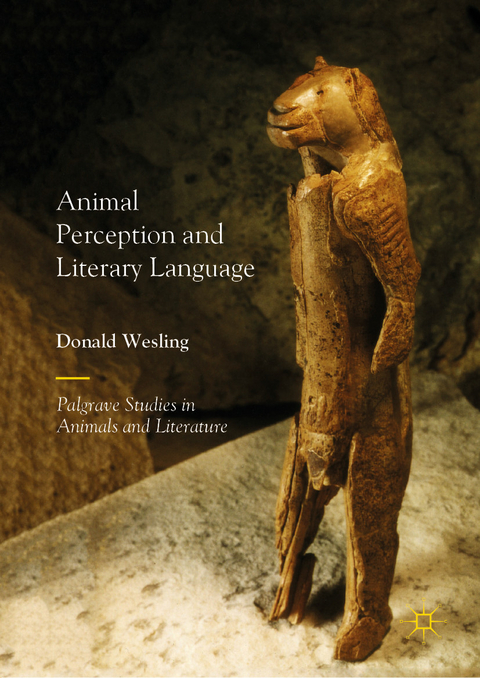
Animal Perception and Literary Language shows that the perceptual content of reading and writing derives from our embodied minds. Donald Wesling considers how humans, evolved from animals, have learned to code perception of movement into sentences and scenes. The book first specifies terms and questions in animal philosophy and surveys recent work on perception, then describes attributes of multispecies thinking and defines a tradition of writers in this lineage. Finally, the text concludes with literature coming into full focus in twelve case studies of varied readings. Overall, Wesling's book offers not a new method of literary criticism, but a reveal of what we all do with perceptual content when we read.
Donald Wesling is Professor Emeritus of English Literature at UC San Diego, USA. He has published on Wordsworth, John Muir, Edward Dorn, and Bakhtin; on rhyme, meter, and avant-garde prosody; and on how voice and emotion get into writing.
Donald Wesling is Professor Emeritus of English Literature at UC San Diego, USA. He has published on Wordsworth, John Muir, Edward Dorn, and Bakhtin; on rhyme, meter, and avant-garde prosody; and on how voice and emotion get into writing.
Foreword: Animalist Perception and Interpretation Part I: Imbroglios of Humans and Nonhumans
1. How the Razor's Edge Becomes a Saw to the Armed Vision
2. Intellectual Histories of the Imbroglio Human/Nonhuman
3. Jacques Derrida and Gernot Böhme: Critique of Existing Discourses on Our Animality
4. Literary Imbroglios: SciFi and Prose Poem
5. With Maurice Merleau-Ponty: Perception Into Writing
Part II: Perception, Cognition, Writing
1. Perception and Sentence-Style
2. Replacing Perception into the Continuity of Cognition, Emotion, and Memory
3. Four Scholars on Five Senses
4. The Creations of Sound
5. A Second Look at Single Sentences
Part III: Attributes of Animalist Thinking
1, Intercreatural
2. Creativity
3.Embodied Mind
4. Dialogism
5. Amplification of Affect, With an Example from Annie Dillard
Part IV: Animalist Thinking From Lucretius to Temple Grandin
1. Imbroglios of Humans and Nonhumans, Once Again
2. Lucretius
3. Michel de Montaigne
4. Samuel Taylor Coleridge
5. John Muir
6. Alphonso Lingis
7. Laurie Shannon
8. Brian Massumi
9. Temple Grandin
10. What Ice-Age Caves Afford to Aurochs in Manganese
Part V: Perception and Expectation in Literature
1. Our Experience of the Body, Ready for an Imaginary Action
2. Perception and Expectation in the Array of 12
3. Uses of the Array of 12 as a Return to the Material Universe
4. The Role of Animalist Perception in Literature Afterword: Alphabet for Animalists
| Erscheint lt. Verlag | 26.12.2018 |
|---|---|
| Reihe/Serie | Palgrave Studies in Animals and Literature | Palgrave Studies in Animals and Literature |
| Zusatzinfo | XXIV, 327 p. 1 illus. |
| Verlagsort | Cham |
| Sprache | englisch |
| Themenwelt | Geisteswissenschaften ► Philosophie ► Ethik |
| Geisteswissenschaften ► Sprach- / Literaturwissenschaft ► Literaturwissenschaft | |
| Schlagworte | animalist thinking • Animal Philosophy • Animals in literature • Animal Studies • Cognitive Literary Studies • Cognitive Psychology • Embodied mind • human and animal • Jacques Derrida • Literary Animal Studies |
| ISBN-10 | 3-030-04969-8 / 3030049698 |
| ISBN-13 | 978-3-030-04969-0 / 9783030049690 |
| Informationen gemäß Produktsicherheitsverordnung (GPSR) | |
| Haben Sie eine Frage zum Produkt? |
 PDF (Wasserzeichen)
DRM: Digitales Wasserzeichen
Dieses eBook enthält ein digitales Wasserzeichen und ist damit für Sie personalisiert. Bei einer missbräuchlichen Weitergabe des eBooks an Dritte ist eine Rückverfolgung an die Quelle möglich.
Dateiformat: PDF (Portable Document Format)
Mit einem festen Seitenlayout eignet sich die PDF besonders für Fachbücher mit Spalten, Tabellen und Abbildungen. Eine PDF kann auf fast allen Geräten angezeigt werden, ist aber für kleine Displays (Smartphone, eReader) nur eingeschränkt geeignet.
Systemvoraussetzungen:
PC/Mac: Mit einem PC oder Mac können Sie dieses eBook lesen. Sie benötigen dafür einen PDF-Viewer - z.B. den Adobe Reader oder Adobe Digital Editions.
eReader: Dieses eBook kann mit (fast) allen eBook-Readern gelesen werden. Mit dem amazon-Kindle ist es aber nicht kompatibel.
Smartphone/Tablet: Egal ob Apple oder Android, dieses eBook können Sie lesen. Sie benötigen dafür einen PDF-Viewer - z.B. die kostenlose Adobe Digital Editions-App.
Buying eBooks from abroad
For tax law reasons we can sell eBooks just within Germany and Switzerland. Regrettably we cannot fulfill eBook-orders from other countries.
aus dem Bereich