


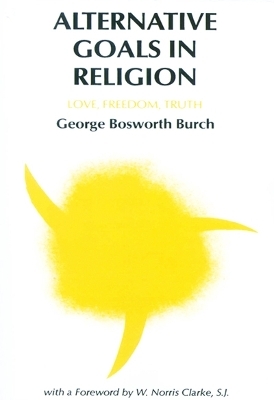
Alternative Goals in Religion
Love, Freedom, Truth
Seiten
1973
McGill-Queen's University Press (Verlag)
978-0-7735-0163-8 (ISBN)
McGill-Queen's University Press (Verlag)
978-0-7735-0163-8 (ISBN)
- Titel z.Zt. nicht lieferbar
- Versandkostenfrei
- Auch auf Rechnung
- Artikel merken
States that religions, start from the same point, take divergent roads to different goals. This title argues for the coexistence of three alternative Absolutes: Truth which corresponds to the religion of Hindu Advaita Vedanta, Absolute Freedom which corresponds to Buddhism, and love which corresponds to Christianity.
"Religions," Mahatma Gandhi once said, "are different roads converging to the same point." But in this stimulating assessment of Christianity, Buddhism, and Vedanta, Professor Burch develops the revolutionary theory that religions, starting from the same point, take divergent roads to different goals incompatible one with the other. Whereas Gandhi asks, "What does it matter that we take different roads so long as we reach the same goal?" Dr. Burch asks, "What does it matter that in taking different roads we reach different goals?" Religions, he maintains, do not have to fight each other because of their differences, or abolish their differences to avoid fighting. He is a firm believer in coexistence for religions. Ecumenicity is good "in so far as it means, on the one hand, cooperation with other faiths in their common concerns of social activities and resistance to irreligion, and on the other hand mutual respect for the other faiths themselves." Dr. Burch argues for the coexistence of three alternative Absolutes: Truth (or Absolute Self as ultimate reality) which corresponds to the religion of Hindu Advaita Vedanta, Absolute Freedom which corresponds to Buddhism, and love (or Absolute Feeling) which corresponds to Christianity. The religious quest requires absolute commitment to one or other of these irreducible alternatives; not to truth and freedom and love, but to truth or freedom or love. In his Foreword, Professor W. Norris Clarke, S.J., of Fordham University, subjects Dr. Burch's theory to the most rigorous critical analysis, but in the end invites each reader to make the effort himself of coming to grips with the author's profound and original challenge.
"Religions," Mahatma Gandhi once said, "are different roads converging to the same point." But in this stimulating assessment of Christianity, Buddhism, and Vedanta, Professor Burch develops the revolutionary theory that religions, starting from the same point, take divergent roads to different goals incompatible one with the other. Whereas Gandhi asks, "What does it matter that we take different roads so long as we reach the same goal?" Dr. Burch asks, "What does it matter that in taking different roads we reach different goals?" Religions, he maintains, do not have to fight each other because of their differences, or abolish their differences to avoid fighting. He is a firm believer in coexistence for religions. Ecumenicity is good "in so far as it means, on the one hand, cooperation with other faiths in their common concerns of social activities and resistance to irreligion, and on the other hand mutual respect for the other faiths themselves." Dr. Burch argues for the coexistence of three alternative Absolutes: Truth (or Absolute Self as ultimate reality) which corresponds to the religion of Hindu Advaita Vedanta, Absolute Freedom which corresponds to Buddhism, and love (or Absolute Feeling) which corresponds to Christianity. The religious quest requires absolute commitment to one or other of these irreducible alternatives; not to truth and freedom and love, but to truth or freedom or love. In his Foreword, Professor W. Norris Clarke, S.J., of Fordham University, subjects Dr. Burch's theory to the most rigorous critical analysis, but in the end invites each reader to make the effort himself of coming to grips with the author's profound and original challenge.
George Bosworth Burch is Fletcher Professor of Philosophy, Emeritus, Tufts University.
| Erscheint lt. Verlag | 1.5.1973 |
|---|---|
| Verlagsort | Montreal |
| Sprache | englisch |
| Maße | 127 x 203 mm |
| Gewicht | 454 g |
| Themenwelt | Geisteswissenschaften ► Philosophie |
| Geisteswissenschaften ► Religion / Theologie ► Hinduismus | |
| ISBN-10 | 0-7735-0163-0 / 0773501630 |
| ISBN-13 | 978-0-7735-0163-8 / 9780773501638 |
| Zustand | Neuware |
| Informationen gemäß Produktsicherheitsverordnung (GPSR) | |
| Haben Sie eine Frage zum Produkt? |
Mehr entdecken
aus dem Bereich


aus dem Bereich
Spiritual Living for Today Based on India's Thousand Names of …
Buch | Softcover (2025)
Nilgiri Press (Verlag)
CHF 35,90
Unearthing and Enacting the Feelings of Nine Himalayan Hindu …
Buch | Hardcover (2025)
De Gruyter (Verlag)
CHF 142,00


