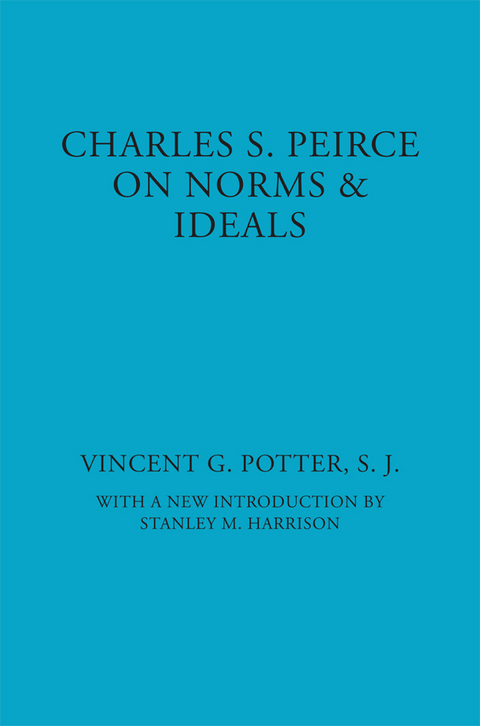
Charles S. Peirce (eBook)
229 Seiten
Fordham University Press (Verlag)
9780823282838 (ISBN)
In recent years, Charles Sanders Peirce has emerged, in the eyes of philosophers both in America and abroad, as one of America’s major philosophical thinkers. His work has forced us back to philosophical reflection about those basic issues that inevitably confront us as human beings, especially in an age of science. Peirce’s concern for experience, for what is actually encountered, means that his philosophy, even in its most technical aspects, forms a reflective commentary on actual life and on the world in which it is lived.
In Charles S. Peirce: On Norms and Ideals, Potter argues that Peirce’s doctrine of the normative sciences is essential to his pragmatism. No part of Peirce’s philosophy is bolder than his attempt to establish esthetics, ethics, and logic as the three normative sciences and to argue for the priority of esthetics among the trio. Logic, Potter cites, is normative because it governs thought and aims at truth; ethics is normative because it analyzes the ends to which thought should be directed; esthetics is normative and fundamental because it considers what it means to be an end of something good in itself. This study shows that pierce took seriously the trinity of normative sciences and demonstrates that these categories apply both to the conduct of man and to the workings of the cosmos.
Professor Potter combines sympathetic and informed exposition with straightforward criticism and he deals in a sensible manner with the gaps and inconsistencies in Peirce’s thought. His study shows that Peirce was above all a cosmological and ontological thinker, one who combined science both as a method and as result with a conception of reasonable actions to form a comprehensive theory of reality. Peirce’s pragmatism, although it has to do with "action and the achievement of results, is not a glorification of action but rather a theory of the dynamic nature of things in which the "ideal" dimension of reality – laws, nature of things, tendencies, and ends – has genuine power for directing the cosmic order, including man, toward reasonable goals.
Vincent G. Potter was Professor of Philosophy at Fordham University; and editor of International Philosophical Quarterly.
| Erscheint lt. Verlag | 18.9.2018 |
|---|---|
| Reihe/Serie | American Philosophy |
| Verlagsort | New York |
| Sprache | englisch |
| Themenwelt | Geisteswissenschaften ► Philosophie ► Allgemeines / Lexika |
| Geisteswissenschaften ► Philosophie ► Ethik | |
| Geisteswissenschaften ► Philosophie ► Geschichte der Philosophie | |
| Geisteswissenschaften ► Philosophie ► Logik | |
| Geisteswissenschaften ► Philosophie ► Philosophie der Neuzeit | |
| ISBN-13 | 9780823282838 / 9780823282838 |
| Informationen gemäß Produktsicherheitsverordnung (GPSR) | |
| Haben Sie eine Frage zum Produkt? |
 EPUB (Adobe DRM)
Kopierschutz: Adobe-DRM
Adobe-DRM ist ein Kopierschutz, der das eBook vor Mißbrauch schützen soll. Dabei wird das eBook bereits beim Download auf Ihre persönliche Adobe-ID autorisiert. Lesen können Sie das eBook dann nur auf den Geräten, welche ebenfalls auf Ihre Adobe-ID registriert sind.
Details zum Adobe-DRM
Dateiformat: EPUB (Electronic Publication)
EPUB ist ein offener Standard für eBooks und eignet sich besonders zur Darstellung von Belletristik und Sachbüchern. Der Fließtext wird dynamisch an die Display- und Schriftgröße angepasst. Auch für mobile Lesegeräte ist EPUB daher gut geeignet.
Systemvoraussetzungen:
PC/Mac: Mit einem PC oder Mac können Sie dieses eBook lesen. Sie benötigen eine
eReader: Dieses eBook kann mit (fast) allen eBook-Readern gelesen werden. Mit dem amazon-Kindle ist es aber nicht kompatibel.
Smartphone/Tablet: Egal ob Apple oder Android, dieses eBook können Sie lesen. Sie benötigen eine
Geräteliste und zusätzliche Hinweise
Buying eBooks from abroad
For tax law reasons we can sell eBooks just within Germany and Switzerland. Regrettably we cannot fulfill eBook-orders from other countries.
aus dem Bereich