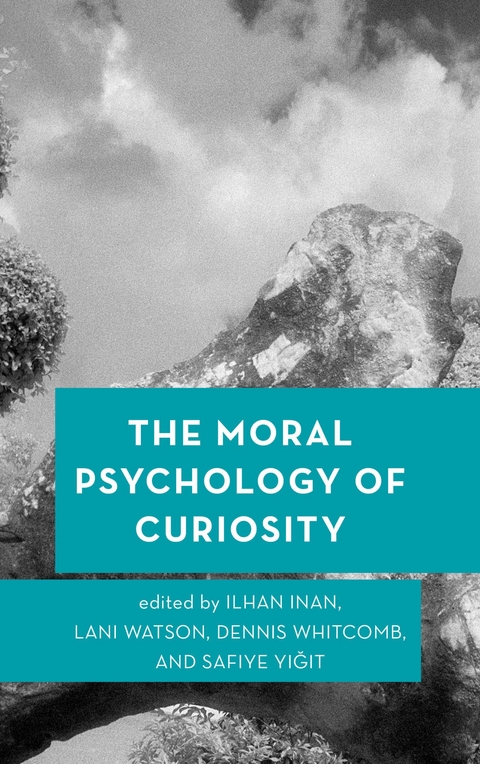
Moral Psychology of Curiosity (eBook)
280 Seiten
Rowman & Littlefield International (Verlag)
978-1-78660-672-3 (ISBN)
Curiosity has taken a winding path through intellectual history, from Early Christian vice to Enlightenment virtue and beyond. This original volume sees contemporary philosophers and psychologists examining the nature and value of curiosity, shedding light on some of its most interesting features and exploring its role in human experience. Authors examine the nature and history of curiosity, the psychology of curiosity and its relationship to interest, understanding, and desire, the impact of language in shaping our curiosity, the cultivation and measurement of curiosity, and the vital part that curiosity can and should play in education. With perspectives on curiosity from all over the world, this diverse, interdisciplinary collection provides an in-depth and multi-faceted examination of the epistemological, psychological, moral, and educative dimensions of curiosity.
lt;span>Ilhan Inan (PhD, UC-Santa Barbara) recently joined the Philosophy Department at Koç University in Istanbul. Prior to that he taught at Boğaziçi University Philosophy Department for twenty years. He is the author of The Philosophy of Curiosity (Routledge, 2012) and his philosophical articles appeared in many respected international and national journals including Philosophical Studies. He works on philosophy of language, broadly construed, to include philosophy of curiosity, evolution of language, creativity, and inostensible reference. He published articles on how curiosity relates to belief, acquaintance and creativity and is currently working on two book manuscripts on the subjects of truth and philosophical curiosity.
Lani Watson (PhD, Edinburgh) is a Leverhulme Early Career Fellow at the University of Edinburgh. Her interdisciplinary research spans the fields of philosophy, educational theory, and experimental psycholinguistics, focusing on the role that questions and questioning play in everyday life, politics, and education. She has recent and forthcoming publications exploring the value of student questioning in education, and the intellectual virtues of curiosity and inquisitiveness. Her research draws on political, social, and virtue epistemology and the epistemology of education. She combines conceptual analysis with experimental methods to demonstrate the significance of questioning, inquisitiveness, and curiosity in education, especially for learning, intellectual character, and political engagement.
Dennis Whitcomb (PhD, Rutgers) is Professor of Philosophy at Western Washington University. His writings cover a range of topics in epistemology broadly construed: knowledge, justification, wisdom, intellectual humility, curiosity, epistemic value, and the ethics of belief. These writings have appeared in Philosophy and Phenomenological Research, Philosophical Studies, Oxford Studies in Philosophy of Religion, Synthese, and Philosophical Quarterly among other venues. He is co-editor of Social Epistemology: Essential Readings (OUP 2011). His most recent work, which focuses on the speech act of question-asking, connects epistemology to the philosophy of language.
Safiye Yigit is a PhD candidate in Philosophy and Education at Columbia University. She has written her Master’s Thesis on ‘Curiosity as an Intellectual and Ethical Virtue’ (2011) at Boğaziçi University, Istanbul, Turkey under the supervision of Ilhan Inan. For three years, she worked as a Researcher at Boğaziçi University in the research project entitled “Curiosity: Epistemics, Semantics, and Ethics” directed by Ilhan Inan. As part of the project, she co-organized an international conference in Istanbul, which gathered several philosophers working on curiosity and she has also given numerous lectures and talks in Turkey, Italy, Netherlands, Slovenia, US, UK, and Poland on curiosity. Her research areas include virtue epistemology, virtue ethics, philosophy of education and especially educating for intellectual virtues and wisdom.
Introduction / Part 1: Nature of Curiosity / 1. Interest, Questions, and Knowledge Kevin Mulligan / 2. Curiosity, Truth, and Knowledge Ilhan Inan / 3. Curiosity, Its Objects and Varieties Nenad Miščević / Part 2: Moral Dimensions of Curiosity / 4. Pre-modern Christian Perspectives on Curiosity Kent Dunnington / 5. Curiosity as an Intellectual Virtue Safiye Yigit / 6. Asking the Right Questions? Confucian Curiosity and Moral Self-Cultivation Ian James Kidd
Part 3: Psychological Dimensions of Curiosity / 7. Constructing and Validating a Scale of Inquisitive Curiosity Kathryn Iurino, Brian Robinson, Markus Christen, Paul Stey, and Mark Alfano / 8. Examining Curiosity as Psychological Virtue and Vice Megan Haggard / 9. Some Epistemic Roles For Curiosity Dennis Whitcomb / Part 4: Epistemological Dimensions of Curiosity / 10. Curiosity, Virtuous Insensitivity, and Luck Reduction Abrol Fairweather and Carlos Montemayor / 11. Curiosity and Understanding Michael S. Brady / 12. Curiosity and Epistemic Norms Pascal Engel / Part 5: Educational Dimensions of Curiosity / 13. Fostering curiosity with Socratic exemplars: Considering the traditional Japanese idea of exemplars in learning Kunimasa Sato / 14. Educating for Curiosity Lani Watson
| Erscheint lt. Verlag | 5.12.2018 |
|---|---|
| Reihe/Serie | Moral Psychology of the Emotions |
| Verlagsort | London |
| Sprache | englisch |
| Themenwelt | Geisteswissenschaften ► Philosophie ► Allgemeines / Lexika |
| Geisteswissenschaften ► Philosophie ► Ethik | |
| Geisteswissenschaften ► Psychologie | |
| Schlagworte | Applied Ethics • Applied Philosophy • Moral Philosophy • philosophy of the emotions • Psychology • psychology of the emotions |
| ISBN-10 | 1-78660-672-0 / 1786606720 |
| ISBN-13 | 978-1-78660-672-3 / 9781786606723 |
| Informationen gemäß Produktsicherheitsverordnung (GPSR) | |
| Haben Sie eine Frage zum Produkt? |
 EPUB (Adobe DRM)
Kopierschutz: Adobe-DRM
Adobe-DRM ist ein Kopierschutz, der das eBook vor Mißbrauch schützen soll. Dabei wird das eBook bereits beim Download auf Ihre persönliche Adobe-ID autorisiert. Lesen können Sie das eBook dann nur auf den Geräten, welche ebenfalls auf Ihre Adobe-ID registriert sind.
Details zum Adobe-DRM
Dateiformat: EPUB (Electronic Publication)
EPUB ist ein offener Standard für eBooks und eignet sich besonders zur Darstellung von Belletristik und Sachbüchern. Der Fließtext wird dynamisch an die Display- und Schriftgröße angepasst. Auch für mobile Lesegeräte ist EPUB daher gut geeignet.
Systemvoraussetzungen:
PC/Mac: Mit einem PC oder Mac können Sie dieses eBook lesen. Sie benötigen eine
eReader: Dieses eBook kann mit (fast) allen eBook-Readern gelesen werden. Mit dem amazon-Kindle ist es aber nicht kompatibel.
Smartphone/Tablet: Egal ob Apple oder Android, dieses eBook können Sie lesen. Sie benötigen eine
Geräteliste und zusätzliche Hinweise
Buying eBooks from abroad
For tax law reasons we can sell eBooks just within Germany and Switzerland. Regrettably we cannot fulfill eBook-orders from other countries.
aus dem Bereich