


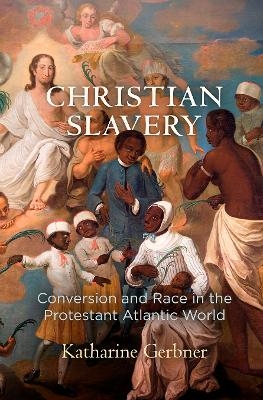
Christian Slavery
Conversion and Race in the Protestant Atlantic World
Seiten
2019
University of Pennsylvania Press (Verlag)
978-0-8122-2436-8 (ISBN)
University of Pennsylvania Press (Verlag)
978-0-8122-2436-8 (ISBN)
Could slaves become Christian? If so, did their conversion lead to freedom? If not, then how could perpetual enslavement be justified? In Christian Slavery, Katharine Gerbner contends that religion was fundamental to the development of both slavery and race in the Protestant Atlantic world. Slave owners in the Caribbean and elsewhere established governments and legal codes based on an ideology of "Protestant Supremacy," which excluded the majority of enslaved men and women from Christian communities. For slaveholders, Christianity was a sign of freedom, and most believed that slaves should not be eligible for conversion.
When Protestant missionaries arrived in the plantation colonies intending to convert enslaved Africans to Christianity in the 1670s, they were appalled that most slave owners rejected the prospect of slave conversion. Slaveholders regularly attacked missionaries, both verbally and physically, and blamed the evangelizing newcomers for slave rebellions. In response, Quaker, Anglican, and Moravian missionaries articulated a vision of "Christian Slavery," arguing that Christianity would make slaves hardworking and loyal.
Over time, missionaries increasingly used the language of race to support their arguments for slave conversion. Enslaved Christians, meanwhile, developed an alternate vision of Protestantism that linked religious conversion to literacy and freedom. Christian Slavery shows how the contentions between slave owners, enslaved people, and missionaries transformed the practice of Protestantism and the language of race in the early modern Atlantic world.
When Protestant missionaries arrived in the plantation colonies intending to convert enslaved Africans to Christianity in the 1670s, they were appalled that most slave owners rejected the prospect of slave conversion. Slaveholders regularly attacked missionaries, both verbally and physically, and blamed the evangelizing newcomers for slave rebellions. In response, Quaker, Anglican, and Moravian missionaries articulated a vision of "Christian Slavery," arguing that Christianity would make slaves hardworking and loyal.
Over time, missionaries increasingly used the language of race to support their arguments for slave conversion. Enslaved Christians, meanwhile, developed an alternate vision of Protestantism that linked religious conversion to literacy and freedom. Christian Slavery shows how the contentions between slave owners, enslaved people, and missionaries transformed the practice of Protestantism and the language of race in the early modern Atlantic world.
Katharine Gerbner teaches history at the University of Minnesota.
Introduction
Chapter 1. Christian Slaves in the Atlantic World
Chapter 2. Protestant Supremacy
Chapter 3. Quaker Slavery and Slave Rebellion
Chapter 4. From Christian to White
Chapter 5. The Imperial Politics of Slave Conversion
Chapter 6. The SPG and Slavery
Chapter 7. Inner Slavery and Spiritual Freedom
Chapter 8. Defining True Conversion
Epilogue. Proslavery Theology and Black Christianity
Notes
Bibliography
Index
Acknowledgments
| Erscheinungsdatum | 21.03.2019 |
|---|---|
| Reihe/Serie | Early American Studies |
| Zusatzinfo | 15 illus. |
| Verlagsort | Pennsylvania |
| Sprache | englisch |
| Maße | 152 x 229 mm |
| Themenwelt | Geschichte ► Teilgebiete der Geschichte ► Religionsgeschichte |
| Religion / Theologie ► Christentum ► Kirchengeschichte | |
| Sozialwissenschaften ► Soziologie ► Allgemeines / Lexika | |
| ISBN-10 | 0-8122-2436-1 / 0812224361 |
| ISBN-13 | 978-0-8122-2436-8 / 9780812224368 |
| Zustand | Neuware |
| Informationen gemäß Produktsicherheitsverordnung (GPSR) | |
| Haben Sie eine Frage zum Produkt? |
Mehr entdecken
aus dem Bereich


aus dem Bereich
von der Antike bis zur Gegenwart
Buch | Softcover (2025)
C.H.Beck (Verlag)
CHF 16,80


