


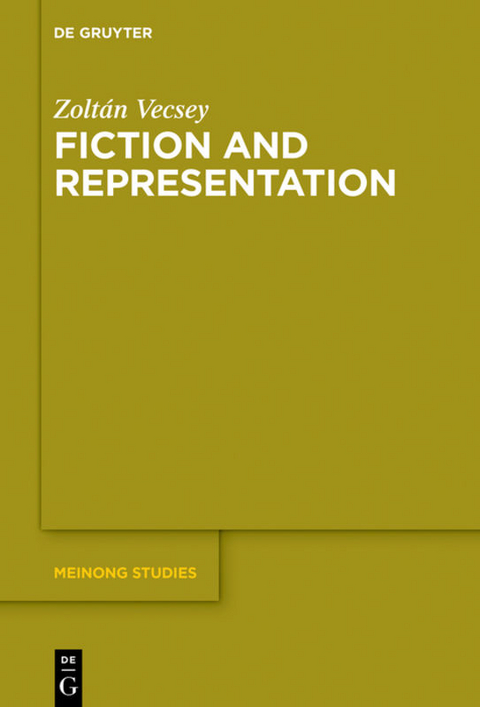
Fiction and Representation
Seiten
2019
De Gruyter (Verlag)
978-3-11-064680-1 (ISBN)
De Gruyter (Verlag)
978-3-11-064680-1 (ISBN)
The series presents historical and systematic studies on the philosophy of Alexius Meinong and his school, as well as on works influenced by aspects of Meinong’s philosophy. Furthermore, the series is open to contributions in the analytic-phenomenological tradition, mirroring the most recent developments in these disciplines.
One of the basic insights of the book is that there is a notion of non-relational linguistic representation which can fruitfully be employed in a systematic approach to literary fiction. This notion allows us to develop an improved understanding of the ontological nature of fictional entities. A related insight is that the customary distinction between extra-fictional and intra-fictional contexts has only a secondary theoretical importance. This distinction plays a central role in nearly all contemporary theories of literary fiction. There is a tendency among researchers to take it as obvious that the contrast between these two types of contexts is crucial for understanding the boundary that divides fiction from non-fiction. Seen from the perspective of non-relational representation, the key question is rather how representational networks come into being and how consumers of literary texts can, and do, engage with these networks. As a whole, the book provides, for the first time, a comprehensive artefactualist account of the nature of fictional entities.
One of the basic insights of the book is that there is a notion of non-relational linguistic representation which can fruitfully be employed in a systematic approach to literary fiction. This notion allows us to develop an improved understanding of the ontological nature of fictional entities. A related insight is that the customary distinction between extra-fictional and intra-fictional contexts has only a secondary theoretical importance. This distinction plays a central role in nearly all contemporary theories of literary fiction. There is a tendency among researchers to take it as obvious that the contrast between these two types of contexts is crucial for understanding the boundary that divides fiction from non-fiction. Seen from the perspective of non-relational representation, the key question is rather how representational networks come into being and how consumers of literary texts can, and do, engage with these networks. As a whole, the book provides, for the first time, a comprehensive artefactualist account of the nature of fictional entities.
Zoltán Vecsey, MTA-DE-SZTE Research Group for Theoretical Linguistics, Debrecen, Hungary.
| Erscheinungsdatum | 18.06.2019 |
|---|---|
| Reihe/Serie | Meinong Studies / Meinong Studien ; 9 |
| Verlagsort | Berlin/Boston |
| Sprache | englisch |
| Gewicht | 413 g |
| Themenwelt | Geisteswissenschaften ► Philosophie ► Philosophie der Neuzeit |
| Geisteswissenschaften ► Religion / Theologie | |
| Schlagworte | abstract artefacts • Abstrakte Artefakte • Alexander • authorial creation • definition of literature • Fiction • Fictional entities • Fiktion • Fiktionale Entitäten • Literatur /Definition • Literatur/Definition • Meinong • Meinong, Alexander • non-relational linguistic representation. • Realism • Realismus |
| ISBN-10 | 3-11-064680-3 / 3110646803 |
| ISBN-13 | 978-3-11-064680-1 / 9783110646801 |
| Zustand | Neuware |
| Informationen gemäß Produktsicherheitsverordnung (GPSR) | |
| Haben Sie eine Frage zum Produkt? |
Mehr entdecken
aus dem Bereich


aus dem Bereich
ein Dialog mit Simone Weil
Buch | Softcover (2025)
Matthes & Seitz Berlin (Verlag)
CHF 19,55


