


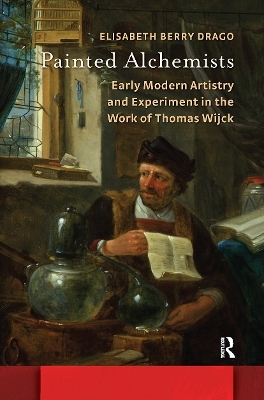
Painted Alchemists
Early Modern Artistry and Experiment in the Work of Thomas Wijck
Seiten
2019
Amsterdam University Press (Verlag)
978-94-6298-649-7 (ISBN)
Amsterdam University Press (Verlag)
978-94-6298-649-7 (ISBN)
- Titel nicht im Sortiment
- Artikel merken
This book explores one artist's transformation of alchemy and its materials into a reputation for virtuosity-and what his work can teach us about the experimental early modern world.
Thomas Wijck’s painted alchemical laboratories were celebrated in his day as artful and ingenious. They fell into obscurity along with their subject, as alchemy came to be viewed as an occult art or a fool’s errand. But these unusual pictures challenge our understanding of early modern alchemy-and of the deeper relationship between chemical workshops and the artists who represented them. The work of artists, like the work of alchemists, contained intellectual-creative and manual-material aspects. Both alchemists and artists claimed a special status owing to their creative powers. Wijck’s formation of an artistic and professional identity around alchemical themes reveals his desire to explore this curious territory, and ultimately to demonstrate art’s superior claims to knowledge and mastery over nature. This book explores one artist’s transformation of alchemy and its materials into a reputation for virtuosity-and what his work can teach us about the experimental early modern world.
Thomas Wijck’s painted alchemical laboratories were celebrated in his day as artful and ingenious. They fell into obscurity along with their subject, as alchemy came to be viewed as an occult art or a fool’s errand. But these unusual pictures challenge our understanding of early modern alchemy-and of the deeper relationship between chemical workshops and the artists who represented them. The work of artists, like the work of alchemists, contained intellectual-creative and manual-material aspects. Both alchemists and artists claimed a special status owing to their creative powers. Wijck’s formation of an artistic and professional identity around alchemical themes reveals his desire to explore this curious territory, and ultimately to demonstrate art’s superior claims to knowledge and mastery over nature. This book explores one artist’s transformation of alchemy and its materials into a reputation for virtuosity-and what his work can teach us about the experimental early modern world.
Elisabeth Berry Drago studies interconnected histories of art and science in the Dutch Golden Age. She received her PhD from the University of Delaware, and is a former Fellow of the Science History Institute in Philadelphia.
INTRODUCTION, 1. CURIOSITY AND CONVENTION, 2. THOMAS WIJCK, ŸARTFULŒ AND ŸINGENIOUSŒ, 3. WIJCK’S ALCHEMICAL ARTISANS, 4. AN EXPERIMENT IN HAARLEM, 5. THE ARTIST’S LABORATORIES ABROAD, 6. THE MASTER OF NATURE, 7. EPILOGU, ENDNOTES, BIBLIOGRAPHY
| Erscheinungsdatum | 19.04.2019 |
|---|---|
| Reihe/Serie | Amsterdam Studies in the Dutch Golden Age |
| Sprache | englisch |
| Maße | 156 x 234 mm |
| Gewicht | 820 g |
| Themenwelt | Geisteswissenschaften ► Archäologie |
| Geschichte ► Allgemeine Geschichte ► Neuzeit (bis 1918) | |
| ISBN-10 | 94-6298-649-5 / 9462986495 |
| ISBN-13 | 978-94-6298-649-7 / 9789462986497 |
| Zustand | Neuware |
| Informationen gemäß Produktsicherheitsverordnung (GPSR) | |
| Haben Sie eine Frage zum Produkt? |
Mehr entdecken
aus dem Bereich
aus dem Bereich
Geschichte einer wilden Handlung
Buch | Hardcover (2024)
C.H.Beck (Verlag)
CHF 47,60


