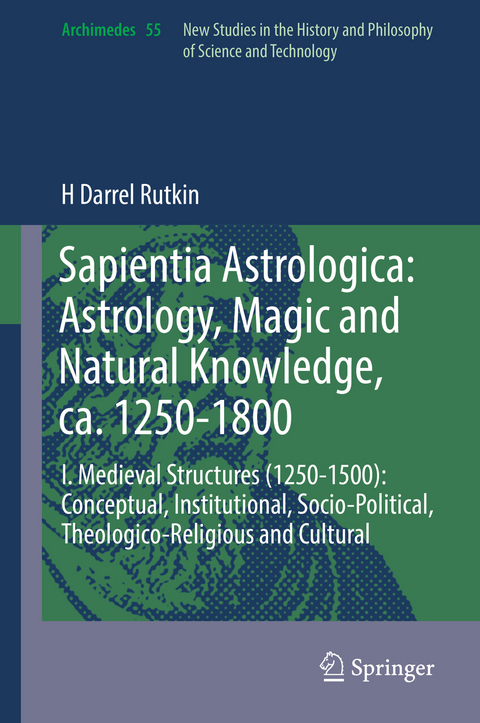
Sapientia Astrologica: Astrology, Magic and Natural Knowledge, ca. 1250-1800
Springer International Publishing (Verlag)
978-3-030-10778-9 (ISBN)
This book explores the changing perspective of astrology from the Middle Ages to the Early Modern Era. It introduces a framework for understanding both its former centrality and its later removal from legitimate knowledge and practice. The discussion reconstructs the changing roles of astrology in Western science, theology, and culture from 1250 to 1500.
The author considers both the how and the why. He analyzes and integrates a broad range of sources. This analysis shows that the history of astrology-in particular, the story of the protracted criticism and ultimate removal of astrology from the realm of legitimate knowledge and practice-is crucial for fully understanding the transition from premodern Aristotelian-Ptolemaic natural philosophy to modern Newtonian science.
This removal, the author argues, was neither obvious nor unproblematic. Astrology was not some sort of magical nebulous hodge-podge of beliefs. Rather, astrology emerged in the 13th century as a richlymathematical system that served to integrate astronomy and natural philosophy, precisely the aim of the "New Science" of the 17th century. As such, it becomes a fundamentally important historical question to determine why this promising astrological synthesis was rejected in favor of a rather different mathematical natural philosophy-and one with a very different causal structure than Aristotle's.A historian of science with a focus on the role of astrology in premodern Western science and culture ca. 1250-1800, H Darrel Rutkin took his PhD at Indiana University in 2002. After a series of splendid postdoctoral fellowships and visiting professorships, he is now Associate Professor (Ricercatore) at Università Ca' Foscari Venezia in the Dipartimento di Filosofia e Beni Culturali (2018-2021). He has also contributed to the Cambridge History of Science and the Harvard Companion to the Classical Tradition.
Part 1: Conceptual Structure (1): Astrology and Natural Philosophy/Science: Reconstructing a 13th-Century Astrologizing Aristotelianism (1250-80). Introduction to Part 1: Astrology and Aristotelian Natural Philosophy. Chapter 1: Ligamentum naturalis philosophiae et metaphysicae: Astrology and Aristotelian Natural Philosophy.- Chapter 2: Mathematizing the Picture: Mathematics, Perspectiva and Astrology in Roger Bacon and Albertus Magnus.- Chapter 3: Albertus Magnus on the Natural Philosophical Foundations for Revolutions Intermezzo.- Chaper 4: Defending Astrology: Roger Bacon and the Speculum astronomiae.- Part 2: Conceptual Structures (2): Astrology and Theology/Religion. Introduction to part 2: Astrology and Theology. Chapter 5: Astrology and Theology in Albertus Magnus and Thomas Aquinas: Fate, Divination and Providence.- Chapter 6: Astrology, Theology and Religion in Roger Bacon.- Part 3: Conceptual Structures (3): Astrology and Magic. Introduction to part 3: Astrology and Magic. Chapter 7: Imagines astronomicae (talismans) in the Speculum astronomiae, Albertus Magnus and Thomas Aquinas.- Chapter 8: Opera et verba sapientiae: Astrology and Magic in Roger Bacon.- Part 4: Institutional, Scocio-Political and Cultural Structures: Universities, Cities and Courts (1300-1500). Introduction to part 4: Astrology, Mathematics and Humanism. Chapter 9: Disciplinary Configurations: Astrology and the Mathematical Disciplines.- Chapter 10: Institutional Foundations: The Universities.- Chapter 11: Astrology in Society, Politics and Culture.- Conclusion to I: The Annus Mirabilis of 1484: Towards Renaissance Astrology and Magic.
"Darrel Rutkin is a leading expert on medieval astrology. This fascinating book, the first stone of an ambitious edifice, provides many fundamental elements for understanding the place of astrology in the philosophical, theological, and scientific worldviews of the Middle Ages. The reader is often led to see the question from unexpected angles and is thus strongly stimulated in his thought." (Nicolas Weill-Parot, Journal for the History of Astronomy, Vol. 53 (2), 2022)
“Darrel Rutkin is a leading expert on medieval astrology. This fascinating book, the first stone of an ambitious edifice, provides many fundamental elements for understanding the place of astrology in the philosophical, theological, and scientific worldviews of the Middle Ages. The reader is often led to see the question from unexpected angles and is thus strongly stimulated in his thought.” (Nicolas Weill-Parot, Journal for the History of Astronomy, Vol. 53 (2), 2022)
| Erscheinungsdatum | 29.04.2019 |
|---|---|
| Reihe/Serie | Archimedes |
| Zusatzinfo | LXXXIX, 515 p. 9 illus. |
| Verlagsort | Cham |
| Sprache | englisch |
| Maße | 155 x 235 mm |
| Gewicht | 1069 g |
| Themenwelt | Geisteswissenschaften ► Philosophie ► Allgemeines / Lexika |
| Geisteswissenschaften ► Philosophie ► Geschichte der Philosophie | |
| Geisteswissenschaften ► Philosophie ► Philosophie der Neuzeit | |
| Schlagworte | Albertus Magnus • Annus Mirabilis of 1484 • Aristotelian Natural Philosophy • Aristotelian-Ptolemaic • Astrologizing Aristotelianism • Astrology and magic (talismans) • Astrology and medieval philosophy • Astrology and medieval science • Astrology and the history of science • Astrology and the Scientific Revolution • mathematical system • Mathematics and Humanism • Opera et verba sapientiae • Revolutions Intermezzo • Roger Bacon • Speculum astronomiae • Thomas Aquinas |
| ISBN-10 | 3-030-10778-7 / 3030107787 |
| ISBN-13 | 978-3-030-10778-9 / 9783030107789 |
| Zustand | Neuware |
| Informationen gemäß Produktsicherheitsverordnung (GPSR) | |
| Haben Sie eine Frage zum Produkt? |
aus dem Bereich