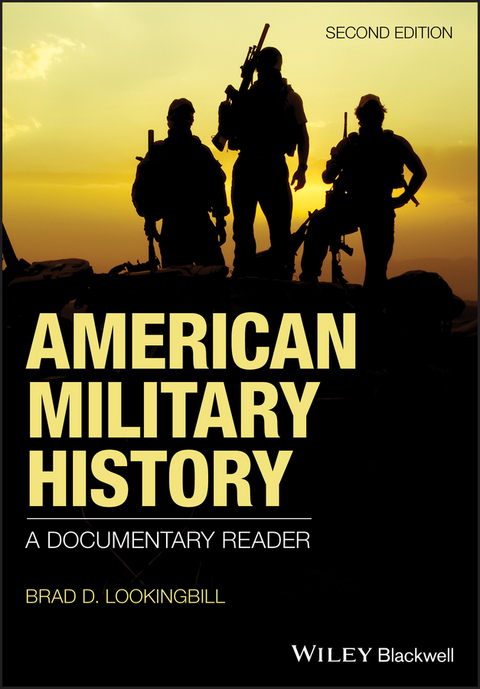
American Military History (eBook)
John Wiley & Sons (Verlag)
978-1-119-33600-6 (ISBN)
A collection of primary documents that explore the many facets of the American military from the colonial period to the present
The second edition of American Military History offers an exceptional collection of primary documents relating to history of the military of the United States from 1607 through the present. The writings offer insight into the armed forces in relation to the social, cultural, economic, political, and territorial development of the United States. Several documents comment on strategic initiatives, combat operations, force structure, public policy, and home fronts. The writings also present firsthand testimony of extraordinary men and women in uniform and most of the documents explore the connections between combatants and the societies that produced them.
From the beginnings of the war against the natives through the tragedy of the Civil War and up to the current Global War on Terror, American Military History offers a chronological account of the evolution of the United States military. This vital text:
- Includes writings that explore the diversity of the armed forces
- Explores leadership in America's military affairs
- Traces America's ways of war beginning in 1607 through the present
- Examines the patterns of design and purpose of the American military over time
- Reveals the vitality of civil-military relations in the United States
Written for academics and students of military history, American Military History is an important text that draws on primary sources to explore the many facets of America's military history.
BRAD D. LOOKINGBILL is Professor of History at Columbia College of Missouri. He is the author of The American Military: A Narrative History (Wiley, 2014) and War Dance at Fort Marion: Plains Indian War Prisoners (2006), and is the editor of American Military History: A Documentary Reader (Wiley, 2011). He received the Eugene Asher Distinguished Teaching Award from the American Historical Association in 2010. Dr. Lookingbill served in the Army National Guard and Reserve.
BRAD D. LOOKINGBILL is Professor of History at Columbia College of Missouri. He is the author of The American Military: A Narrative History (Wiley, 2014) and War Dance at Fort Marion: Plains Indian War Prisoners (2006), and is the editor of American Military History: A Documentary Reader (Wiley, 2011). He received the Eugene Asher Distinguished Teaching Award from the American Historical Association in 2010. Dr. Lookingbill served in the Army National Guard and Reserve.
Introduction
“To fight out a war, you must believe something and want something with all your might,” declared Oliver Wendell Holmes, a wounded veteran of the American Civil War and later an associate justice on the United States Supreme Court. His words before a Memorial Day audience in 1884 expressed something elemental about American military history. The former Lieutenant Colonel spoke of those who were near and dear to him, “not because their lives have become historic,” but because “their lives are the type of what every soldier has known and seen” in war. He called them “the army of the dead,” who swept before the nation wearing “wounds like stars.” He remembered his comrades with great reverence: “I speak of those whom I have seen.” With a gesture to the audience, he mused: “But you all have known such; you, too, remember!”1
No one should forget the millions of Americans, who have fought in wars large and small. They embody what endures at the heart of military affairs, that is, the will to fight for something greater than the self. For centuries, they provided for the common defense. The history of the American military offers a framework through which the people and the nation can be analyzed. At the dawn of a new millennium, acts of war still permit individuals to dedicate themselves to a cause in life as well as in death. Because so many have fought with all their might, I ask the readers of this textbook to consider the historical question: What did American warriors believe and want?
What they said has survived in scores of documents, which I sample in the following pages as broadly as possible. A number consider the role and the use of the armed forces in relation to the social, cultural, economic, political, and territorial development of the United States. Some feature commentary on strategic initiatives, combat operations, force structure, public policy, and home fronts. Others offer the firsthand testimony of extraordinary men and women in uniform. Most reveal the connections between combatants and the societies that spawned them. Thanks to an abundance of documentary materials, I present excerpts from diaries, memoirs, letters, speeches, songs, posters, memoranda, reports, manuals, laws, debates, petitions, reviews, and articles.
Attentive to diversity in the American military, I present not one point of view but many. The sampling of extracts makes for an eclectic mix, but not infinitely so. The result may be described as a reconnaissance of a historical field. The point is not to go left or right to engage the past. Rather, it is to dig deeper and to reach wider in the effort to grasp what happened and why. Whether part of the U.S. Army, Navy, Air Force, Marine Corps, National Guard, or Coast Guard, Americans from all walks of life served with honor and dignity. Even while facing the prospect of death, they remained focused on accomplishing their missions in theaters around the world. In the process, their experiences became entangled with thematic issues common to each historical era. To help readers recognize the most prevalent themes of the documents, my aims in this textbook are threefold.
My first aim is to trace America’s ways of war. Beginning in 1607, the approaches to combat in North America appeared as varied and as ambiguous as each individual. In a sense, each was fighting his or her own battles. Over time, the use of the armed forces by the United States revealed patterns of design and purpose. Although war often created a momentum of its own, Americans mastered strategies for attrition as well as tactics for defense, concentration, maneuver, and assault. Combat included not only strategic and tactical aspects but also social and intellectual thrusts. In other words, operations involved fighting as well as thinking. What distinguished American warriors was not just the logistics of their military campaigns. It was also their passion for the literature, music, and art of war. The face of battle elicited extreme emotional responses, which resonated with the lingering effects of stress and trauma. At the same time, the nation expressed a great deal of pride about the profession of arms. The ways of war involved a private and public sense of civic virtue, collective anxieties, and shared memories.
Of course, there never was a single or simple way of war. Warfare involved extraordinary actions, which combatants often remembered differently. Whether charging or retreating, no one observed everything on the battlefield. Lies, falsehoods, distortions, and exaggerations appear at times in the spoken and the written accounts of individuals. Thus, language itself may seem inadequate for the task of recovering the whole story from partial and fragmentary narratives. Even so, the recollections and the commemorations of war illustrate the martial spirit at home and abroad. Veterans told stories about adventures that astonished and perplexed. They recalled experiences marked by horror and misery. The most vivid and compelling tales give a sense of combat, thereby providing the next best—or worst—thing to having been there. Once recorded, the reports of eyewitnesses convey far more than words alone can possibly say. Their voices deserve amplification, because they have come to terms with the incontrovertible fact that death remains the end of all war. Engaging with the primary sources permits readers to study the ways of war in a raw and unfiltered form.
My second aim is to study leadership in military affairs. Time and again, commissioned and noncommissioned officers led others through the fog of war. They made tough choices in order to achieve military objectives, whether or not they fully recognized all the obstacles before them. In spite of the risks to life and limb, they persuaded their comrades in arms to follow them up hills or into caves. While setting courageous examples, they drove the rank and file across dark skies and stormy waters. They endeavored to seize the initiative in a struggle, which on many occasions placed them in the crossfire. Their sway turned motley crews into cohesive units. Their foresight made teamwork successful. To be sure, combat operations were punctuated with accidents and surprises. Even the best laid plans for action faltered in the absence of adequate resources, proper training, high morale, or public support. From boot camps to battle stations, however, leaders often adapted and overcame. Many of the challenges they met in the past continue to pose challenges to men and women in uniform today. With respect to decision‐making, the following pages will expose readers to models of military leadership at all levels of service.
Without a doubt, a number of martial figures in the United States possessed a genius for leadership. More than simply trumpeting their military accomplishments, many leaders wrote reflectively about how they worked major problems. The best and the brightest studied innovative concepts to improve the readiness of the armed forces. Searching for determining factors in war, they obsessed over losses as well as victories. They carefully analyzed elements of battle—from both the ground up and the inside out. They assessed outcomes to better understand their own strengths and weaknesses rather than merely to second‐guess the choices made by others. They benefited from the privileges of hindsight, which enabled them to identify historical parallels instructive to future generations. Lively and open‐ended discussions about the lessons learned tended to educate their senses. Insights born out of wisdom provoked and enlightened not simply by pleasing guardians of a set of ideological assumptions or by refighting each battle from the last campaign. Rather, great military leaders developed a pragmatic style that privileged performance and results over orthodoxies and doctrines.
Thirdly, my aim is to reveal the vitality of civil–military relations in the United States. Since the Age of Enlightenment, standing armies and navies represented nothing if not state‐organized instruments of violence. The founders of the American republic established the military based—at least in theory—on the notion that service constituted an obligation of all citizens. The U.S. Constitution permitted Congress to draw largely from the preexisting militia system while building a new nation. Moreover, each Commander in Chief tried to strike a delicate balance. On the one hand, the military establishment seemed at odds with the most liberal impulses of community life. On the other hand, global empires on the march made the world unsafe for democracy. Consequently, a professional military with trained regulars prepared for peace as well as for war. Civilian authorities used them in constabulary roles across the continent and deployed them in contingency operations overseas. During the draft era, the federal government forged a massive war machine to stop the aggression of totalitarian regimes. With the introduction of nuclear arms and guided missiles, the American military became a mighty tool for national security.
For the sake of national security, the United States continues to marshal its military power to meet the challenges of globalization. Blood is still shed on land, at sea, and in air, but battles also rage in cyberspace. Wars have been won and lost in Washington, DC, where the Commander in Chief works closely with the military brass inside the Pentagon. With Congressional appropriations for procurement, pay, and benefits, civilian control over the military establishment endures. However, American society no longer considers military service an obligation of...
| Erscheint lt. Verlag | 16.11.2018 |
|---|---|
| Sprache | englisch |
| Themenwelt | Geschichte ► Teilgebiete der Geschichte ► Militärgeschichte |
| Schlagworte | A French Officer Draws the Continental Line • Albigence Waldo Treats Soldiers at Valley Forge • Alexander Hamilton Considers National Forces • An Unknown Soldier Sings Yankee Doodle • Benjamin Church Plans for Action in New England • Deborah Sampson Wears a Uniform • Elizabeth Bacon Observes Skirmishes in Virginia • Establishing the Military • George Washington Bids Farewell to the Army • Geschichte • Geschichte der USA • Henry Knox Arranges the Militia • History • James Monroe Goes to War • James Oglethorpe Strikes Spanish Outposts • Jeffrey Brace Fights for Liberty • John Mason Campaigns against the Pequot • John Paul Jones Captures a British Frigate • Militärgeschichte • military history • Powhatan Describes War among the Natives • Robert Rogers Provides Rules for the Rangers • us history • war for independence |
| ISBN-10 | 1-119-33600-7 / 1119336007 |
| ISBN-13 | 978-1-119-33600-6 / 9781119336006 |
| Informationen gemäß Produktsicherheitsverordnung (GPSR) | |
| Haben Sie eine Frage zum Produkt? |
 EPUB (Adobe DRM)
Kopierschutz: Adobe-DRM
Adobe-DRM ist ein Kopierschutz, der das eBook vor Mißbrauch schützen soll. Dabei wird das eBook bereits beim Download auf Ihre persönliche Adobe-ID autorisiert. Lesen können Sie das eBook dann nur auf den Geräten, welche ebenfalls auf Ihre Adobe-ID registriert sind.
Details zum Adobe-DRM
Dateiformat: EPUB (Electronic Publication)
EPUB ist ein offener Standard für eBooks und eignet sich besonders zur Darstellung von Belletristik und Sachbüchern. Der Fließtext wird dynamisch an die Display- und Schriftgröße angepasst. Auch für mobile Lesegeräte ist EPUB daher gut geeignet.
Systemvoraussetzungen:
PC/Mac: Mit einem PC oder Mac können Sie dieses eBook lesen. Sie benötigen eine
eReader: Dieses eBook kann mit (fast) allen eBook-Readern gelesen werden. Mit dem amazon-Kindle ist es aber nicht kompatibel.
Smartphone/Tablet: Egal ob Apple oder Android, dieses eBook können Sie lesen. Sie benötigen eine
Geräteliste und zusätzliche Hinweise
Buying eBooks from abroad
For tax law reasons we can sell eBooks just within Germany and Switzerland. Regrettably we cannot fulfill eBook-orders from other countries.
aus dem Bereich