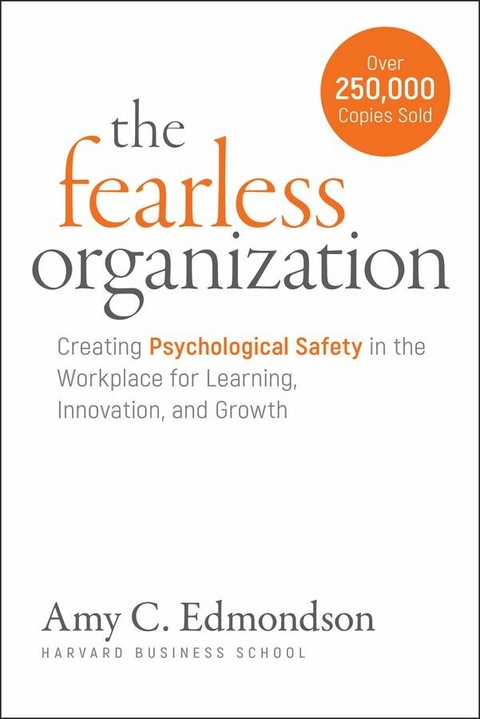
The Fearless Organization (eBook)
John Wiley & Sons (Verlag)
978-1-119-47726-6 (ISBN)
Conquer the most essential adaptation to the knowledge economy
The Fearless Organization: Creating Psychological Safety in the Workplace for Learning, Innovation, and Growth offers practical guidance for teams and organizations who are serious about success in the modern economy. With so much riding on innovation, creativity, and spark, it is essential to attract and retain quality talent-but what good does this talent do if no one is able to speak their mind? The traditional culture of 'fitting in' and 'going along' spells doom in the knowledge economy. Success requires a continuous influx of new ideas, new challenges, and critical thought, and the interpersonal climate must not suppress, silence, ridicule or intimidate. Not every idea is good, and yes there are stupid questions, and yes dissent can slow things down, but talking through these things is an essential part of the creative process. People must be allowed to voice half-finished thoughts, ask questions from left field, and brainstorm out loud; it creates a culture in which a minor flub or momentary lapse is no big deal, and where actual mistakes are owned and corrected, and where the next left-field idea could be the next big thing.
This book explores this culture of psychological safety, and provides a blueprint for bringing it to life. The road is sometimes bumpy, but succinct and informative scenario-based explanations provide a clear path forward to constant learning and healthy innovation.
- Explore the link between psychological safety and high performance
- Create a culture where it's 'safe' to express ideas, ask questions, and admit mistakes
- Nurture the level of engagement and candor required in today's knowledge economy
- Follow a step-by-step framework for establishing psychological safety in your team or organization
Shed the 'yes-men' approach and step into real performance. Fertilize creativity, clarify goals, achieve accountability, redefine leadership, and much more. The Fearless Organization helps you bring about this most critical transformation.
AMY C. EDMONDSON is the Novartis Professor of Leadership and Management at the Harvard Business School. Edmondson, recognized by the biannual Thinkers 50 global ranking of management thinkers since 2011, teaches and writes on leadership, teams and organizational learning. Her articles have been published in Harvard Business Review and California Management Review, Administrative Science Quarterly, and the Academy of Management Journal. She is the author of Teaming: How Organizations Learn, Innovate and Compete in the Knowledge Economy and Teaming to Innovate from Jossey-Bass.
Conquer the most essential adaptation to the knowledge economy The Fearless Organization: Creating Psychological Safety in the Workplace for Learning, Innovation, and Growth offers practical guidance for teams and organizations who are serious about success in the modern economy. With so much riding on innovation, creativity, and spark, it is essential to attract and retain quality talent but what good does this talent do if no one is able to speak their mind? The traditional culture of "e;fitting in"e; and "e;going along"e; spells doom in the knowledge economy. Success requires a continuous influx of new ideas, new challenges, and critical thought, and the interpersonal climate must not suppress, silence, ridicule or intimidate. Not every idea is good, and yes there are stupid questions, and yes dissent can slow things down, but talking through these things is an essential part of the creative process. People must be allowed to voice half-finished thoughts, ask questions from left field, and brainstorm out loud; it creates a culture in which a minor flub or momentary lapse is no big deal, and where actual mistakes are owned and corrected, and where the next left-field idea could be the next big thing. This book explores this culture of psychological safety, and provides a blueprint for bringing it to life. The road is sometimes bumpy, but succinct and informative scenario-based explanations provide a clear path forward to constant learning and healthy innovation. Explore the link between psychological safety and high performance Create a culture where it s safe to express ideas, ask questions, and admit mistakes Nurture the level of engagement and candor required in today s knowledge economy Follow a step-by-step framework for establishing psychological safety in your team or organization Shed the "e;yes-men"e; approach and step into real performance. Fertilize creativity, clarify goals, achieve accountability, redefine leadership, and much more. The Fearless Organization helps you bring about this most critical transformation.
AMY C. EDMONDSON is the Novartis Professor of Leadership and Management at the Harvard Business School. Edmondson, recognized by the biannual Thinkers 50 global ranking of management thinkers since 2011, teaches and writes on leadership, teams and organizational learning. Her articles have been published in Harvard Business Review and California Management Review, Administrative Science Quarterly, and the Academy of Management Journal. She is the author of Teaming: How Organizations Learn, Innovate and Compete in the Knowledge Economy and Teaming to Innovate from Jossey-Bass.
Introduction xiii
What It Takes to Thrive in a Complex, Uncertain World xiii
Discovery by Mistake xvi
Overview of the Book xviii
Endnotes xxi
PART I The Power of Psychological Safety 1
Chapter 1 The Underpinning 3
Unconscious Calculators 4
Envisioning the Psychologically Safe Workplace 6
An Accidental Discovery 8
Standing on Giants' Shoulders 12
Why Fear Is Not an Effective Motivator 13
What Psychological Safety Is Not 15
Measuring Psychological Safety 19
Psychological Safety Is Not Enough 21
Endnotes 22
Chapter 2 The Paper Trail 25
Not a Perk 26
The Research 29
An Epidemic of Silence 30
A Work Environment that Supports Learning 35
Why Psychological Safety Matters for Performance 39
Psychologically Safe Employees Are Engaged Employees 41
Psychological Safety as the Extra Ingredient 43
Bringing Research to Practice 45
Endnotes 46
PART II Psychological Safety at Work 51
Chapter 3 Avoidable Failure 53
Exacting Standards 54
Stretching the Stretch Goal 60
Fearing the Truth 63
Who Regulates the Regulators? 66
Avoiding Avoidable Failure 68
Adopting an Agile Approach to Strategy 70
Endnotes 72
Chapter 4 Dangerous Silence 77
Failing to Speak Up 78
What Was Not Said 79
Excessive Confidence in Authority 83
A Culture of Silence 86
Silence in the Noisy Age of Social Media 92
Endnotes 97
Chapter 5 The Fearless Workplace 103
Making Candor Real 104
Extreme Candor 109
Be a Don't Knower 113
When Failure Works 116
Caring for Employees 119
Learning from Psychologically Safe Work Environments 123
Endnotes 124
Chapter 6 Safe and Sound 129
Use Your Words 130
One for All and All for One 135
Speaking Up for Worker Safety 138
Transparency by Whiteboard 142
Unleashing Talent 146
Endnotes 147
PART III Creating a Fearless Organization 151
Chapter 7 Making it Happen 153
The Leader's Tool Kit 154
How to Set the Stage for Psychological Safety 158
How to Invite Participation So People Respond 167
How to Respond Productively to Voice - No Matter Its Quality 173
Leadership Self-Assessment 181
Endnotes 183
Chapter 8 What's Next? 187
Continuous Renewal 187
Deliberative Decision-Making 189
Hearing the Sounds of Silence 191
When Humor Isn't Funny 193
Psychological Safety FAQs 195
Tacking Upwind 208
Endnotes 209
Appendix: Variations in survey measures to Illustrate Robustness of Psychological Safety 213
Acknowledgments 217
About the Author 219
Index 221
Introduction
“No passion so effectively robs the mind of all its powers of acting and reasoning as fear.”
—Edmund Burke, 1756.1
Whether you lead a global corporation, develop software, advise clients, practice medicine, build homes, or work in one of today's state-of-the-art factories that require sophisticated computer skills to manage complex production challenges, you are a knowledge worker.2 Just as the engine of growth in the Industrial Revolution was standardization, with workers as laboring bodies confined to execute “the one best way” to get almost any task done, growth today is driven by ideas and ingenuity. People must bring their brains to work and collaborate with each other to solve problems and accomplish work that's perpetually changing. Organizations must find, and keep finding, new ways to create value to thrive over the long term. And creating value starts with putting the talent you have to its best and highest use.
What It Takes to Thrive in a Complex, Uncertain World
While it's not news that knowledge and innovation have become vital sources of competitive advantage in nearly every industry, few managers stop to really think about the implications of this new reality – particularly when it comes to what it means for the kind of work environment that would help employees thrive and organizations succeed. The goal of this book is to help you do just that – and to equip you with some new ideas and practices to make knowledge-intensive organizations work better.
For an organization to truly thrive in a world where innovation can make the difference between success and failure, it is not enough to hire smart, motivated people. Knowledgeable, skilled, well-meaning people cannot always contribute what they know at that critical moment on the job when it is needed. Sometimes this is because they fail to recognize the need for their knowledge. More often, it's because they're reluctant to stand out, be wrong, or offend the boss. For knowledge work to flourish, the workplace must be one where people feel able to share their knowledge! This means sharing concerns, questions, mistakes, and half-formed ideas. In most workplaces today, people are holding back far too often – reluctant to say or ask something that might somehow make them look bad. To complicate matters, as companies become increasingly global and complex, more and more of the work is team-based. Today's employees, at all levels, spend 50% more time collaborating than they did 20 years ago.3 Hiring talented individuals is not enough. They have to be able to work well together.
In my research over the past 20 years, I've shown that a factor I call psychological safety helps explain differences in performance in workplaces that include hospitals, factories, schools, and government agencies. Moreover, psychological safety matters for groups as disparate as those in the C-suite of a financial institution and on the front lines of the intensive care unit. My field-based research has primarily focused on groups and teams, because that's how most work gets done. Few products or services today are created by individuals acting alone. And few individuals simply do their work and then hand the output over to other people who do their work, in a linear, sequential fashion. Instead, most work requires people to talk to each other to sort out shifting interdependencies. Nearly everything we value in the modern economy is the result of decisions and actions that are interdependent and therefore benefit from effective teamwork. As I've written in prior books and articles, more and more of that teamwork is dynamic – occurring in constantly shifting configurations of people rather than in formal, clearly-bounded teams.4 This dynamic collaboration is called teaming.5 Teaming is the art of communicating and coordinating with people across boundaries of all kinds – expertise, status, and distance, to name the most important. But whether you're teaming with new colleagues all the time or working in a stable team, effective teamwork happens best in a psychologically safe workplace.
Psychological safety is not immunity from consequences, nor is it a state of high self-regard. In psychologically safe workplaces, people know they might fail, they might receive performance feedback that says they're not meeting expectations, and they might lose their jobs due to changes in the industry environment or even to a lack of competence in their role. These attributes of the modern workplace are unlikely to disappear anytime soon. But in a psychologically safe workplace, people are not hindered by interpersonal fear. They feel willing and able to take the inherent interpersonal risks of candor. They fear holding back their full participation more than they fear sharing a potentially sensitive, threatening, or wrong idea. The fearless organization is one in which interpersonal fear is minimized so that team and organizational performance can be maximized in a knowledge intensive world. It is not one devoid of anxiety about the future!
As you will learn in this book, psychological safety can make the difference between a satisfied customer and an angry, damage-causing tweet that goes viral; between nailing a complex medical diagnosis that leads to a patient's full recovery and sending a critically ill patient home too soon; between a near miss and a catastrophic industrial accident; or between strong business performance and dramatic, headline-grabbing failure. More importantly, you will learn crucial practices that help you build the psychologically safe workplaces that allow your organization to thrive in a complex, uncertain, and increasingly interdependent world.
Psychological safety is broadly defined as a climate in which people are comfortable expressing and being themselves. More specifically, when people have psychological safety at work, they feel comfortable sharing concerns and mistakes without fear of embarrassment or retribution. They are confident that they can speak up and won't be humiliated, ignored, or blamed. They know they can ask questions when they are unsure about something. They tend to trust and respect their colleagues. When a work environment has reasonably high psychological safety, good things happen: mistakes are reported quickly so that prompt corrective action can be taken; seamless coordination across groups or departments is enabled, and potentially game-changing ideas for innovation are shared. In short, psychological safety is a crucial source of value creation in organizations operating in a complex, changing environment.
Yet a 2017 Gallup poll found that only 3 in 10 employees strongly agree with the statement that their opinions count at work.6 Gallup calculated that by “moving that ratio to six in 10 employees, organizations could realize a 27 percent reduction in turnover, a 40 percent reduction in safety incidents and a 12 percent increase in productivity.”7 That's why it's not enough for organizations to simply hire talent. If leaders want to unleash individual and collective talent, they must foster a psychologically safe climate where employees feel free to contribute ideas, share information, and report mistakes. Imagine what could be accomplished if the norm became one where employees felt their opinions counted in the workplace. I call that a fearless organization.
Discovery by Mistake
My interest in psychological safety began in the mid-1990s when I had the good fortune to join an interdisciplinary team of researchers undertaking a ground-breaking study of medication errors in hospitals. Providing patient care in hospitals presents a more extreme case of the challenges faced in other industries – notably, the challenge of ensuring teamwork in highly-technical, highly-customized, 24/7 operations. I figured that learning from an extreme case would help me develop new insights for managing people in other kinds of organizations.
As part of the study, trained nurse investigators painstakingly gathered data about these potentially devastating human errors over a six-month period, hoping to shed new light on their actual incidence in hospitals. Meanwhile, I observed how different hospital units worked, trying to understand their structures and cultures and seeking to gain insight into the conditions under which errors might happen in these busy, customized, occasionally chaotic operations, where coordination could be a matter of life-or-death. I also distributed a survey to get another view of how well the different patient care units worked as teams.
Along the way, I accidentally stumbled into the importance of psychological safety. As I will explain in Chapter 1, this launched me on a new research program that ultimately provided empirical evidence that validates the ideas developed and presented in this book. For now, let's just say I didn't set out to study psychological safety but rather to study teamwork and its relationship to mistakes. I thought that how people work together was an important element of what allows organizations to learn in a changing world. Psychological safety showed up unexpectedly – in what I would later describe as a blinding flash of the obvious – to explain some puzzling results in my data. Today, studies of psychological safety can be found in sectors ranging from business to healthcare to K–12 education. Over the past 20 years, a burgeoning academic literature has taken shape on the causes and consequences...
| Erscheint lt. Verlag | 14.11.2018 |
|---|---|
| Sprache | englisch |
| Themenwelt | Geisteswissenschaften ► Psychologie ► Arbeits- und Organisationspsychologie |
| Wirtschaft ► Betriebswirtschaft / Management ► Personalwesen | |
| Wirtschaft ► Betriebswirtschaft / Management ► Planung / Organisation | |
| Wirtschaft ► Betriebswirtschaft / Management ► Unternehmensführung / Management | |
| Schlagworte | Business & Management • Business Leadership • Effective Teams • Employee Management • follower leadership • Human Resources • leading employees • leading people • leading people in business • <p>Organizational leadership • Management • Management f. Teams • Management / Teams • Mentorship • organization management</p> • team leadership • Wirtschaft u. Management |
| ISBN-10 | 1-119-47726-3 / 1119477263 |
| ISBN-13 | 978-1-119-47726-6 / 9781119477266 |
| Informationen gemäß Produktsicherheitsverordnung (GPSR) | |
| Haben Sie eine Frage zum Produkt? |
 EPUB (Adobe DRM)
Kopierschutz: Adobe-DRM
Adobe-DRM ist ein Kopierschutz, der das eBook vor Mißbrauch schützen soll. Dabei wird das eBook bereits beim Download auf Ihre persönliche Adobe-ID autorisiert. Lesen können Sie das eBook dann nur auf den Geräten, welche ebenfalls auf Ihre Adobe-ID registriert sind.
Details zum Adobe-DRM
Dateiformat: EPUB (Electronic Publication)
EPUB ist ein offener Standard für eBooks und eignet sich besonders zur Darstellung von Belletristik und Sachbüchern. Der Fließtext wird dynamisch an die Display- und Schriftgröße angepasst. Auch für mobile Lesegeräte ist EPUB daher gut geeignet.
Systemvoraussetzungen:
PC/Mac: Mit einem PC oder Mac können Sie dieses eBook lesen. Sie benötigen eine
eReader: Dieses eBook kann mit (fast) allen eBook-Readern gelesen werden. Mit dem amazon-Kindle ist es aber nicht kompatibel.
Smartphone/Tablet: Egal ob Apple oder Android, dieses eBook können Sie lesen. Sie benötigen eine
Geräteliste und zusätzliche Hinweise
Buying eBooks from abroad
For tax law reasons we can sell eBooks just within Germany and Switzerland. Regrettably we cannot fulfill eBook-orders from other countries.
aus dem Bereich