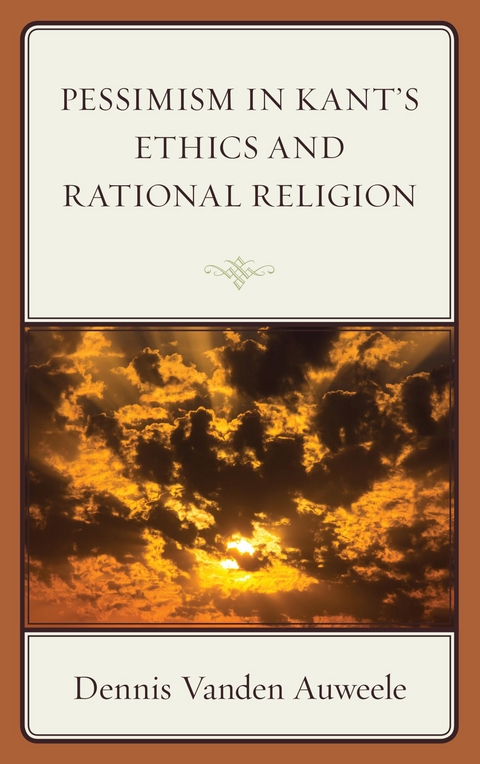
Pessimism in Kant's Ethics and Rational Religion (eBook)
246 Seiten
Lexington Books (Verlag)
978-1-4985-8040-3 (ISBN)
The historical period of the Enlightenment is usually thought of as the high point of philosophical optimism. By breaking the chains of traditional heteronomous morality, the tutelage of dogmatic religion and the oppression of authoritarian politics, the Enlightenment created the space for a new, self-critical and autonomous frame of reference for human effort. Immanuel Kant is undoubtedly the greatest philosopher in the German Enlightenment. And Kant was a pessimist? In this book, the author explores Kant's moral and religious philosophy and shows that a pessimistic undercurrent pervades these. This provides a new vantage point not only to assess comprehensively Kantian philosophy but also to provide much needed context and reading assistance to the general premises of Kant's philosophy of autonomy and rationality. For Kant, to be autonomous and rational is not something human nature naturally pursues; instead, reason but must reframe, rethink and reshape human nature. Human nature is a problem, autonomy and rationality are the solution. Kant's subsequent attempts to establish a rational religion can be explained in extension of this problem. Since human beings are not naturally prone to act autonomously, they have to be educated through historical institutions that are reformed appropriately so as to provide the incentives for human beings to become autonomous. This is where Kant believed religion could play an important pedagogical function.
Dennis Vanden Auweele is postdoctoral researcher at the Institute for Philosophy of KU Leuven.
Chapter 1: Pessimism, Theodicy and The Protestant FactorChapter 2: Grounding Morality in Duty and AutonomyChapter 3: Motivating Morality by RespectChapter 4: Natural (In)Aptitude for MoralityInterlude: The Problem of Moral MotivationChapter 5: Religious Assistance through Moral EducationChapter 6: Kantian Christianity, Sincerity and PessimismConclusion: Where does a Kantian pessimism lead?
| Erscheint lt. Verlag | 5.11.2018 |
|---|---|
| Sprache | englisch |
| Themenwelt | Geisteswissenschaften ► Philosophie ► Allgemeines / Lexika |
| Geisteswissenschaften ► Religion / Theologie | |
| Schlagworte | Christianity • Enlightenment • Ethical Theory • existential pessimism • German Enlightenment • Königsberg • Moral Community • Moral Education • moral law • Moral Philosophy • Nietzsche • optimism • pessimism • Philosophical Anthropology • Philosophy of History • Philosophy of Religion • pietism • Rational religion • Schopenhauer • Soteriology • Systematic Theology • Theology • Wöllner |
| ISBN-10 | 1-4985-8040-8 / 1498580408 |
| ISBN-13 | 978-1-4985-8040-3 / 9781498580403 |
| Informationen gemäß Produktsicherheitsverordnung (GPSR) | |
| Haben Sie eine Frage zum Produkt? |
 EPUB (Adobe DRM)
Kopierschutz: Adobe-DRM
Adobe-DRM ist ein Kopierschutz, der das eBook vor Mißbrauch schützen soll. Dabei wird das eBook bereits beim Download auf Ihre persönliche Adobe-ID autorisiert. Lesen können Sie das eBook dann nur auf den Geräten, welche ebenfalls auf Ihre Adobe-ID registriert sind.
Details zum Adobe-DRM
Dateiformat: EPUB (Electronic Publication)
EPUB ist ein offener Standard für eBooks und eignet sich besonders zur Darstellung von Belletristik und Sachbüchern. Der Fließtext wird dynamisch an die Display- und Schriftgröße angepasst. Auch für mobile Lesegeräte ist EPUB daher gut geeignet.
Systemvoraussetzungen:
PC/Mac: Mit einem PC oder Mac können Sie dieses eBook lesen. Sie benötigen eine
eReader: Dieses eBook kann mit (fast) allen eBook-Readern gelesen werden. Mit dem amazon-Kindle ist es aber nicht kompatibel.
Smartphone/Tablet: Egal ob Apple oder Android, dieses eBook können Sie lesen. Sie benötigen eine
Geräteliste und zusätzliche Hinweise
Buying eBooks from abroad
For tax law reasons we can sell eBooks just within Germany and Switzerland. Regrettably we cannot fulfill eBook-orders from other countries.
aus dem Bereich