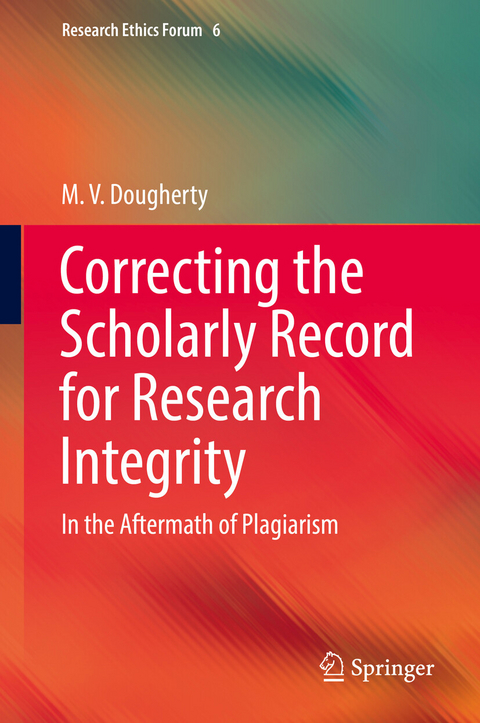
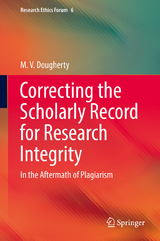
Correcting the Scholarly Record for Research Integrity (eBook)
XV, 248 Seiten
Springer International Publishing (Verlag)
978-3-319-99435-2 (ISBN)
M. V. Dougherty is the Sr. Ruth Caspar Chair in Philosophy at Ohio Dominican University (USA). He is author of Moral Dilemmas in Medieval Thought: From Gratian to Aquinas (Cambridge University Press, 2011) and has edited Aquinas's 'Disputed Questions on Evil': A Critical Guide (Cambridge University Press, 2016) and Pico della Mirandola: New Essays (Cambridge University Press, 2008). He has authored and co-authored articles on academic plagiarism, and his research interests include the history of ethics and research ethics. Since 2009, he has been involved in securing dozens of retractions, errata, and corrigenda for published articles in the discipline of philosophy and in related fields. His work in generating corrections for academic plagiarism and other authorship violations has been featured on Retraction Watch and on other academic news outlets.
M. V. Dougherty is the Sr. Ruth Caspar Chair in Philosophy at Ohio Dominican University (USA). He is author of Moral Dilemmas in Medieval Thought: From Gratian to Aquinas (Cambridge University Press, 2011) and has edited Aquinas’s ‘Disputed Questions on Evil’: A Critical Guide (Cambridge University Press, 2016) and Pico della Mirandola: New Essays (Cambridge University Press, 2008). He has authored and co-authored articles on academic plagiarism, and his research interests include the history of ethics and research ethics. Since 2009, he has been involved in securing dozens of retractions, errata, and corrigenda for published articles in the discipline of philosophy and in related fields. His work in generating corrections for academic plagiarism and other authorship violations has been featured on Retraction Watch and on other academic news outlets.
PrefaceIntroductionCorrecting the Scholarly RecordThe Integrity of AuthorshipPre-Publication and Post-Publication Responses to PlagiarismThe Purpose of Academic PublishingA Précis of ChaptersReferences1. Defining the Scholarly Record1.1 The Limits of the Scholarly Record1.1.1 The Knowledge Condition1.1.2 The Authorship Condition1.1.3 The Publication Condition1.1.4 The Library and the Database Conditions1.1.5 The Discipline Condition1.2 Works at the Margin of the Scholarly Record1.3 The Scholarly Record in Transition1.4 The Identity of Items of the Scholarly Record1.5 A Definable Scholarly RecordReferences2. What is Academic Plagiarism?2.1 2.1. Identifying Academic Plagiarism2.1.1 Appropriation2.1.2 Non-Triviality2.1.3 Inadequate Credit2.1.4 An Appearance of Original Authorship2.1.5 A Discrete Item of the Scholarly Record2.2 The Intent to Plagiarize2.3 Self-Plagiarism2.4 Euphemisms for Academic Plagiarism2.5 Plagiarism vs. Copyright Infringement2.6 Statutes of Limitation for Plagiarism2.7 In SumReferences3. A Test Case for Published Corrections: The Discipline of Philosophy3.1 Classifying Responses to Plagiarism3.2 Issuing a Statement of Concern3.3 Issuing a Statement of Retraction (SR)3.3.1 Maximal and Minimal Statements of Retraction3.3.2 Paywalled SRs and Untethered SRs3.3.3 SRs with University Support3.3.4 Academic Editors and Independent SRs3.3.5 Problems with Minimal and Medial SRs3.4 Reprinting a Volume After the Removal of Plagiarized Material3.5 Halting the Sale of the Plagiarized Material3.6 Taking No Public Action3.7 Conclusion3.7.1 Table 13.7.2 Table 23.7.3 Table 3References4. Academic Whistleblowing4.1 The Whistleblowing Dilemma4.2 To Whom Can One Blow the Academic Whistle?4.2.1 Whistleblowing Directly to the Suspected Plagiarist4.2.2 Whistleblowing in a Post-Publication Review Venue4.2.3 Whistleblowing to a Journal or Volume Editor4.2.4 Whistleblowing to a Publisher4.2.5 Whistleblowing to a University Research Integrity Office4.2.6 Whistleblowing to a Grant Agency4.2.7 Whistleblowing to a Journalist or News Agency4.2.8 Whistleblowing to the Genuine Authors4.3 Multi-Targeted Whistleblowing4.4 How will the Whistleblowing Impact the Academic Whistleblower?4.5 What Might Whistleblower Harassment and Academic Witness Intimidation Look Like?4.5.1 The National Grant Agency4.5.2 Journal Editors4.5.3 Research Integrity Offices4.6 Conclusion4.7 Appendix: Sample Letters for Requesting Corrections of the Scholarly Record4.7.1 Sample of Letter Requesting a Retraction4.7.2 Sample of Letter Requesting a Corrigendum4.7.3 Sample of Letter Requesting a Clarification of AuthorshipReferences5. Publishing Corrections of the Scholarly Record: Some Test Cases5.1 Disambiguating Retractions, Errata, and Corrigenda5.2 Case 1: Proceedings from the International Semiotics Institute5.3 Case 2: Subject Matters: A Journal of Communications and the Self5.4 Case 3: John Benjamins Publishing Company5.5 Case 4: The Catholic University of America Press5.6 Cases 5 and 6: Argumentation5.7 Case 7: Swiss Medical Weekly5.8 Cases 8 and 9: Brill Publishing5.9 Cases 10 and 11: Studies in Communication Sciences5.10 Case 12: Patient Education and Counseling5.11 Case 13: Science | Environment | Health5.12 Case 14: Journal of Communication in Healthcare5.13 Ten Corrections of the Scholarly Record5.14 Using the Correct Tools for Correction5.15 Responsibility for the Scholarly RecordReferences6. Contested Authorship, Self-Plagiarism, and the Scholarly Record6.1 A Discredited Technique6.2 Disability Studies Quarterly6.2.1 The First Request for a Statement of Retraction6.2.2 The Second Request for a Statement of Retraction6.2.3 The Retraction6.3 Cambridge University Press6.3.1 The Request for Retraction6.4 An AnalogyReferencesConclusion: Beyond the Published RetractionThe Database ProblemThe Anthology ProblemThe Platform ProblemThe Repository ProblemThe Pretend-It-Didn’t-Happen ProblemA Partial AnswerInformal Corrections of the Scholarly RecordAdditional Disclosures of Corrections of the Scholarly RecordSolutionsThe Future of the Scholarly RecordReferencesIndex
| Erscheint lt. Verlag | 9.11.2018 |
|---|---|
| Reihe/Serie | Research Ethics Forum | Research Ethics Forum |
| Zusatzinfo | XV, 248 p. 5 illus. |
| Verlagsort | Cham |
| Sprache | englisch |
| Themenwelt | Geisteswissenschaften ► Philosophie ► Allgemeines / Lexika |
| Geisteswissenschaften ► Sprach- / Literaturwissenschaft | |
| Schlagworte | academic plagiarism • academic whistleblowing • authentic research • consequences of plagiarism • contested authorship • duplication of published research • research ethics • scholarly record for research integrity • Self-Plagiarism • the scholarly record • what is academic plagiarism? |
| ISBN-10 | 3-319-99435-2 / 3319994352 |
| ISBN-13 | 978-3-319-99435-2 / 9783319994352 |
| Informationen gemäß Produktsicherheitsverordnung (GPSR) | |
| Haben Sie eine Frage zum Produkt? |
 PDF (Wasserzeichen)
DRM: Digitales Wasserzeichen
Dieses eBook enthält ein digitales Wasserzeichen und ist damit für Sie personalisiert. Bei einer missbräuchlichen Weitergabe des eBooks an Dritte ist eine Rückverfolgung an die Quelle möglich.
Dateiformat: PDF (Portable Document Format)
Mit einem festen Seitenlayout eignet sich die PDF besonders für Fachbücher mit Spalten, Tabellen und Abbildungen. Eine PDF kann auf fast allen Geräten angezeigt werden, ist aber für kleine Displays (Smartphone, eReader) nur eingeschränkt geeignet.
Systemvoraussetzungen:
PC/Mac: Mit einem PC oder Mac können Sie dieses eBook lesen. Sie benötigen dafür einen PDF-Viewer - z.B. den Adobe Reader oder Adobe Digital Editions.
eReader: Dieses eBook kann mit (fast) allen eBook-Readern gelesen werden. Mit dem amazon-Kindle ist es aber nicht kompatibel.
Smartphone/Tablet: Egal ob Apple oder Android, dieses eBook können Sie lesen. Sie benötigen dafür einen PDF-Viewer - z.B. die kostenlose Adobe Digital Editions-App.
Buying eBooks from abroad
For tax law reasons we can sell eBooks just within Germany and Switzerland. Regrettably we cannot fulfill eBook-orders from other countries.
aus dem Bereich