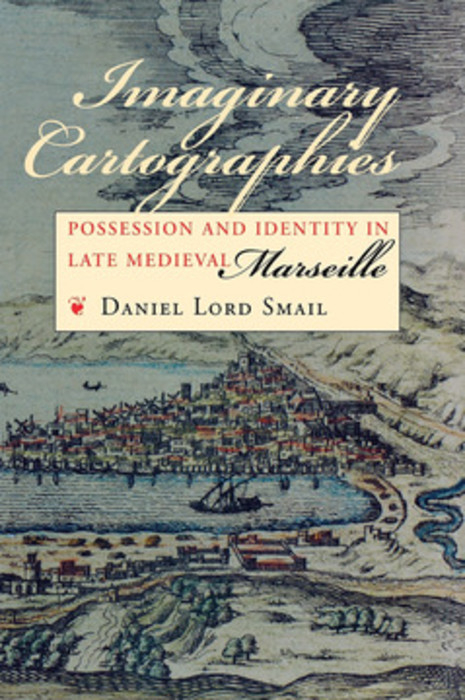
Imaginary Cartographies (eBook)
280 Seiten
Cornell University Press (Verlag)
9781501718090 (ISBN)
How, in the years before the advent of urban maps, did city residents conceptualize and navigate their communities? In his strikingly original book, Daniel Lord Smail develops a new method and a new vocabulary for understanding how urban men and women thought about their personal geography. His thorough research of property records of late medieval Marseille leads him to conclude that its inhabitants charted their city, its social structure, and their own identities within that structure through a set of cartographic grammars which powerfully shaped their lives.Prior to the fourteenth century, different interest groups-notaries, royal officials, church officials, artisans-developed their own cartographies in accordance with their own social, political, or administrative agendas. These competing templates were created around units ranging from streets and islands to vicinities and landmarks. Smail shows how the notarial template, which privileged the street as the most basic marker of address, gradually emerged as the cartographic norm. This transformation, he argues, led to the rise of modern urban maps and helped to inaugurate the process whereby street addresses were attached to citizen identities, a crucial development in the larger enterprise of nation building.Imaginary Cartographies opens up powerful new means for exploring late medieval and Renaissance urban society while advancing understanding of the role of social perceptions in history.
SmailDaniel Lord:
Daniel Lord Smail is the author of Imaginary Cartographies: Possession and Identity in Late Medieval Marseille, also from Cornell, winner of the American History Association's Herbert Baxter Adams prize.
How, in the years before the advent of urban maps, did city residents conceptualize and navigate their communities? In his strikingly original book, Daniel Lord Smail develops a new method and a new vocabulary for understanding how urban men and women thought about their personal geography. His thorough research of property records of late medieval Marseille leads him to conclude that its inhabitants charted their city, its social structure, and their own identities within that structure through a set of cartographic grammars which powerfully shaped their lives.Prior to the fourteenth century, different interest groups-notaries, royal officials, church officials, artisans-developed their own cartographies in accordance with their own social, political, or administrative agendas. These competing templates were created around units ranging from streets and islands to vicinities and landmarks. Smail shows how the notarial template, which privileged the street as the most basic marker of address, gradually emerged as the cartographic norm. This transformation, he argues, led to the rise of modern urban maps and helped to inaugurate the process whereby street addresses were attached to citizen identities, a crucial development in the larger enterprise of nation building.Imaginary Cartographies opens up powerful new means for exploring late medieval and Renaissance urban society while advancing understanding of the role of social perceptions in history.
| Erscheint lt. Verlag | 18.10.2018 |
|---|---|
| Sprache | englisch |
| Themenwelt | Geschichte ► Allgemeine Geschichte ► Mittelalter |
| Geschichte ► Allgemeine Geschichte ► Neuzeit (bis 1918) | |
| Geisteswissenschaften ► Geschichte ► Regional- / Ländergeschichte | |
| Geschichte ► Teilgebiete der Geschichte ► Kulturgeschichte | |
| Naturwissenschaften ► Geowissenschaften ► Geografie / Kartografie | |
| Sozialwissenschaften ► Soziologie | |
| ISBN-13 | 9781501718090 / 9781501718090 |
| Informationen gemäß Produktsicherheitsverordnung (GPSR) | |
| Haben Sie eine Frage zum Produkt? |
 PDF (Adobe DRM)
Kopierschutz: Adobe-DRM
Adobe-DRM ist ein Kopierschutz, der das eBook vor Mißbrauch schützen soll. Dabei wird das eBook bereits beim Download auf Ihre persönliche Adobe-ID autorisiert. Lesen können Sie das eBook dann nur auf den Geräten, welche ebenfalls auf Ihre Adobe-ID registriert sind.
Details zum Adobe-DRM
Dateiformat: PDF (Portable Document Format)
Mit einem festen Seitenlayout eignet sich die PDF besonders für Fachbücher mit Spalten, Tabellen und Abbildungen. Eine PDF kann auf fast allen Geräten angezeigt werden, ist aber für kleine Displays (Smartphone, eReader) nur eingeschränkt geeignet.
Systemvoraussetzungen:
PC/Mac: Mit einem PC oder Mac können Sie dieses eBook lesen. Sie benötigen eine
eReader: Dieses eBook kann mit (fast) allen eBook-Readern gelesen werden. Mit dem amazon-Kindle ist es aber nicht kompatibel.
Smartphone/Tablet: Egal ob Apple oder Android, dieses eBook können Sie lesen. Sie benötigen eine
Geräteliste und zusätzliche Hinweise
Buying eBooks from abroad
For tax law reasons we can sell eBooks just within Germany and Switzerland. Regrettably we cannot fulfill eBook-orders from other countries.
aus dem Bereich