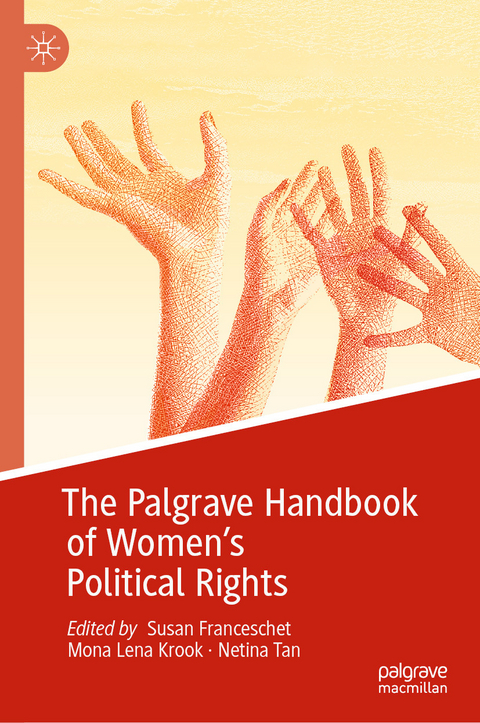
The Palgrave Handbook of Women’s Political Rights (eBook)
XXIII, 758 Seiten
Palgrave Macmillan UK (Verlag)
978-1-137-59074-9 (ISBN)
This Palgrave Handbook provides a definitive account of women's political rights across all major regions of the world, focusing both on women's right to vote and women's right to run for political office. This dual focus makes this the first book to combine historical overviews of debates about enfranchising women alongside analyses of more contemporary efforts to increase women's political representation around the globe. Chapter authors map and assess the impact of these groundbreaking reforms, providing insight into these dynamics in a wide array of countries where women's suffrage and representation have taken different paths and led to varying degrees of transformation. On the eve of many countries celebrating a century of women's suffrage, as well as record numbers of women elected and appointed to political office, this timely volume offers an important introduction to ongoing developments related to women's political empowerment worldwide. It will be of interest to students and scholars across the fields of gender and politics, women's studies, history and sociology.
Susan Franceschet is Professor of Political Science at the University of Calgary, Canada. She is the author of Women and Politics in Chile (2005) and co-editor of The Impact of Gender Quotas (with M. L. Krook and J. M. Piscopo, 2012). She has published extensively on women's political representation and political institutions in comparative perspective.
Mona Lena Krook is Professor of Political Science at Rutgers University, USA. She is the author of Quotas for Women in Politics (2009), as well as numerous articles on gender quotas, women's political representation, and violence against women in politics.
Netina Tan is Assistant Professor of Political Science at McMaster University, Canada. Her dissertation, Hegemonic Party Rule in Singapore and Taiwan, won the 2011 Vincent Lemieux Prize for the best Ph.D. thesis in Canada. She has authored numerous articles on authoritarian resilience and representation of women and ethnic minorities in Asia.
This Palgrave Handbook provides a definitive account of women's political rights across all major regions of the world, focusing both on women's right to vote and women's right to run for political office. This dual focus makes this the first book to combine historical overviews of debates about enfranchising women alongside analyses of more contemporary efforts to increase women's political representation around the globe. Chapter authors map and assess the impact of these groundbreaking reforms, providing insight into these dynamics in a wide array of countries where women's suffrage and representation have taken different paths and led to varying degrees of transformation. On the eve of many countries celebrating a century of women's suffrage, as well as record numbers of women elected and appointed to political office, this timely volume offers an important introduction to ongoing developments related to women's political empowerment worldwide. It will be of interest to studentsand scholars across the fields of gender and politics, women's studies, history and sociology.
Susan Franceschet is Professor of Political Science at the University of Calgary, Canada. She is the author of Women and Politics in Chile (2005) and co-editor of The Impact of Gender Quotas (with M. L. Krook and J. M. Piscopo, 2012). She has published extensively on women’s political representation and political institutions in comparative perspective.Mona Lena Krook is Professor of Political Science at Rutgers University, USA. She is the author of Quotas for Women in Politics (2009), as well as numerous articles on gender quotas, women's political representation, and violence against women in politics.Netina Tan is Assistant Professor of Political Science at McMaster University, Canada. Her dissertation, Hegemonic Party Rule in Singapore and Taiwan, won the 2011 Vincent Lemieux Prize for the best Ph.D. thesis in Canada. She has authored numerous articles on authoritarian resilience and representation of women and ethnic minorities in Asia.
TABLE OF CONTENTS
Preface
PART I: THEORIES AND CONCEPTS
Chapter 1: Global Patterns and Debates in the Granting of Women’s Suffrage (Ann Towns)
Chapter 2: Gender and Electoral Behavior (Miki Kittilson)
Chapter 3: The Political Representation of Women Over Time (Melanie M. Hughes and Pamela Paxton)
Chapter 4: The Impact of Women in Parliament (Jennifer M. Piscopo and Diana Z. O’Brien)
Chapter 5: New Horizons in Women’s Political Rights (Mona Lena Krook)
Part II: SUFFRAGE AND POLITICAL PARTICIPATION
Latin America and the Caribbean
Chapter 6: Chile: Women’s Suffrage and Political Participation, 1935–2015 (Ricardo Gamboa and Miguel Angel López)
Chapter 7: Colombia: Civil Conflict, Violence, and Women’s Political Participation (Juliana Restrepo Sanín)
Chapter 8: Mexico: The Long Road to Women’s Suffrage (Gabriela Cano)
West Europe, North America, and Australasia
Chapter 9: New Zealand: A Country of Firsts in Women’s Political Rights (Jennifer Curtin)
Chapter 10: Finland: Suffrage, Nation, and Political Mobilization (Irma Sulkunen)
Chapter 11: Switzerland: Direct Democracy and Women’s Political Participation (Anouk Lloren)
Chapter 12: Canada: Uneven Paths to Suffrage and Women’s Electoral Participation (Nancy Janovicek and Melanee Thomas)
Middle East and North Africa
Chapter 13: Afghanistan: Uphill Challenges for Women’s Political Rights (Andrea Fleschenberg)
Chapter 14: Kuwait: Why Did Women’s Suffrage Take So Long? (Meriem Aissa)
Chapter 15: Morocco: Ongoing Struggle for More Representation (Katja Zvan-Elliot)
Chapter 16: Turkey: From Symbols to Actors in the Struggle for Political Rights (Marella Bodur Ün)
Sub-Saharan Africa
Chapter 17: Kenya: Women’s Suffrage and Political Participation as Voters (Mi Yung Yoon and Christol Okeke)
Chapter 18: Nigeria: Women’s Suffrage, Change, and Continuities in Political Participation (Chiedo Nwankwor)
Chapter 19: Cameroon: Early Mobilization and Limited Impact of Women’s Suffrage (Melinda Adams)
Chapter 20: Zimbabwe: Women’s Mass Movement and Violence (Barbara Rudo Gaidzanwa)
East, Southeast, and South Asia
Chapter 21: China: Women’s Political Rights Advocacy (Kimberly Manning)
Chapter 22: Indonesia: Local Advocacy for Suffrage (Kurniawati Hastuti Dewi)
Chapter 23: Malaysia: Middle-Equality Trap (Bridget Welsh)
Chapter 24: Sri Lanka: Struggle for Franchise (Malathi de Alwis and Chulani Kodikar)
Easter and Central Europe, Central Asia, and Post-Soviet Republics
Chapter 25: Czech Republic: Nationalism, Suffrage, and Political Participation (Dana Musilová)
Chapter 26: Russia: The Great War and Women’s Political Rights (Rochelle Goldberg Ruthchild)
PART III: ELIGIBILITY AND POLITICAL REPRESENTATION
Latin America and the Caribbean
Chapter 27: Bolivia: Parity, Empowerment, and Institutional Change (Stéphanie Rousseau)
Chapter 28: Cuba: Women’s Complicated Political Participation and Representation (Lana Wylie and Sarah Shoker)
Chapter 29: Uruguay: Slow Progress in Women’s Political Representation (Niki Johnson)
Western Europe, North America, and Australasia
Chapter 30: United States: Gendered Institutions, Processes, and Outcomes (Kelly Dittmar)
Chapter 31: Sweden: An Incremental Process (Lenita Freidenvall)
Chapter 32: France: The Republic Tested by Parity (Rejane Sénac)
Chapter 33: Australia: Uneven Progress toward Equality in Women’s Political Rights (Joy McCann and Marian Sawer)
Middle East and North Africa
Chapter 34: Jordan: Quotas and Change in Women’s Political Representation (Sarah Bush)
Chapter 35: Tunisia: Changing Patterns of Women’s Representation (Lindsay Benstead)
Chapter 36: Israel: A Century of Political Involvement (Reut Itzkovitch Malka and Chen Friedberg)
Chapter 37: Mauritius: Still a Long Journey Ahead (Ramola Ramtohul)
Sub-Saharan Africa
Chapter 38: Rwanda: Women’s Political Representation and Its Consequences (Jennie E. Burnet)
Chapter 39: Uganda: Achievements and Challenges for Women in Elected Office (Aili Mari Tripp)
Chapter 40: Niger: Patterns of Women’s Political Presence Since Independence (Alice Kang)
Chapter 41: Ghana: Stalled Patterns of Women’s Parliamentary Representation (Gretchen Bauer)
East, Southeast, and South Asia
Chapter 42: South Korea: Women’s Political Representation (Young-Im Lee)
Chapter 43: Taiwan: Asia’s Exception (Chang-Ling Huang)
Chapter 44: Myanmar: Women’s Political Life (Paul Minoletti)
Chapter 45: India: A Contradictory Record (Francesca Refsum Jensenius)
Eastern and Central Europe, Central Asia, and Post-Soviet Republics
Chapter 46: Poland: Regime Transformation and Women’s Political Representation (Małgorzata Fuszara)
Chapter 47: Slovenia: From Socialist Legacies to Legislative Gender Quotas (Milica Antić Gaber)
Chapter 48: Mongolia: Transformation of Women’s Representation (Pavel Maskarinec)
Chapter 49: Armenia: Persistent Gender Stereotypes (Kristin Cavoukia and Nona Shahnazarian)
| Erscheint lt. Verlag | 26.10.2018 |
|---|---|
| Reihe/Serie | Gender and Politics | Gender and Politics |
| Zusatzinfo | XXIII, 758 p. 20 illus., 4 illus. in color. |
| Verlagsort | London |
| Sprache | englisch |
| Themenwelt | Geschichte ► Teilgebiete der Geschichte ► Kulturgeschichte |
| Sozialwissenschaften ► Politik / Verwaltung ► Politische Systeme | |
| Sozialwissenschaften ► Politik / Verwaltung ► Vergleichende Politikwissenschaften | |
| Sozialwissenschaften ► Soziologie ► Gender Studies | |
| Schlagworte | comparative gender politics • Democracy • development of women's rights • enfranchisement of women • female political representation • gender and political leadership • global gender studies • history of women's suffrage • international women's politics • political engagement and gender • political participation and gender • women in government • women in parliament • women in political office • women's political empowerment • Women's political rights • women's right to run for office • women's right to vote |
| ISBN-10 | 1-137-59074-2 / 1137590742 |
| ISBN-13 | 978-1-137-59074-9 / 9781137590749 |
| Informationen gemäß Produktsicherheitsverordnung (GPSR) | |
| Haben Sie eine Frage zum Produkt? |
 PDF (Wasserzeichen)
DRM: Digitales Wasserzeichen
Dieses eBook enthält ein digitales Wasserzeichen und ist damit für Sie personalisiert. Bei einer missbräuchlichen Weitergabe des eBooks an Dritte ist eine Rückverfolgung an die Quelle möglich.
Dateiformat: PDF (Portable Document Format)
Mit einem festen Seitenlayout eignet sich die PDF besonders für Fachbücher mit Spalten, Tabellen und Abbildungen. Eine PDF kann auf fast allen Geräten angezeigt werden, ist aber für kleine Displays (Smartphone, eReader) nur eingeschränkt geeignet.
Systemvoraussetzungen:
PC/Mac: Mit einem PC oder Mac können Sie dieses eBook lesen. Sie benötigen dafür einen PDF-Viewer - z.B. den Adobe Reader oder Adobe Digital Editions.
eReader: Dieses eBook kann mit (fast) allen eBook-Readern gelesen werden. Mit dem amazon-Kindle ist es aber nicht kompatibel.
Smartphone/Tablet: Egal ob Apple oder Android, dieses eBook können Sie lesen. Sie benötigen dafür einen PDF-Viewer - z.B. die kostenlose Adobe Digital Editions-App.
Buying eBooks from abroad
For tax law reasons we can sell eBooks just within Germany and Switzerland. Regrettably we cannot fulfill eBook-orders from other countries.
aus dem Bereich