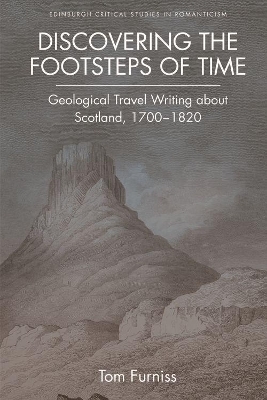
Discovering the Footsteps of Time
Edinburgh University Press (Verlag)
978-1-4744-5247-2 (ISBN)
Discovering the Footsteps of Time probes the development of a distinctively Scottish tradition of geological travel writing from the seventeenth to early nineteenth century. The tradition tracks a fertile interaction of scientific and aesthetic themes, mediated through literary techniques, which highlights the emergence of ‘Romanticism’ as such; a distinctive, recognisable cultural movement of taste and style. Making an important new contribution to our understanding of the ‘discovery’ and representation of Scotland in the long eighteenth century, the book explores why Scotland’s topography has been decisive in the history of geology to such a great extent. Written by a literary academic rather than a geologist, the book is as much concerned with textual strategies and the aesthetic experience of geological discovery as with geology itself.
Key Features
Adds to our understanding of the ‘discovery of Scotland’ in the 18th and early 19th century, developing a new account of the literary, aesthetic and geological meanings of ‘the land of mountain and flood’ in the period Offers new insights about James Hutton’s geological theory by attending to his geological travel writing about Scotland, and also locates Hutton’s work within wider geological debates in and about ScotlandBuilds on previous work on the literariness of scientific writing in the ‘second scientific revolution’Contributes to research on ‘Romantic Scotland’ and on the transition from Enlightenment to Romantic scientific travel writing
Tom Furniss is Senior Lecturer in the Department of English at the University of Strathclyde. He has published widely on literature, philosophy, travel writing and geology of the eighteenth century and Romantic periods. He is the author of Edmund Burke’s Aesthetic Ideology: Language, Gender and Political Economy in Revolution (CUP, 1993).
1. Introduction; 2. Natural History, Travel, and Early Explorations of Scotland’s Natural History; 3. John Walker’s ‘Report on the Hebrides’ (1764-1771); 4. A Country Torn and Convulsed: Pioneering Geological Observations in Thomas Pennant’s Tours of Scotland (1769, 1772); 5. Astonishing Productions of Volcanic Combustion: Barthélemy Faujas de Saint-Fond’s Travels in England, Scotland, and the Hebrides (1784, 1799); 6. James Hutton’s Geological Tours of Scotland (1764-1788); 7. Natural History Among the Mountains of a Wild Country: Robert Jameson on Arran, 1797 and 1799; 8. The End of Romantic Geology in Scotland? John MacCulloch’s A Description of the Western Islands of Scotland (1819); References; Index.
| Erscheinungsdatum | 29.08.2019 |
|---|---|
| Reihe/Serie | Edinburgh Critical Studies in Romanticism |
| Zusatzinfo | 20 black and white illustrations |
| Verlagsort | Edinburgh |
| Sprache | englisch |
| Maße | 156 x 234 mm |
| Gewicht | 485 g |
| Themenwelt | Literatur ► Biografien / Erfahrungsberichte |
| Literatur ► Essays / Feuilleton | |
| Geisteswissenschaften ► Geschichte ► Allgemeine Geschichte | |
| Geisteswissenschaften ► Geschichte ► Regional- / Ländergeschichte | |
| Geisteswissenschaften ► Sprach- / Literaturwissenschaft ► Anglistik / Amerikanistik | |
| Geisteswissenschaften ► Sprach- / Literaturwissenschaft ► Literaturgeschichte | |
| Geisteswissenschaften ► Sprach- / Literaturwissenschaft ► Literaturwissenschaft | |
| ISBN-10 | 1-4744-5247-7 / 1474452477 |
| ISBN-13 | 978-1-4744-5247-2 / 9781474452472 |
| Zustand | Neuware |
| Informationen gemäß Produktsicherheitsverordnung (GPSR) | |
| Haben Sie eine Frage zum Produkt? |
aus dem Bereich