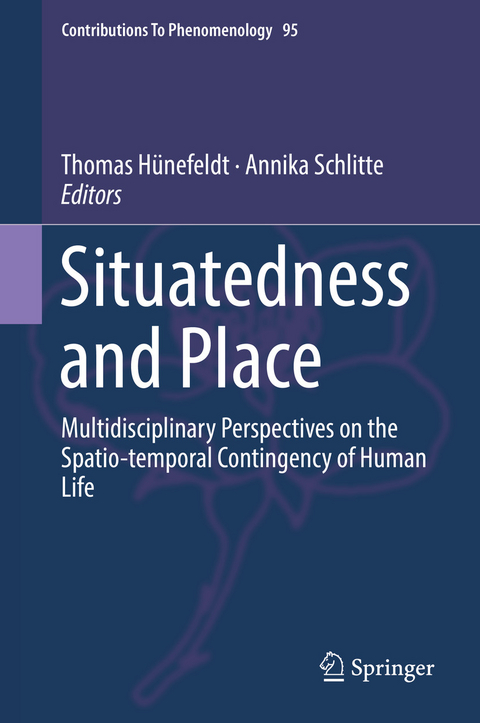
Situatedness and Place (eBook)
201 Seiten
Springer International Publishing (Verlag)
978-3-319-92937-8 (ISBN)
This book explores the ways in which the spatio-temporal contingency of human life is being conceived in different fields of research. Specifically, it looks at the relationship between the situatedness of human life, the situation or place in which human life is supposed to be situated, and the dimensions of space and time in which both situation and place are usually themselves supposed to be situated.
Over the last two or three decades, the spatio-temporal contingency of human life has become an important topic of research in a broad range of different disciplines including the social sciences, the cultural sciences, the cognitive sciences, and philosophy. However, this research topic is referred to in quite different ways: while some researchers refer to it in terms of “situation”, emphasizing the “situatedness” of human experience and action, others refer to it in terms of “place”, emphasizing the “power of place” and advocating a “topological” or “topographical turn”in the context of a larger “spatial turn”. Interdisciplinary exchange is so far hampered by the fact that the notions referred to and the relationships between them are usually not sufficiently questioned. This book addresses these issues by bringing together contributions on the spatio-temporal contingency of human life from different fields of research.
Thomas Hünefeldt, Ph.D. in Philosophy (Tübingen, 2002) and in Cognitive Psychology (Rome, 2008), is adjunct professor at the Sapienza University of Rome (Italy). From 2013-2016 he was postdoc research fellow at the Interdisciplinary Research Academy “Philosophy of Place” at the Catholic University of Eichstätt-Ingolstadt (Germany). Dr. Annika Schlitte,Ph.D. in philosophy (Bochum 2010), is junior professor for philosophy at Johannes Gutenberg University in Mainz (Germany). From 2011-2016 she was postdoc research fellow and speaker of the Interdisciplinary Research Academy “Philosophy of Place” at the Catholic University of Eichstätt-Ingolstadt (Germany).
1. Introduction: Situatedness and Place (Thomas Hünefeldt).- 2. Edges of Places (Edward Casey).- 3. Projecting Ourselves into Space: The Embodied Experience of Exploring Mars through Robotic Laboratories (William J. Clancey).- 4. Situating Interaction in Peripersonal and Extrapersonal Space: Phenomenology, Social Psychology and Neuroscience (Shaun Gallagher).- 5. Virtual Places as Real Places. About the Distinction Between Fiction and Interactive Virtual Reality (Tobias Holischka).- 6. The Situatedness of Cognition and the Place of the Mind (Thomas Hünefeldt).- 7. Place and Placedness (Jeff Malpas).- 8. Human-Immersion-in-Place: Phenomenology, Body-Subject, and Environmental Embodiment (David Seamon).- 9. Place, Position, Situation – Thinking with Helmuth Plessner (Annika Schlitte).- 10. A Sense of (Non)-Place: A Phenomenological Analysis (Dylan Trigg).- 11. Thinking in and out of Place (Barbara Tversky).- 12. Spatiality of Shared Intentionality and Language Universals: A Philosophical Reflection (Tsutomu Ben Yagi).
| Erscheint lt. Verlag | 23.10.2018 |
|---|---|
| Reihe/Serie | Contributions to Phenomenology | Contributions to Phenomenology |
| Zusatzinfo | X, 201 p. 19 illus. |
| Verlagsort | Cham |
| Sprache | englisch |
| Themenwelt | Geisteswissenschaften ► Philosophie ► Allgemeines / Lexika |
| Geisteswissenschaften ► Philosophie ► Erkenntnistheorie / Wissenschaftstheorie | |
| Geisteswissenschaften ► Psychologie ► Allgemeine Psychologie | |
| Schlagworte | cognitive science • Embodiment of Space • Extrapersonal Space • hermeneutics • Peripersonal Space • Philosophy of place • situated cognition • Spatio-temporal Contingency • topological turn • Virtual Reality |
| ISBN-10 | 3-319-92937-2 / 3319929372 |
| ISBN-13 | 978-3-319-92937-8 / 9783319929378 |
| Informationen gemäß Produktsicherheitsverordnung (GPSR) | |
| Haben Sie eine Frage zum Produkt? |
 PDF (Wasserzeichen)
DRM: Digitales Wasserzeichen
Dieses eBook enthält ein digitales Wasserzeichen und ist damit für Sie personalisiert. Bei einer missbräuchlichen Weitergabe des eBooks an Dritte ist eine Rückverfolgung an die Quelle möglich.
Dateiformat: PDF (Portable Document Format)
Mit einem festen Seitenlayout eignet sich die PDF besonders für Fachbücher mit Spalten, Tabellen und Abbildungen. Eine PDF kann auf fast allen Geräten angezeigt werden, ist aber für kleine Displays (Smartphone, eReader) nur eingeschränkt geeignet.
Systemvoraussetzungen:
PC/Mac: Mit einem PC oder Mac können Sie dieses eBook lesen. Sie benötigen dafür einen PDF-Viewer - z.B. den Adobe Reader oder Adobe Digital Editions.
eReader: Dieses eBook kann mit (fast) allen eBook-Readern gelesen werden. Mit dem amazon-Kindle ist es aber nicht kompatibel.
Smartphone/Tablet: Egal ob Apple oder Android, dieses eBook können Sie lesen. Sie benötigen dafür einen PDF-Viewer - z.B. die kostenlose Adobe Digital Editions-App.
Buying eBooks from abroad
For tax law reasons we can sell eBooks just within Germany and Switzerland. Regrettably we cannot fulfill eBook-orders from other countries.
aus dem Bereich