


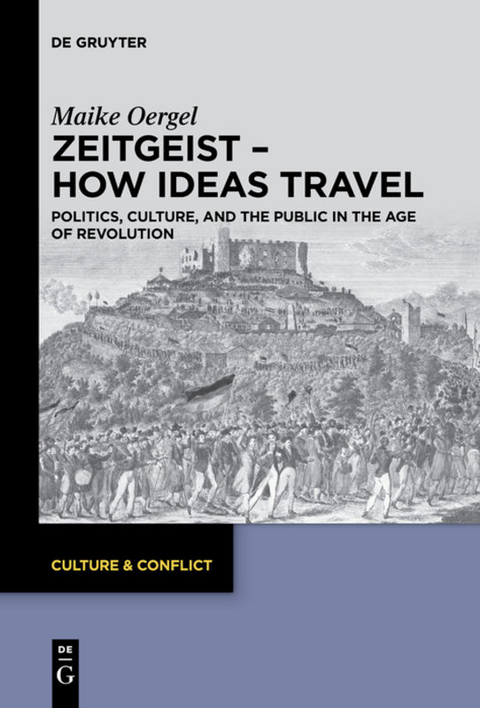
Zeitgeist – How Ideas Travel
Politics, Culture and the Public in the Age of Revolution
Seiten
2019
De Gruyter (Verlag)
978-3-11-063066-4 (ISBN)
De Gruyter (Verlag)
978-3-11-063066-4 (ISBN)
The series Culture and Conflict aims to promote a dynamic, pluridisciplinary dialogue meant to discuss the multiple ways in which conflict influences, supports or constrains the production of meaning in modernity. It publishes innovative original scholarship from the fields of literary and cultural studies as well as media, visual and film studies. Culture and conflict inevitably go together. The very idea of culture is marked by the notion of difference and creative, i.e., conflictual interaction. Differential markers, such as self and other, inside and outside, high and low, pure and dirty, old and new, support the key themes of the study of culture, e.g., identity and diversity, memory and trauma, translation of cultures and globalization, mediation and exclusion. The new series Culture and Conflict aims to promote a dynamic, pluridisciplinary dialogue meant to discuss the multiple ways in which conflict influences, supports or constrains the production of meaning in modernity. It publishes innovative original scholarship from the fields of literary and cultural studies as well as media, visual and film studies.
This book investigates the emergence of the modern concept of zeitgeist, the notion of a pervasive contemporary coherence, in the late 18th century. It traces zeitgeist’s descent from genius saeculi and investigates its association with public spirit and public opinion before surveying its prominence around the Wars of Liberation in Germany and during the politically restless 1820s in England. This trajectory shows that zeitgeist emerged from the 18th-century discourses about culture and the public functioning of social collectives. Under the impact of the French Revolution the term came to describe social processes of political and cultural challenge. Zeitgeist was discussed as a social dynamic in which emerging elites disseminate new ideas which find enough public approval to influence cultural and political behaviour and practice. These findings modify the view that zeitgeist eludes critical grasp and is mainly invoked for manipulative purposes by showing that the zeitgeist discussions around 1800 contributed to the formation of modern politics and capture key aspects of how ideas are disseminated within societies and across borders, providing a way of reading history horizontally.
This book investigates the emergence of the modern concept of zeitgeist, the notion of a pervasive contemporary coherence, in the late 18th century. It traces zeitgeist’s descent from genius saeculi and investigates its association with public spirit and public opinion before surveying its prominence around the Wars of Liberation in Germany and during the politically restless 1820s in England. This trajectory shows that zeitgeist emerged from the 18th-century discourses about culture and the public functioning of social collectives. Under the impact of the French Revolution the term came to describe social processes of political and cultural challenge. Zeitgeist was discussed as a social dynamic in which emerging elites disseminate new ideas which find enough public approval to influence cultural and political behaviour and practice. These findings modify the view that zeitgeist eludes critical grasp and is mainly invoked for manipulative purposes by showing that the zeitgeist discussions around 1800 contributed to the formation of modern politics and capture key aspects of how ideas are disseminated within societies and across borders, providing a way of reading history horizontally.
Maike Oergel, University of Nottingham, Nottingham, UK.
| Erscheinungsdatum | 19.03.2019 |
|---|---|
| Reihe/Serie | Culture & Conflict ; 13 |
| Zusatzinfo | 1 b/w ill. |
| Verlagsort | Berlin/Boston |
| Sprache | englisch |
| Maße | 155 x 230 mm |
| Gewicht | 642 g |
| Themenwelt | Geschichte ► Teilgebiete der Geschichte ► Kulturgeschichte |
| Schlagworte | 18th/19th Century • Cultural transfer • intellectual networks • intellectual networks, 18th/19th century • Public Opinion • public spirit • Zeitgeist |
| ISBN-10 | 3-11-063066-4 / 3110630664 |
| ISBN-13 | 978-3-11-063066-4 / 9783110630664 |
| Zustand | Neuware |
| Informationen gemäß Produktsicherheitsverordnung (GPSR) | |
| Haben Sie eine Frage zum Produkt? |
Mehr entdecken
aus dem Bereich


aus dem Bereich
Die Revolution des Gemeinen Mannes
Buch | Softcover (2024)
C.H.Beck (Verlag)
CHF 16,80
Eine Geschichte des Geschmacks
Buch | Hardcover (2025)
C.H.Beck (Verlag)
CHF 49,95


