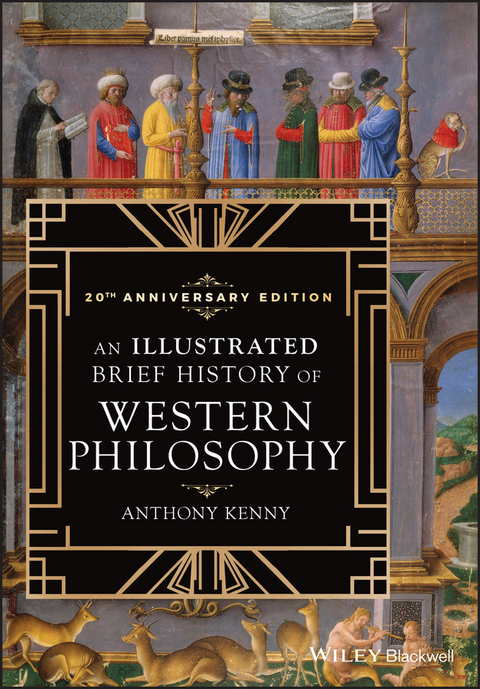
An Illustrated Brief History of Western Philosophy, 20th Anniversary Edition (eBook)
John Wiley & Sons (Verlag)
978-1-119-45280-5 (ISBN)
In 1998, the first edition of Anthony Kenny's comprehensive history of Western philosophy was published, to be met with immediate praise and critical acclaim. As the first book since Bertrand Russell's 1945 A History of Western Philosophy to offer a concise single-author review of the complete history of philosophy from the pre-Socratics to the modern masters of the 20th century, Kenny's work fills a critical gap in the modern philosophy reading list and offers valuable guidance for the general reader of philosophy-an ideal starting point for anyone with an interest in great thinkers and the family lines of philosophical evolution.
Widely considered to be one of the most thorough and accessible historical reviews in philosophy, An Illustrated Brief History of Western Philosophy has earned an estimable and distinctive reputation, both for the compelling writing style of Anthony Kenny, one of the most respected and accomplished living philosophers, and for the rich collection of paintings, illustrations, maps, and photos included with every chapter to complement this review of 2,500 years of philosophical thought.
Newly revised and expanded for a special 20th anniversary publication, the latest edition of An Illustrated Brief History of Western Philosophy contains all of Kenny's original writings on the history of Western philosophy from ancient to modern, along with new writings on the philosophy of the mid-20th century, covering important contributions from continental philosophers and philosophers of the post-Wittgenstein anglophone tradition, including the work of many women who have too often been neglected by the historical record.
ANTHONY KENNY has held many prestigious titles over the course of his career, including Master of Balliol College, Oxford; Warden of Rhodes House, Oxford; President of the British Academy; President of the Royal Institute of Philosophy; and Chair of the Board of the British Library. With over fifty books published in his career, his most recent works are The Enlightenment: A Very Short History (2017) and a memoir, Brief Encounters, to be published in September 2018.
In 1998, the first edition of Anthony Kenny's comprehensive history of Western philosophy was published, to be met with immediate praise and critical acclaim. As the first book since Bertrand Russell's 1945 A History of Western Philosophy to offer a concise single-author review of the complete history of philosophy from the pre-Socratics to the modern masters of the 20th century, Kenny's work fills a critical gap in the modern philosophy reading list and offers valuable guidance for the general reader of philosophy an ideal starting point for anyone with an interest in great thinkers and the family lines of philosophical evolution. Widely considered to be one of the most thorough and accessible historical reviews in philosophy, An Illustrated Brief History of Western Philosophy has earned an estimable and distinctive reputation, both for the compelling writing style of Anthony Kenny, one of the most respected and accomplished living philosophers, and for the rich collection of paintings, illustrations, maps, and photos included with every chapter to complement this review of 2,500 years of philosophical thought. Newly revised and expanded for a special 20th anniversary publication, the latest edition of An Illustrated Brief History of Western Philosophy contains all of Kenny's original writings on the history of Western philosophy from ancient to modern, along with new writings on the philosophy of the mid-20th century, covering important contributions from continental philosophers and philosophers of the post-Wittgenstein anglophone tradition, including the work of many women who have too often been neglected by the historical record.
ANTHONY KENNY has held many prestigious titles over the course of his career, including Master of Balliol College, Oxford; Warden of Rhodes House, Oxford; President of the British Academy; President of the Royal Institute of Philosophy; and Chair of the Board of the British Library. With over fifty books published in his career, his most recent works are The Enlightenment: A Very Short History (2017) and a memoir, Brief Encounters, to be published in September 2018.
Introduction
A person wondering whether to read a history of philosophy may reasonably wish to ascertain in advance what is the nature of the discipline whose history she is offered. However, it is by no means easy to give a plain and uncontentious answer to the question ‘what is philosophy?’
The word has meant different things at different times and in different cultures, and even at the present time it carries different connotations in different places. If you look at the shelves in a bookstore labelled ‘philosophy’ you will find books on self-help and on the environment, books containing advice on how to make yourself a better person and the world a better place. On the other hand, if you look at the lecture lists of a university philosophy faculty you will be invited to be instructed on such topics as the metaphysics of entanglement and to hear the answer to questions such as ‘Are there synthetic a priori propositions?’
Philosophy, as treated in the present book, will be conceived neither as broadly as in the bookstore definition nor as narrowly as in the faculty definition. But, sadly, it will only be after reading the book that the reader will understand exactly how I believe the term is to be understood.
But I can say at the outset that philosophy is simultaneously the most exciting and frustrating of subjects. It is exciting because it is the broadest of all disciplines, since it explores the basic concepts which run through all our talking and thinking. It is frustrating because its great generality makes it extremely difficult: not even the greatest philosophers have succeeded in reaching a complete and coherent understanding even of the language that we use to think our simplest thoughts. The man who is, as it were, the patron saint of philosophers, Socrates, claimed that the only way in which he surpassed others in wisdom was that he was aware of his own ignorance.
This may well seem a dispiriting introduction. The counterbalancing good news is that philosophy does not require any special preliminary training, and can be undertaken by anyone who is willing to think hard and follow a line of reasoning. In itself, it does not call for any mathematical skill or literary connoisseurship.
A first crude attempt to define the subject is to say that philosophy is what the great philosophers did. This is fairly watertight as an initial account: we would laugh out of court any definition of the philosopher that ruled out Plato and Aristotle. But the problem remains unsolved. Those two giants were not only philosophers – Plato was a magnificent dramatist, and Aristotle a pioneering scientist – and we have to make up our minds what parts or aspects of their works count as philosophy pure and simple.
The philosophy section in the bookstore will very likely be placed between the section on religion and the section on science. Throughout its history philosophy has been entwined with both these activities: it has marched through the ages in a central position with religion on its right hand and science on its left hand. In many areas of study philosophical thought grew out of religious reflection and grew into empirical science. Many issues which in the past were discussed by philosophers would nowadays be regarded as the province of science: the structure of matter and the history of the cosmos, for instance. But long before philosophers addressed these issues they were the topics of religious myths.
Religion, philosophy, and science all offer answers to fundamental questions, responses to the wonder which is the starting point of the human intellectual quest. Religion suggests answers by appealing to sacred texts regarded as revelations from a superhuman power; science provides answers by observation of, and experiment upon, the natural world. Philosophy has no sacred texts, and operates not by experience but by pure thought. In this it resembles mathematics, which is perhaps its closest kin in the family of intellectual disciplines.
It can be said that philosophy is the younger sister of religion, and the elder sister of science. In Greek and Hebrew culture mythical accounts of the origin and nature of the world preceded any scientific conjectures. In ancient Athens it was Plato who divorced philosophy from religion by his devastating criticism of the theology of the Homeric poems that were the nearest thing the Greeks had to a Bible. Aristotle, on the other hand, brought under the umbrella of philosophy a number of sciences, such as astronomy, cosmology, physics, and biology. But the one discipline that he claimed to have invented, namely logic, was, like philosophy, closer to mathematics than to science. And logic remained the partner of philosophy when the sciences had, in the course of history, set up house independently.
Aristotle made a distinction between practical sciences and theoretical sciences. What he meant by practical sciences were disciplines such as ethics and politics, which guide behaviour and teach us how to relate to each other. Such studies, we might say, belong on the right-hand side of philosophy, where its concerns overlap with those of religion. Theoretical sciences have no practical goal, but pursue truth for its own sake. Prominent among these is what he called ‘physics’, from the Greek word for nature. For centuries it bore the name ‘Natural Philosophy’, and it belongs on the left-hand side of philosophy, where it is concerned with the same objects as what we would nowadays call science.
It can indeed be said that Aristotle invented the concept of science as we understand it and as it has been understood since the Renaissance. First, he is the first person whose surviving works show detailed observations of natural phenomena. Secondly, he was the first philosopher to have a sound grasp of the relationship in scientific method between observation and theory. Thirdly, he identified and classified different scientific disciplines and explored their relationships to each other. Indeed, the very concept of a distinct discipline is due to him. Fourthly, he is the first professor to have organized his lectures into courses, and to have taken trouble over their appropriate place in a syllabus. Fifthly, he set up the first research institute of which we have any detailed knowledge, the Lyceum, in which a number of scholars and investigators joined in collaborative inquiry and documentation. Sixthly, and not least important, he was the first person in history to build up a research library – not simply a handful of books for his own bookshelf, but a systematic collection to be used by his colleagues and to be handed on to posterity.
Aristotle's contributions to practical philosophy, his treatises on ethics and politics, are still read today, and not just out of antiquarian interest. But his contributions to natural philosophy – physics, chemistry, biology, and physiology – have long ago been superseded. In the second century AD the medic Galen proved Aristotle wrong on a crucial point of physiology: it was the brain, and not the heart, that was the primary vehicle of human intellectual activity. In the sixth century an Aristotelian scholar called John Philoponus demolished his master's physics, denying Aristotle's account of motion and his thesis that the world had no beginning.
In late antiquity the most significant event for the history of philosophy was the advent, and eventual political triumph, of Christianity. A recent historian of philosophy, Anthony Gottlieb, describes its impact in terms of the tale of Sleeping Beauty. ‘Having pricked its finger on Christian theology, philosophy fell asleep for about a thousand years until awakened by the kiss of Descartes.’
Certainly, from the period when the Christian Emperor Justinian closed the schools of Athens in 529, philosophy was for many centuries subordinate to theology. Thinkers were no longer free to follow an argument wherever it led in accordance with the philosophical ideal held up long ago by Socrates. Henceforth, if an argument led to a conclusion in conflict with Christian doctrine, then it must be given up. But the relationship between philosophy and religion operated in both directions. The first great Christian philosopher, St Augustine, introduced a heavy dose of Platonic philosophy into a community that had begun as a Jewish sect. It must also be admitted that the religious strictures were not always harmful to philosophy. Philoponus' improvement upon Aristotle's physics was largely motivated by a desire to defend the Judeo-Christian doctrine of creation.
During the seventh and eighth centuries philosophy did go to sleep throughout Christendom, and its slumbers were hardly disturbed by the attempts of Charlemagne (crowned Holy Roman Emperor in 800) to revive the study of letters. The kiss that awoke it came from an unlikely quarter: from the realm of Islam which had spread from Arabia across Africa and southern Europe in the two centuries after the death of Muhammad in 633. In Islam as in Christendom philosophy was intertwined with religion in an embrace that was not always easy. The greatest Muslim philosopher of the period, Avicenna (980–1037), was anxious to ensure that his teachings did not come into conflict with the Koran, but his work was regarded as suspect by conservative mullahs.
During the ninth and tenth centuries it was Islam that kept alive the flame of Greek philosophy. It was not until the twelfth century that Aristotle's works were available in Latin, in translations that were sometimes from the original Greek and sometimes from Arabic versions. They...
| Erscheint lt. Verlag | 15.10.2018 |
|---|---|
| Sprache | englisch |
| Themenwelt | Geisteswissenschaften ► Philosophie ► Allgemeines / Lexika |
| Geisteswissenschaften ► Philosophie ► Geschichte der Philosophie | |
| Geisteswissenschaften ► Philosophie ► Philosophie der Neuzeit | |
| Schlagworte | American metaphysics • analytical ethics • Analytical Philosophy • ancient philosophers • anglophone philosophy • Aquinas • Aristotle • Augustine • Berkeley • continental philosophy in the early twentieth century • Darwin • Davidson • Descartes • E Ansecombe • Eduard Husserl • Einführungen in die Philosophie • famous philosophers • Frege • Freud • Geach • Geschichte • Geschichte der westlichen Philosophie • guide to history of western philosophy • Hegel • Henri Bergson • Historical Western Philosophy • History • history of western philosophy • History Special Topics • Hobbes • illustrated history of western philosophy • Introductions to Philosophy • Jacques Derrida • Jean Paul Sartre • Jesus • Jurgen Habermas • Kant • Logical Positivism • Machiavelli • Martin Heidegger • Marx • Mill • modern philosophers • Nietzsche • Philippa Foot • Philosophie • Philosophy • Plato • quine • Rawls • recent continental philosophy • Rousseau • Simone de Beauvoir • Socrates • Spezialthemen Geschichte • Spinoza • Strawson • the Cartesian revival • The Frankfurt School • Tractatus logico-philosophicus • understanding the history of western philosophy • von Wright • Western Philosophy • Western thought • Wittgenstein |
| ISBN-10 | 1-119-45280-5 / 1119452805 |
| ISBN-13 | 978-1-119-45280-5 / 9781119452805 |
| Informationen gemäß Produktsicherheitsverordnung (GPSR) | |
| Haben Sie eine Frage zum Produkt? |
 EPUB (Adobe DRM)
Kopierschutz: Adobe-DRM
Adobe-DRM ist ein Kopierschutz, der das eBook vor Mißbrauch schützen soll. Dabei wird das eBook bereits beim Download auf Ihre persönliche Adobe-ID autorisiert. Lesen können Sie das eBook dann nur auf den Geräten, welche ebenfalls auf Ihre Adobe-ID registriert sind.
Details zum Adobe-DRM
Dateiformat: EPUB (Electronic Publication)
EPUB ist ein offener Standard für eBooks und eignet sich besonders zur Darstellung von Belletristik und Sachbüchern. Der Fließtext wird dynamisch an die Display- und Schriftgröße angepasst. Auch für mobile Lesegeräte ist EPUB daher gut geeignet.
Systemvoraussetzungen:
PC/Mac: Mit einem PC oder Mac können Sie dieses eBook lesen. Sie benötigen eine
eReader: Dieses eBook kann mit (fast) allen eBook-Readern gelesen werden. Mit dem amazon-Kindle ist es aber nicht kompatibel.
Smartphone/Tablet: Egal ob Apple oder Android, dieses eBook können Sie lesen. Sie benötigen eine
Geräteliste und zusätzliche Hinweise
Buying eBooks from abroad
For tax law reasons we can sell eBooks just within Germany and Switzerland. Regrettably we cannot fulfill eBook-orders from other countries.
aus dem Bereich