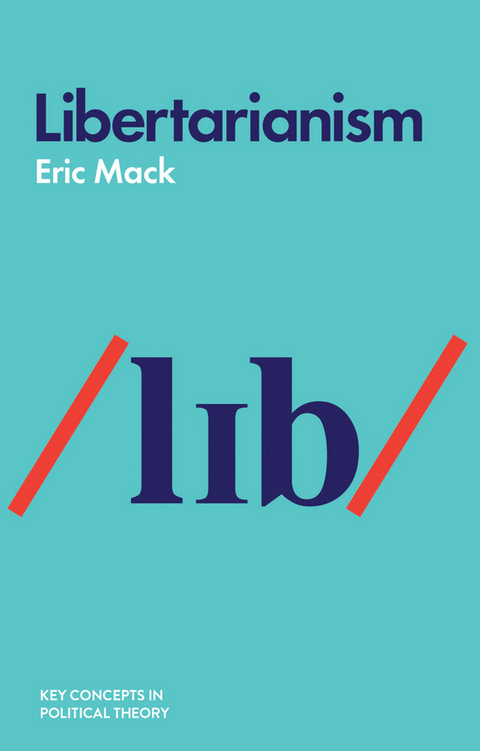
In this book, leading expert Eric Mack provides a rigorous and clear account of the philosophical principles of libertarianism. He offers accounts of three distinctive schools of libertarian thought, which he labels the natural rights approach, the cooperation to mutual advantage approach, and the indirect consequentialist approach. After examining the historical roots of these approaches in the thought of figures such as John Locke and David Hume, he provides illuminating accounts of the foundational arguments and the theories of economic justice offered by Robert Nozick and F.A. Hayek. He then examines a range of other debates, such as those surrounding the nature of the minimal state and those between critics and defenders of libertarianism.
This book will be essential reading for anyone interested in political philosophy, political ideologies and the nature of liberty and state authority, from students and scholars to general readers.
Eric Mack is Professor of Philosophy at Tulane University.
The essence of libertarianism is the view that coercive political institutions, such as the state, are justified only insofar as they function to protect each person s liberty to pursue their own goals and well-being in their own way. Libertarians accordingly argue that any attempt to enforce top-down concepts of social justice or economic equality are fundamentally misconceived. In this book, leading expert Eric Mack provides a rigorous and clear account of the philosophical principles of libertarianism. He offers accounts of three distinctive schools of libertarian thought, which he labels the natural rights approach, the cooperation to mutual advantage approach, and the indirect consequentialist approach. After examining the historical roots of these approaches in the thought of figures such as John Locke and David Hume, he provides illuminating accounts of the foundational arguments and the theories of economic justice offered by Robert Nozick and F.A. Hayek. He then examines a range of other debates, such as those surrounding the nature of the minimal state and those between critics and defenders of libertarianism. This book will be essential reading for anyone interested in political philosophy, political ideologies and the nature of liberty and state authority, from students and scholars to general readers.
Eric Mack is Professor of Philosophy at Tulane University.
"This book is, unquestionably, the best available account of the literature on the philosophical foundations of modern libertarianism. Mack, himself a major contributor to that literature, carefully tracks its historical origins and offers an impressively acute analysis of the works of libertarianism's leading contemporary exponents."
--Hillel Steiner, University of Manchester
"Eric Mack is at once one of the gentlest but also one of the most probing critics our profession has ever seen. His reconstructions are works of art, even when he ultimately disagrees. Mack has been as good as it gets for a very long time, and this is his greatest work."
--David Schmidtz, University of Arizona
2
Philosophical Antecedents
Introduction
This chapter offers accounts of John Locke’s articulation of the natural rights theme, David Hume’s articulation of the cooperation to mutual advantage theme (along with allied ideas offered by Adam Smith), and John Stuart Mill and Herbert Spencer’s articulations of the indirect utilitarian theme. My goal here is not to provide episodes in the history of libertarian political thought. Rather, it is to flesh out philosophical themes that are central to libertarian and classical liberal theorizing – including the theorizing that will be examined in the next three chapters – whether or not each of their expositors should be classified as a libertarian or classical liberal.
Locke on Natural Rights, Political Society, Resistance, and Toleration
The two most important seventeenth-century English defenses of unlimited political authority, those authored by Robert Filmer and Thomas Hobbes, were composed around the time of the English Civil Wars and were still, in their somewhat divergent ways, the primary vindications of the absolutist position in the decade leading up to the Glorious Revolution of 1688. John Locke’s two most important works in political philosophy, Two Treatises of Government and A Letter Concerning Toleration, were composed in this tumultuous decade. The Two Treatises was largely written between 1679 and 1683 as both a critique of absolutism and as support for the increasing extra-legal opposition to Charles II that was led by Locke’s patron, the Earl of Shaftesbury. The Letter was written in 1685 while Locke was in hiding in Holland – on the lam for his association with revolutionary activities in England in 1679–83. Both works were published in England in 1689 after Locke’s return following the Glorious Revolution. I will begin with the doctrine of the Two Treatises and then turn to the Letter.
Locke’s First Treatise – most of which was lost during Locke’s exile – was a detailed critique of Filmer’s defense of monarchical authority. Locke presents his own positive doctrine in the Second Treatise. Locke frequently employs the traditional language of the “Law of Nature,” but he takes the core substance of the Law of Nature to consist in the moral rights possessed by all individuals. Locke takes these rights to define morally protected domains within which individuals may do as they see fit. Locke rejects the Hobbesian view that freedom is a matter of being under no moral constraints and, hence, being morally at liberty to do whatever one pleases. For, if one is subject to no moral constraints, others also will be under no such constraints and, hence, they will be free to domineer over one whenever it suits their humor to do so. That can hardly be a state of freedom. Instead, freedom requires we each be subject to norms that preclude “restraint and violence from others” – norms that preclude infringement upon one’s “person, actions, possessions, and [one’s] whole property.” While these norms provide one with protection against the arbitrary will of others, to be subject to these norms is not to be subject to anyone’s arbitrary will (1980: §57).
The keynote claim of the Second Treatise is that each person possesses a natural moral right to freedom – a natural right to live one’s own life in accord with one’s own choices. This fundamental right is articulated in terms of a number of somewhat more specific first-order rights, viz., the right to dispose of one’s own body, faculties, and efforts as one sees fit and the right to acquire holdings in extra-personal objects which one may use as one sees fit. Correlative to each person’s natural rights are each other persons’ natural obligations “… not, unless it be to do justice on an offender, to take away, or impair the life, or what tends to the preservation of the life, the liberty, health, limb, or goods of another” (1980: §6). A further aspect of our natural right to freedom is our right that others not violate their contractual agreements with us. “[P]romises and compacts” made in the state of nature are binding on us because “truth and keeping of faith belongs to men as men” (1980: §14). In addition, all persons possess second-order natural rights to defend themselves against violations of their first-order rights and to extract restitution from and to punish those who have violated their rights (1980: §10–§12).
It is often said that Locke simply asserts these natural rights or asserts that God has decreed them. This is a serious misreading. Throughout his life Locke did hold that the law of nature counts as law and as obligatory because of God’s authoritative endorsement of it (1959: 473, 474). Nevertheless, the rights that God wills that we abide by are grounded in our nature; and they can only be known through an investigation of our nature. As Locke puts it in his early (1663–4) Essays on the Law of Nature,
since man has been made such as he is, equipped with reason and his other faculties and destined for this mode of life, there necessarily result from his inborn constitution some definite duties for him, which cannot be other than they are … [H]e has made man such that these duties of his necessarily follow from his very nature … [N]atural law stands and falls together with the nature of man as it is at present. (1997b: 125, 126)
The law of nature is “the permanent rule of morals” because it is “firmly rooted in the soil of human nature.” Locke’s claims about the rights of individuals, the nature of the political institutions they have reason to adopt, and the grounds for resistance against unjust state action are largely detached from his theological contentions that God created us and wills that we respect the rights that are rooted in our human nature.
Almost all of Locke’s argumentation in the Second Treatise on behalf of natural rights rests on two normatively seminal facts about our inborn condition. The first of these is that each individual pursues his own happiness and that this pursuit of happiness is rational. In his An Essay Concerning Human Understanding, Locke says that, while all human happiness is good, each individual naturally and reasonably pursues his own happiness. “All other good, however great in reality or appearance, excites not a man’s desires who looks not on it to make a part of that happiness wherewith he, in his present thoughts, can satisfy himself” (1959: 341). Locke makes clear that he is affirming each individual’s pursuit of personal happiness in a fragment written shortly before the publication of the Two Treatises.
’Tis a man’s proper business to seek happiness and avoid misery. … I will therefore make it my business to seek satisfaction and delight and avoid uneasiness and disquiet and to have as much of the one and as little of the other as may be. But here I must have a care I mistake not, for if I prefer a short pleasure to a lasting one, ’tis plain I cross my own happiness. (1997d: 296)
In the Second Treatise, Locke focuses on the crucial, necessary condition of individual happiness, viz., self-preservation and more specifically yet on the crucial interpersonally necessary condition for self-preservation, viz. freedom. Freedom is what we need from other people if we are to attain self-preservation and happiness (1980: §17).
The second normatively seminal fact about human beings is that we all have the same fundamental moral standing. We are naturally in a state of moral equality,
wherein all the power and jurisdiction is reciprocal, no one having more than another; there being nothing more evident, than that creatures of the same species and rank, promiscuously born to all the same advantages of nature, and the use of the same faculties, should also be equal one amongst another without subordination or subjection. (1980: §4)
We are all “equal and independent” beings “sharing all in one community of nature.” Both these claims come into play in the various ways in which Locke supports his claim that “reason … teaches all mankind … that being all equal and independent, no one ought to harm another in his life, health, liberty, or possessions” (1980: §6).
The first of Locke’s arguments for a natural right to freedom is the generalization argument. It begins with Locke reiterating “[t]his equality of men by nature” (1980: §5). Locke then provides a long passage in which Richard Hooker asserts that, if one makes a claim to be loved by others, one must recognize their like claim to one’s love for them. Since Locke himself is not proposing that we each have a right to be loved and an obligation to love, the point of the Hooker passage must be to illustrate the principle of generalization; any claim that one makes for oneself against others, one must grant to all others of the same moral status. For Locke, the crucial claim that is rational for each person to make against others is the claim to freedom from interference. Since each rationally makes this claim against others, each is rationally required to affirm every other...
| Erscheint lt. Verlag | 8.10.2018 |
|---|---|
| Reihe/Serie | Key Concepts in Political Theory |
| Political Profiles Series | Political Profiles Series |
| Sprache | englisch |
| Themenwelt | Geisteswissenschaften ► Philosophie ► Allgemeines / Lexika |
| Sozialwissenschaften ► Politik / Verwaltung ► Politische Systeme | |
| Sozialwissenschaften ► Politik / Verwaltung ► Politische Theorie | |
| Schlagworte | argue • attempt • Book • Concepts • enforce • Equality • Essence • Expert • Function • fundamentally • Geschichte • goals • History • history of ideas • Ideengeschichte • Insofar • Justice • Libertarianism • libertarians • Liberty • misconceived • persons • Philosophical • Philosophie • Philosophy • Political & Economic Philosophy • Political Institutions • Political Philosophy & Theory • Political Science • Politikwissenschaft • Politische Philosophie u. Politiktheorie • Politische u. Ökonomische Philosophie • Social • State • topdown • View |
| ISBN-13 | 9781509519330 / 9781509519330 |
| Informationen gemäß Produktsicherheitsverordnung (GPSR) | |
| Haben Sie eine Frage zum Produkt? |
 EPUB (Adobe DRM)
Kopierschutz: Adobe-DRM
Adobe-DRM ist ein Kopierschutz, der das eBook vor Mißbrauch schützen soll. Dabei wird das eBook bereits beim Download auf Ihre persönliche Adobe-ID autorisiert. Lesen können Sie das eBook dann nur auf den Geräten, welche ebenfalls auf Ihre Adobe-ID registriert sind.
Details zum Adobe-DRM
Dateiformat: EPUB (Electronic Publication)
EPUB ist ein offener Standard für eBooks und eignet sich besonders zur Darstellung von Belletristik und Sachbüchern. Der Fließtext wird dynamisch an die Display- und Schriftgröße angepasst. Auch für mobile Lesegeräte ist EPUB daher gut geeignet.
Systemvoraussetzungen:
PC/Mac: Mit einem PC oder Mac können Sie dieses eBook lesen. Sie benötigen eine
eReader: Dieses eBook kann mit (fast) allen eBook-Readern gelesen werden. Mit dem amazon-Kindle ist es aber nicht kompatibel.
Smartphone/Tablet: Egal ob Apple oder Android, dieses eBook können Sie lesen. Sie benötigen eine
Geräteliste und zusätzliche Hinweise
Buying eBooks from abroad
For tax law reasons we can sell eBooks just within Germany and Switzerland. Regrettably we cannot fulfill eBook-orders from other countries.
aus dem Bereich