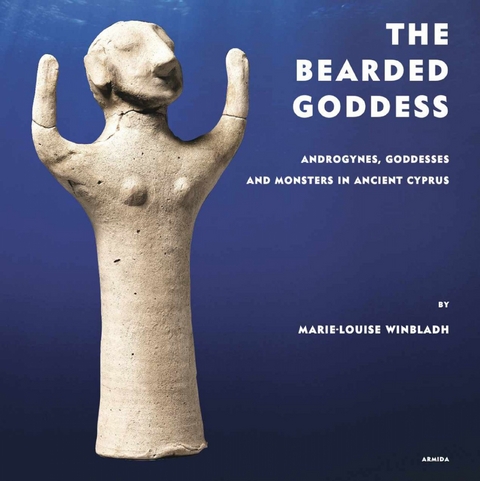
Bearded Goddess (eBook)
106 Seiten
Armida Publications (Verlag)
978-9963-706-32-7 (ISBN)
Most of us associate Aphrodite - also known as Venus - with love, beauty, and fertility, but the symbolic value of this goddess is by far more complex than we would have known or dared to believe.
Aphrodite - a hermaphrodite?
The book examines a rather obscure side of the cult surrounding this illustrious fertility goddess. How many of us would have guessed that one of Aphrodite's most famous representations was, in fact, a figurine from Ayia Irini, Cyprus, that portrays this female deity as The Bearded Goddess, a bisexual and self-sufficient entity?
The book reveals the unspoken truth about Aphrodite; a closer look at the islands archaeological sites suggests a new sexual archetype of Aphrodite and other criteria for the sublime female figure in ancient religion(s).
The author, the well-known archaeologist Marie-Louise Winbladh, enlightens her audience in plain language about the mysterious devotion of Aphrodite as an androgynous being. She casts light on the enigmatic representations of this deity, who is believed to have originated from Cyprus, the epicenter of ancient crossroads.
How did the cult of Aphrodite evolve?
How was this goddess worshiped?
Did 'temple prostitution' really exist?
What was the role of the 'priestesses' and their relation to The Bearded Goddess?
These and many more questions are addressed in the book.
Most of us associate Aphrodite - also known as Venus - with love, beauty, and fertility, but the symbolic value of this goddess is by far more complex than we would have known or dared to believe.Aphrodite a hermaphrodite?The book examines a rather obscure side of the cult surrounding this illustrious fertility goddess. How many of us would have guessed that one of Aphrodite s most famous representations was, in fact, a figurine from Ayia Irini, Cyprus, that portrays this female deity as The Bearded Goddess, a bisexual and self-sufficient entity?The book reveals the unspoken truth about Aphrodite; a closer look at the islands archaeological sites suggests a new sexual archetype of Aphrodite and other criteria for the sublime female figure in ancient religion(s).The author, the well-known archaeologist Marie-Louise Winbladh, enlightens her audience in plain language about the mysterious devotion of Aphrodite as an androgynous being. She casts light on the enigmatic representations of this deity, who is believed to have originated from Cyprus, the epicenter of ancient crossroads.How did the cult of Aphrodite evolve?How was this goddess worshiped?Did temple prostitution really exist?What was the role of the priestesses and their relation to The Bearded Goddess?These and many more questions are addressed in the book.
II. Bearers of eternal life
Chalcolithic, c. 3800 BC - 2500/2300 BC
Map of Cyprus with important archaeological sites.
In antiquity, the most famous sanctuary of the goddess Aphrodite was situated in south-western Cyprus, to which people made pilgrimages from several countries around the Mediterranean. The temple was located at Old Paphos (Gr. Palaípaphos), where today the modern village of Kouklia is situated. A few miles to the west are the ruins of the town New Paphos (Gr. Nea Paphos), which was the capital of Cyprus during the Roman period. It was, however, in the area of Old Paphos that a fertility goddess was venerated for millennia and the believers practised rituals to her honour. Perhaps there were cult places in the villages where people gathered for communal worship, but families also devoted themselves to the goddess within their household shrines. The fertility cult was closely associated with farming, which always dominated the economy of Cyprus. People were dependent on good crops and livestock reproduction to survive. During this era, small cruciform figurines were manufactured in green stone called picrolite, which is akin to steatite. These small statuettes are so well known that they have become the archaeological trademark of the Chalcolithic age in Cyprus. The small figurines – and the use of picrolite – are unique to Cyprus and do not occur anywhere else.
Cruciform figurines of green picrolite. The small one has probably been used as a pendant. The left figurine derives from Kythrea; the right from Ayia Irini. Chalcolithic, c. 3900 - 2500 BC.
The soft green stone allowed the artist to model the finest of details and the strong stylization appeals to a modern eye. These figurines were, however, not intended for the human eye, but rather had a symbolic role in the household cult and the grave. The prehistoric artist started with a naturalistic model, not to imitate, but to create a figurine with an important symbolic function. Non-essential details were omitted in order to emphasize more important features. The details of the face were most often omitted. The majority of the idols are represented with upturned heads, outstretched arms and in a sitting position. Usually their stomach is flat since they have just given birth to the baby. Perhaps the tiny figurines represent women giving birth in a sitting position, which was common in prehistoric and later times and still occurs in certain societies. The squatting position when giving birth is said to be much more comfortable for the woman.
Some of the statuettes are fragmentary and worn from use. Women, wishing a favorable and healthy delivery, wore them as sympathetic amulets. The picrolite figurines were tiny and could be worn close to the body, wrapped in cloth. It was important to the continuation of the community that the babies survived. Some of the idols have a suspension hole, and the women wore them as pendants around the neck. Many large female statues have similar figurines as a pendant around the neck, and this miniscule hanging ornament in its turn wears another tiny pendant figurine. The many statuettes found in tombs carry an aspect of fertility, but in a transferred sense. As a bearer of life, the figurine symbolized a possibility of rebirth and thereby became the guarantor of a new life, a reality and a necessity for prehistoric people. A few of them have been found in settlements, but the majority were excavated in tombs. Scholars consider these small idols to be imitations of larger cult statues, used in official rites to guarantee fertility to people, animal and fields.
The two figurines in the Cyprus Collections do not derive from the Paphos area. The one from Ayia Irini was probably a precious belonging, preserved for generations and finally deposited in the sanctuary, thousands of years later. The larger figurine was found among the ruins of a Chalcolithic village at Kythrea, far away from the place where it was manufactured.
During the Chalcolithic era[1], female terracotta figurines with prominent sexual features pictured the fertility cult of the Mother Goddess. Chalcolithic figurines are mostly female or sexless, but some figurines are also represented with breasts and phallic heads. The phallic feature was more prominent in earlier periods, while the more feminine characteristics dominated during the Chalcolithic period. Male figures do occur, but are rather unusual.
Excavations immediately north of New Paphos at a site called Kissonerga-Mosphilia have yielded extraordinary results from about 3000 BC. A ceremonial area was excavated, with pits filled with ash and purposely deposited objects. In one of the pits was found an outstanding collection of about fifty objects in and around a terracotta house model, which is an exact reproduction of the contemporary structures. The external walls of the house model are painted with stepped bands and rectangles with red ochre in a very attractive design. Ash in the pit and cracks on the outer surface of the building model indicate that the vessel was intentionally burned before its burial. The objects include eight terracotta statuettes, ten stone figurines, one anthropomorphic vessel and a model stool. Many of them were purposely broken. Most figurines are females, seated on birthing stools used during the delivery of a child. The most remarkable figure represents a woman in sitting position giving birth to a baby, rendered in red paint, and emerging with the head first from between the broken legs of its mother. She is sitting on a special stool and around her neck she wears a cruciform amulet, painted in red. The finds indicate that people on this site practised a fertility rite in connection with pregnancy and childbirth. A public ceremony was perhaps performed, where the figurines functioned in a ritual, intended to promote childbirth and fertility. Moreover, close to the find spot, there were ashes, burnt charcoal and stones, cracked by the heat. The context shows that the stones were not used in cooking, but had instead been heated in order to give off steam, as is the practice today in saunas and vapor baths.
The Greek historian Herodotos (5th cent. BC) tells about Scythian customs and mentions vapor baths as a means of ritual purification after a funeral. He describes how hemp was placed on heated stones in order to produce a fragrant aroma.
After the burial, those engaged in it have to purify themselves, which they do in the following way. First they well soap and wash their heads; then, in order to cleanse their bodies, they act as follows: they make a booth by fixing in the ground three sticks inclined towards one another, and stretching around them woollen felts, which they arrange so as to fit as close as possible: inside the booth a dish is placed upon the ground, into which they put a number of red-hot stones, and then add some hemp-seed. [...] Immediately it smokes and gives out such a vapor that no Greek steam bath can surpass it. [...] the Scyths howl with pleasure at these baths.
The History of Herodotos, Book IV, 1-82, “Country and customs of the Scythians” (in this context, approx. southern Russia and Ukraine)
In Russia and Finland the sauna bath is still considered to have a healing effect, since sweating is supposed to exorcise evil powers. Until the 1940s, women still gave birth to children in saunas, because it was often the cleanest building with water available.
After giving birth, the woman was usually cleaned with water or steam. Healing materials as herbs and fragrant leaves could be added to the water or the vapor baths. Hot steam was produced from heated stones by adding water and herbs. This treatment was both hygienic and healing, and also kept evil away. Vapor baths and washing could be seen as a treatment integrated with childbirth in prehistoric times. Can vapour baths have been used 5000 years ago in Cyprus in connection with delivery? This treatment could have been practised to purify and protect the delivering woman, and in that way the survival of the human race. It is obvious from the multifarious female figurines that women would venerate the Mother Goddess to protect themselves with ritual purification during their pregnancies.
Large figures made of stone and terracotta have been excavated in settlements and were not intended for burial. The largest one from Lemba-Lakkous was leaning against a wall in a separate building, waiting in the dark to be used in the cult. Her pet name is The Lemba Lady and she is dated to c. 3000 BC. She constitutes an imposing sight with her prominent female attributes in combination with a long phallic neck and stylized features. A...
| Erscheint lt. Verlag | 5.10.2018 |
|---|---|
| Sprache | englisch |
| Themenwelt | Geisteswissenschaften ► Archäologie |
| Geschichte ► Allgemeine Geschichte ► Vor- und Frühgeschichte | |
| Geschichte ► Allgemeine Geschichte ► Altertum / Antike | |
| Geschichte ► Teilgebiete der Geschichte ► Religionsgeschichte | |
| Geisteswissenschaften ► Religion / Theologie ► Weitere Religionen | |
| Schlagworte | Ancient Religion • Aphrodite • archaeology • Cults • Cyprus • Middle East History • Venus |
| ISBN-10 | 9963-706-32-0 / 9963706320 |
| ISBN-13 | 978-9963-706-32-7 / 9789963706327 |
| Informationen gemäß Produktsicherheitsverordnung (GPSR) | |
| Haben Sie eine Frage zum Produkt? |
 EPUB (Ohne DRM)
Digital Rights Management: ohne DRM
Dieses eBook enthält kein DRM oder Kopierschutz. Eine Weitergabe an Dritte ist jedoch rechtlich nicht zulässig, weil Sie beim Kauf nur die Rechte an der persönlichen Nutzung erwerben.
Dateiformat: EPUB (Electronic Publication)
EPUB ist ein offener Standard für eBooks und eignet sich besonders zur Darstellung von Belletristik und Sachbüchern. Der Fließtext wird dynamisch an die Display- und Schriftgröße angepasst. Auch für mobile Lesegeräte ist EPUB daher gut geeignet.
Systemvoraussetzungen:
PC/Mac: Mit einem PC oder Mac können Sie dieses eBook lesen. Sie benötigen dafür die kostenlose Software Adobe Digital Editions.
eReader: Dieses eBook kann mit (fast) allen eBook-Readern gelesen werden. Mit dem amazon-Kindle ist es aber nicht kompatibel.
Smartphone/Tablet: Egal ob Apple oder Android, dieses eBook können Sie lesen. Sie benötigen dafür eine kostenlose App.
Geräteliste und zusätzliche Hinweise
Buying eBooks from abroad
For tax law reasons we can sell eBooks just within Germany and Switzerland. Regrettably we cannot fulfill eBook-orders from other countries.
aus dem Bereich