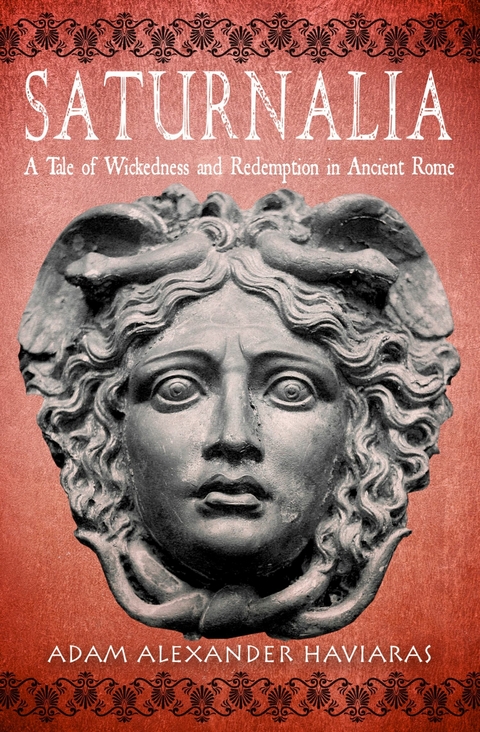
Saturnalia (eBook)
263 Seiten
Eagles and Dragons Publishing (Verlag)
978-1-988309-20-0 (ISBN)
Long before Ebenezer Scrooge, there was Catus Pompilius, the meanest man in Rome.
It is the time of Saturnalia, the most highly-anticipated festival across the whole of the Roman Empire.
In the ancient city of Rome, citizens and slaves are preparing to honour the gods and to enjoy a time of freedom and revelry among family and friends. Saturnalia truly is the best of days for all!
That is, for all except the wickedest landlord in Rome: Catus Pompilius.
With a blatant disregard for gods and men alike, Catus Pompilius moves through the streets of Rome spreading misery wherever he can, dousing the Saturnalian light of the world around him.
However, this Saturnalia, the gods have decided that Catus' time has come. Judgment is upon him!
Will Catus Pompilius be able to redeem himself and prevail upon the gods' mercy? Or will their divine wrath hurl him into the darkest depths of Tartarus for all eternity?
Read this dark tale of gods and men, wickedness and redemption, to find out!
Saturnalia is an exciting retelling of Charles Dickens' classic tale. It is also a story for fans of ancient Rome, of tales of gods and men, and stories that make one examine the quality of the life we lead as mortals.
If you are a fan of A Christmas Carol, stories about life and redemption against all odds, then you will love Saturnalia!
Long before Ebenezer Scrooge, there was Catus Pompilius, the meanest man in Rome.It is the time of Saturnalia, the most highly-anticipated festival across the whole of the Roman Empire.In the ancient city of Rome, citizens and slaves are preparing to honour the gods and to enjoy a time of freedom and revelry among family and friends. Saturnalia truly is the best of days for all!That is, for all except the wickedest landlord in Rome: Catus Pompilius.With a blatant disregard for gods and men alike, Catus Pompilius moves through the streets of Rome spreading misery wherever he can, dousing the Saturnalian light of the world around him.However, this Saturnalia, the gods have decided that Catus time has come. Judgment is upon him!Will Catus Pompilius be able to redeem himself and prevail upon the gods mercy? Or will their divine wrath hurl him into the darkest depths of Tartarus for all eternity?Read this dark tale of gods and men, wickedness and redemption, to find out!Saturnalia is an exciting retelling of Charles Dickens classic tale. It is also a story for fans of ancient Rome, of tales of gods and men, and stories that make one examine the quality of the life we lead as mortals.If you are a fan of A Christmas Carol, stories about life and redemption against all odds, then you will love Saturnalia!
II
Shades of the Past
Every year with the arrival of the month of December there was an air of change, of hope in ancient Rome. No matter how desolate one’s situation, or empty one’s purse, the Gods seemed to infuse both citizen and slave with anticipation and joy.
This suffusion of jollity was no doubt closely tied to the great festival of Saturnalia when, even for a short time, life was better. As the poet once said, ‘Saturnalia is the very best of days!’
In the days leading up to the seventeenth of December, everywhere you went among the seven hills, doorways were decorated with garlands. The homes of both rich and poor were brightly lit with myriad candles and lamps in those last, darkest days of the year.
The city and imperial fora were cleaned and scrubbed in preparation for the array of games to be put on by the Senate, and the convivium publicum, the public feast that would follow the sacrifices to Saturn. The markets were all a chorus of buying and selling, the stalls brimming with freshly butchered meats, mountains of fruit and grain from the countryside, fish from the sea, and wines from Italia, Graecia and Gaul. The shipments of garum from Afrika and Iberia tripled in order to meet the demand.
The entire city was a circus at which every person hoped for a share of joy, of food, and of the Gods’ favour.
Token gifts, the sigillaria, were purchased in advance of the festival too, from the wax and tallow candles and figurines of the poor, to toys for children, clothing, lamps and writing tablets for those with a few extra denarii, all the way to exotic animals and pleasure slaves for the rich.
People prepared to set aside their togas in favour of the colourful, festive synthesis of Saturnalia, and the felt or leather pileus which men would wear atop their heads.
Oh, how the world was bright and lively at that time of year!
How all looked forward to these seven days from the seventeenth of December to the twenty-third, the Dies Natalis Solis Invicti, the birthday of the unconquerable Sun, when the dark days of Winter would begin to burn away once more.
In addition to the permitted public gambling, the propensity for guising, overeating, and joyful drunkenness, the most exciting part of Saturnalia was the three days at the beginning of the festival when there was no work forced upon any person, when businesses and courts were shut, and schools and gymnasia closed.
The warlike people of Mars even refused to fight at this time of year, with no pilum or gladius raised against any enemy across the Empire.
This was a time to savour life, a time when master and slave exchanged places for even a day, the one served by the other, when kind words might be exchanged, and past wrongs perhaps forgiven, things made right.
From the emperor and empress who were far away, to the poorest family in the Suburra of Rome, there was a share of lightheartedness for each when the spirits would lift to the heights of Olympus at the hearing of that most wonderful of wishes, ‘Io Saturnalia!’.
The Gods know the world is an imperfect place, but it must be admitted that it would indeed be better without certain people in it.
In Rome at the time, if you were to ask normal folk for the name of the most hated person, the name most likely to burst from their lips would not be that of the most brutal Aventine thug, or even the vilest and abusive wretch in the urban guard. No. The name of the person you would hear shouted with passionate hate would be that of Catus Pompilius.
Catus Pompilius was, one could say, the richest man in Rome. Some said that he was even wealthier than Marcus Licinius Crassus had been in his day. Everyone borrowed money from Catus Pompilius, not because it was preferred, but because he had much of it, and was not so choosy about whom he leant it to, whereas other lenders were. Everyone owed Pompilius: from the smallest butcher to the Praetorian Prefect, Papinianus, whom it was said needed extra funds to aid Emperor Severus in his imminent conquest of Caledonia.
He was also one of the wealthiest landlords in all of Rome, having used the funds he earned from interest, and the money he absconded from his dead partner, Krelis Manvilio, to buy up almost half of the city.
Most of his holdings consisted of the usual three and five story tenements nestled in the Suburra of Rome, that poor and rough area tucked between the Viminal Hill, and the Esquiline Hill on which Pompilius lived, of course in a vast domus he had repossessed from a failed merchant’s family.
Not even the Gods could save a debtor from Pompilius’ bony clutches!
However, on that day, the Gods sitting in their Olympic eyrie took notice of the fiend as he stormed out of the Basilica Julia into the Forum Romanum.
Pompilius had just been to court on the eve of Saturnalia, only prior to its closing for the festival, to complete a suit against an olive oil importer from Hispania who had defaulted on a loan.
The man, now standing beneath the arcade of the basilica, shouting at Pompilius’ back as he left, had told the magistrate that he would have the funds to fully repay the loan after Saturnalia, but Pompilius had refused and demanded that instead, all of the merchant’s ships, stock, and real estate be transferred to him immediately.
This signed order he now rolled, as he strode through the Forum, and tucked it into the fold of his plain, grey toga.
Despite the crowds gathering to watch the preparations for the celebrations before the temple of Saturn and the convivium publicum where the people would dine at the expense of the Senate, a pathway cleared before Catus Pompilius’ form as he pressed on. People avoided eye contact with the man at all cost, some even jostling to get far away from him, and not be called out.
Like a jungle predator, Catus Pompilius scanned the faces for people who owed him rents or other debts and, poor fellows, those whose arms he clamped onto were shivering with fright as the old man piled vitriol and shame upon them before their fellow citizens.
It was well-known how many men Catus had sent to the mines, or onto the merchant ships, to repay debts, how many families he had torn asunder for the price of a few denarii.
Some men of the patrician class stood their ground before the landlord and money-lender, staring down their long noses at him as though the Cloaca Maxima were in flow right beneath their snouts.
Yet he stared back, unperturbed, unafraid, and uncaring of any of them.
At a distance, if you did not know him, you would think Catus Pompilius simply a man of very advanced years, ignorant of his unclean appearance, and rude in his manner. He walked hunched over, as if constantly poring over his papyrus ledgers, so that the first thing one noticed was the top of his balding, spotted head flanked by the wings of his ears.
Harmless enough, until he raised his head like a vulture from a carcass to lay his eyes upon you, to assess you, to determine if you owed him something.
Until he took notice, all one saw was a face verily creased with bitterness and anger - the Gods alone knew at what! - the skin gathering in a great furrow above his brows as if his constant frown pulled the skin forward and down upon his face. Loose skin had also gathered about his large nose, which many said could scent coin the way a hound smells a bitch in heat. His mouth was turned down permanently, even when he spoke, so that the only sound he made was a low growl, his chin moving but a little.
This was Catus Pompilius, and on the eve of Saturnalia he was often at his worst, determined to ruin the circus atmosphere of the season and slap the smile from a thousand faces if he could.
They all owe me money, and yet they spend and spend and spend! he raged to himself as he strode along the tables being set out for the morrow’s public banquet which would follow the ritus Graecus, the rituals in the Greek fashion that were performed at the temple of Saturn.
He hated everything about the festival - the waste of state funds on the profane citizenry, the giving of sigillaria, the guising, the public gambling, all of it! But most of all, he hated that he was forced to give Giles Amadea, his collector, the first three days of the festival off, just like the rest of Rome, due to the ancient decree of dies festus.
That is why he needed an early start on the eve of Saturnalia every year, so that he could send Giles out to collect as many rents as he could before the coming of December seventeenth.
The sun was shining in the sky above as Pompilius made his way toward the slope of the Esquiline Hill, having already stopped at the markets of Trajan to gather rents from those who rented the blocks of stalls he had bought up, their rents having been due at the beginning of the month.
The gnarled branches of oak trees dotting the Esquiline Hill came into view, like claws rapping at the doors of the rich villas dotted around the plateau.
Catus turned onto his street and noted the garlands and flowers being hung at the doors of all of his neighbours, the polished herms, and well-dressed, happy slaves.
Of course they’re happy! he snorted, their fool masters will spend money on them and serve them a banquet like the idiots they are.
One thing he could never understand was the kindness and generosity shown toward slaves at that time of year, for he strongly suspected that once the mongrels were given a little freedom to speak and do as they pleased, they would never again respect or fear their proper dominus.
“The Dead to dine on...
| Erscheint lt. Verlag | 11.10.2018 |
|---|---|
| Sprache | englisch |
| Themenwelt | Literatur ► Fantasy / Science Fiction ► Fantasy |
| Literatur ► Historische Romane | |
| Literatur ► Krimi / Thriller / Horror ► Horror | |
| Literatur ► Romane / Erzählungen | |
| Geschichte ► Allgemeine Geschichte ► Vor- und Frühgeschichte | |
| Geschichte ► Allgemeine Geschichte ► Altertum / Antike | |
| Geisteswissenschaften ► Religion / Theologie ► Weitere Religionen | |
| Schlagworte | A Christmas Carol • ancient Rome historical fiction • Charles Dickens A Christmas Carol • Christmas fiction • Ghost Stories • Roman Empire historical fantasy • stories about redemption and human rights |
| ISBN-10 | 1-988309-20-4 / 1988309204 |
| ISBN-13 | 978-1-988309-20-0 / 9781988309200 |
| Informationen gemäß Produktsicherheitsverordnung (GPSR) | |
| Haben Sie eine Frage zum Produkt? |
 EPUB (Ohne DRM)
Digital Rights Management: ohne DRM
Dieses eBook enthält kein DRM oder Kopierschutz. Eine Weitergabe an Dritte ist jedoch rechtlich nicht zulässig, weil Sie beim Kauf nur die Rechte an der persönlichen Nutzung erwerben.
Dateiformat: EPUB (Electronic Publication)
EPUB ist ein offener Standard für eBooks und eignet sich besonders zur Darstellung von Belletristik und Sachbüchern. Der Fließtext wird dynamisch an die Display- und Schriftgröße angepasst. Auch für mobile Lesegeräte ist EPUB daher gut geeignet.
Systemvoraussetzungen:
PC/Mac: Mit einem PC oder Mac können Sie dieses eBook lesen. Sie benötigen dafür die kostenlose Software Adobe Digital Editions.
eReader: Dieses eBook kann mit (fast) allen eBook-Readern gelesen werden. Mit dem amazon-Kindle ist es aber nicht kompatibel.
Smartphone/Tablet: Egal ob Apple oder Android, dieses eBook können Sie lesen. Sie benötigen dafür eine kostenlose App.
Geräteliste und zusätzliche Hinweise
Buying eBooks from abroad
For tax law reasons we can sell eBooks just within Germany and Switzerland. Regrettably we cannot fulfill eBook-orders from other countries.
aus dem Bereich