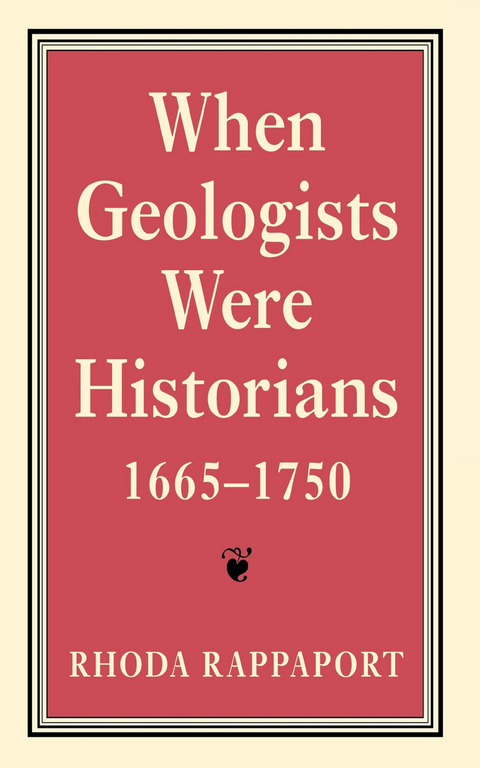
When Geologists Were Historians, 1665–1750 (eBook)
320 Seiten
Cornell University Press (Verlag)
978-1-5017-2961-4 (ISBN)
"An essential perspective for those seeking a serious introduction to early geological science and a fundamental point of departure for future research.... No other book has this scope and conceptual focus."—Kenneth L. Taylor, University of...
"An essential perspective for those seeking a serious introduction to early geological science and a fundamental point of departure for future research.... No other book has this scope and conceptual focus."—Kenneth L. Taylor, University of OklahomaIn the years between 1665 and 1750, geology was a new kind of science, combining physical law with historical process. Rhoda Rappaport explains its novelty and provides a transnational account of the development of geological thinking. She begins with the establishment of formal institutions of international exchange, including the Philosophical Transactions of the Royal Society of London and the Journal des savants in Paris, and shows how new media fostered increasing communication among scientists, particularly in England, France, and Italy. Early geological thinking was thoroughly integrated with epistemology, historical and biblical scholarship, natural philosophy, and natural history. Ancient written documents supplemented what was called "physical conjecture," providing human witnesses to past events. How to combine elements of law, empirical observations, and texts posed serious problems in debates about the biblical flood, which Rappaport presents as a prime example of a well-attested historical event. Buffon argued forcefully that geology should be wholly a physical science and that historical texts were irrelevant to the reconstruction of physical processes. Rappaport explains how his contemporaries responded to this novel proposal and how Buffon heralded the end of an era.
"An essential perspective for those seeking a serious introduction to early geological science and a fundamental point of departure for future research.... No other book has this scope and conceptual focus."—Kenneth L. Taylor, University of Oklahoma
In the years between 1665 and 1750, geology was a new kind of science, combining physical law with historical process. Rhoda Rappaport explains its novelty and provides a transnational account of the development of geological thinking. She begins with the establishment of formal institutions of international exchange, including the Philosophical Transactions of the Royal Society of London and the Journal des savants in Paris, and shows how new media fostered increasing communication among scientists, particularly in England, France, and Italy.
Early geological thinking was thoroughly integrated with epistemology, historical and biblical scholarship, natural philosophy, and natural history. Ancient written documents supplemented what was called "physical conjecture," providing human witnesses to past events. How to combine elements of law, empirical observations, and texts posed serious problems in debates about the biblical flood, which Rappaport presents as a prime example of a well-attested historical event.
Buffon argued forcefully that geology should be wholly a physical science and that historical texts were irrelevant to the reconstruction of physical processes. Rappaport explains how his contemporaries responded to this novel proposal and how Buffon heralded the end of an era.
Rhoda Rappaport is Professor of History at Vassar College.
| Erscheint lt. Verlag | 5.9.2018 |
|---|---|
| Verlagsort | Ithaca |
| Sprache | englisch |
| Maße | 160 x 160 mm |
| Themenwelt | Geisteswissenschaften ► Geschichte |
| Naturwissenschaften ► Geowissenschaften ► Geologie | |
| ISBN-10 | 1-5017-2961-6 / 1501729616 |
| ISBN-13 | 978-1-5017-2961-4 / 9781501729614 |
| Informationen gemäß Produktsicherheitsverordnung (GPSR) | |
| Haben Sie eine Frage zum Produkt? |
 PDF (Adobe DRM)
Kopierschutz: Adobe-DRM
Adobe-DRM ist ein Kopierschutz, der das eBook vor Mißbrauch schützen soll. Dabei wird das eBook bereits beim Download auf Ihre persönliche Adobe-ID autorisiert. Lesen können Sie das eBook dann nur auf den Geräten, welche ebenfalls auf Ihre Adobe-ID registriert sind.
Details zum Adobe-DRM
Dateiformat: PDF (Portable Document Format)
Mit einem festen Seitenlayout eignet sich die PDF besonders für Fachbücher mit Spalten, Tabellen und Abbildungen. Eine PDF kann auf fast allen Geräten angezeigt werden, ist aber für kleine Displays (Smartphone, eReader) nur eingeschränkt geeignet.
Systemvoraussetzungen:
PC/Mac: Mit einem PC oder Mac können Sie dieses eBook lesen. Sie benötigen eine
eReader: Dieses eBook kann mit (fast) allen eBook-Readern gelesen werden. Mit dem amazon-Kindle ist es aber nicht kompatibel.
Smartphone/Tablet: Egal ob Apple oder Android, dieses eBook können Sie lesen. Sie benötigen eine
Geräteliste und zusätzliche Hinweise
Buying eBooks from abroad
For tax law reasons we can sell eBooks just within Germany and Switzerland. Regrettably we cannot fulfill eBook-orders from other countries.
aus dem Bereich