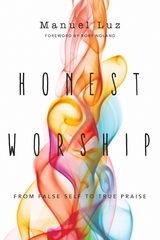
Manuel Luz is the creative arts pastor of Oak Hills Church in Folsom, California, and has been an active advocate for worship and the arts for more than twenty-five years. He is also the author of Imagine That, a working musician and songwriter, and the co-inventer of the musical instrument the WalkaBout.
When asked by his son why some churches have smoke machines, worship pastor Manuel Luz found himself responding, "e;Well, technically, you need smoke machines to see the lasers."e; But when you take down the smokescreen, what do you have left? Where do we encounter the Holy in the midst of all this? Where can we worship with our full selves-heart, soul, mind, and body-in Spirit and truth?Drawing from his own experience leading worship in a large congregation and feeling the pull of performance, Manuel Luz guides us on a journey through worship that takes us far beyond style and deep into our own souls. He calls us back to an honest worship that moves past facades and pulls us inward toward the true self that God is forming within each of us. Each chapter ends with a spiritual practice designed to help us set aside pretense and enter into the very presence of God.
Manuel Luz is the creative arts pastor of Oak Hills Church in Folsom, California, and has been an active advocate for worship and the arts for more than twenty-five years. He is also the author of Imagine That, a working musician and songwriter, and the co-inventer of the musical instrument the WalkaBout.
One
Holy Smoke
Then he was told, “Go, stand on the mountain at attention before GOD. GOD will pass by.”
A hurricane wind ripped through the mountains and shattered the rocks before GOD, but GOD wasn’t to be found in the wind; after the wind an earthquake, but GOD wasn’t in the earthquake; and after the earthquake fire, but GOD wasn’t in the fire; and after the fire a gentle and quiet whisper.
When Elijah heard the quiet voice, he muffled his face with his great cloak, went to the mouth of the cave, and stood there.
MY TEENAGE SON, JUSTIN, had been invited to an area church by a friend. Since he had grown up as a PK (pastor’s kid) and had never been to a megachurch like this before, I wondered what impression it might give him.
Sure enough, soon after his experience, Justin asked me a question: “Why do they need smoke machines in church?”
There was much I could have said in that moment. I could have contrasted different philosophies of ministry, especially in relation to the seeker movement in our postmodern culture, and explained how some view the Sunday service as having components of both worship and evangelism. I could have articulated the differences between entertainment and engagement and how the two, while they may look similar, are very different in intent and outcome. And I could have passionately shared my deeply held convictions on worship theology, what it means to come before the throne of God as the people of God, the bride and the Bridegroom, the community of believers with the community of the Godhead. But I didn’t.
Instead I simply replied, “Well, technically, you need the smoke machines to be able to see the lasers.”
THE STATE OF THE ART
Generalizing broadly, worship in a number of churches today is a far cry from that of previous generations. Computer-controlled concert lighting, digital automated sound systems, high decibels, and high-definition screens create a dynamic, multisensory experience. On the expansive platform, talented musicians command center stage, performing the current worship songs with note-for-note perfection, underscored by click tracks and drum loops. Ushers greet people warmly, offering ear plugs along with the bulletins. There’s an emphasis on branding, social media, and corporate organization. There may even be a hipster self-awareness that permeates the room, an anti-fashion fashionableness.
These churches, which some refer to as “attractional model,” carefully and purposefully design high-impact experiences to attract people to their weekend services. With roots that trace through the seeker movement of the eighties and nineties, they understand that high production values and marquee personalities both attract nonbelievers and retain believers. High-tech media and pop style are the vernacular of modern culture and can be used to effectively speak into that culture. And to these churches’ credit, many people come and worship God, mature as Christians, and share their faith.
Smaller churches, which often sit in the shadows of their neighboring megachurches, are also swept into the slipstream of this cutting edge. Small and medium-sized churches are often caught in the whirlwind of trying to modernize technology, media, facilities, web presence—and talent. Even volunteer worship leaders feel the pressure to “sound like the record” when they lead worship.
Due to the explosion of the worship industry in the last decade (from CDs to radio airplay to major concert tours), musical selection in worship services has become more important than ever. People want to hear their latest favorite worship songs. And while the worship wars of the previous generation are generally a distant memory, we are still jounced by their wake. Hymn books, pipe organs, and choirs have become anachronisms. Some churches have settled on separate services, providing traditional and blended alternatives. While this pragmatism has proved workable for many churches, the issue remains that worship has too often devolved into stylistic preferences.
In the midst of these sweeping trends, some attenders succumb to the temptation to church-hop, sampling church services like so many downtown restaurants. Many older attenders are unsettled, even exasperated by the changes, and make it their business to rally for some semblance of familiarity, for hymns and “praise choruses.” Some young and old, unimpressed by the high production values of today’s churches, are instead turning to liturgy, to quieter, ancient-future expressions of the faith, in order to meet an unhurried God.1 Others, seeking more organic community, are attending intimate, high-touch house churches. But the disturbing trend is that some people—from boomers to millennials—are choosing to leave the institution of the church entirely. Perhaps they have been jaded by the experience of church or the attitudes of the attenders, like Dorothy discovering the wizard behind the curtain. Or perhaps the world’s distractions are simply too big and too loud to ignore.
Certainly the church is in flux. And the implications for worship—and the worshiper—are many.
Now, I’m not doubting the sincerity or integrity of any of these churches or of their leaders. I firmly believe that these churches are filled with good-hearted, God-focused people who are trying to do their best to further the kingdom. I also don’t have anything against high-tech production or hip music or excellence in the arts. Cutting-edge worship music is a staple at the church I pastor, and for many years I’ve been an outspoken advocate for the arts in the church and for artists of faith. This is an exciting time to be an artist of faith, and I’m grateful to be a part of it all. Further, I have many friends and associates who minister in both small churches and megachurches, and I know them to be God-honoring Christ-followers. But there are pitfalls and tripwires all around these issues of which we must be acutely aware. As A. W. Tozer warned, “Worship is no longer worship when it reflects the culture around us more than the Christ within us.”2
At the crux of all these trends is the desire to help worshipers worship, to meet God in a transcendent and transformative way, and to give God glory. And that’s a good thing. The holes in our hearts can be filled only by God, and it is the calling of the church to help people become heart-filled and soul-alive.
SPECTACLE AND TRANSCENDENCE
As humans, we long for transcendence.3 We long for experiences that take us beyond the mere material, corporeal world. We thirst for things beyond this earthly plane, things that lift us up and give us a sense of wholeness and acceptance and assurance. We were made this way. This universal longing is a good thing because it serves as a divining rod of sorts, pointing us to the one true God.
But we are self-focused beings by nature, living in an increasingly narcissistic culture. And we take that cultural self-centeredness into our worship services in deep and subversive ways that we may not realize. We bring our angst, our neediness, our consumer-driven worldview, our pop-culture appetites, and our narcissistic tendencies into Sunday morning. Instead of seeking communion with God, we often seek experiences of God. Instead of encounter, we settle for escapism. When we do, we’re in danger of revering the experience more than the Person. And that puts us in a precarious place.
Transcendent moments with God can’t be manufactured. No matter how we try, we can’t program them, design them, or will them to happen. Transcendence is a Holy Spirit thing.
So we turn to the arts, which are transcendent in nature. They can express the unexplainable and convey emotion, beauty, and truth beyond mere words. Using the arts, we create spectacle, because that’s what we know how to do. We compose amazing songs and assemble talented bands with accomplished vocalists to sing them. We employ mind-blowing sound, lighting, and multimedia systems. We incorporate theatrical and visual arts into our productions. Whether it be a mass choir and orchestra, a rock band with pulsing lasers, or a gospel fusion ensemble with a horn section, we create emotive and sensational experiences. Because we’re human beings and because the arts are a natural part of how we express ourselves, we create great spectacles. And honestly, we’re really good at it. We’ve become quite sophisticated at stirring our emotions and impressing ourselves. But spectacle can turn people into spectators. And the act of worship is neither passive nor inert.
Now, I’m not saying that God-breathed transcendence doesn’t happen in these experiences. It most certainly does. What I am saying is that we’re sometimes too quick to create spectacle, too quick to want to be wowed and have our emotions stirred in the name of God. If we are brutally honest with ourselves, we will admit this to be too often true. We can’t manufacture holy transcendence, but we can manufacture spectacle, so we create spectacular services that titillate and tease, inspire and impress. And then we trust that God will show up.
I know this to be true—because I am one of those leaders who created spectacle, who led large teams of musicians, artists, and technicians to create grand and glorious shows brimming with the gospel, full of great energy and creativity and technology. It was my job. We did it really well. And truth be told, we were all a little intoxicated by the thrill of...
| Erscheint lt. Verlag | 7.8.2018 |
|---|---|
| Vorwort | Rory Noland |
| Verlagsort | Lisle |
| Sprache | englisch |
| Themenwelt | Religion / Theologie ► Christentum ► Kirchengeschichte |
| Religion / Theologie ► Christentum ► Liturgik / Homiletik | |
| Religion / Theologie ► Christentum ► Moraltheologie / Sozialethik | |
| Religion / Theologie ► Christentum ► Pastoraltheologie | |
| Schlagworte | ART • authentic • Christian • Church • church ministry • church worship • Compassion • Creative arts • creative worship • exalt • Expression • extol • genuine • glorify • God • Hillsong • Holy • how to lead worship • Identity • Imagination • Justice • Leader • Mega • ministry • modern worship • music • Oak Hills Church • Parish • Performative • practicalapplication • Presence • Renovation o • Rhythm • self-awareness • Soul • SPIRIT • spirit of worship • Spiritual • true worship • Truth • Worship • worship arts • worship leader • worship ministry • worship pastor • worship service |
| ISBN-10 | 0-8308-8025-9 / 0830880259 |
| ISBN-13 | 978-0-8308-8025-6 / 9780830880256 |
| Informationen gemäß Produktsicherheitsverordnung (GPSR) | |
| Haben Sie eine Frage zum Produkt? |
 EPUB (Adobe DRM)
Kopierschutz: Adobe-DRM
Adobe-DRM ist ein Kopierschutz, der das eBook vor Mißbrauch schützen soll. Dabei wird das eBook bereits beim Download auf Ihre persönliche Adobe-ID autorisiert. Lesen können Sie das eBook dann nur auf den Geräten, welche ebenfalls auf Ihre Adobe-ID registriert sind.
Details zum Adobe-DRM
Dateiformat: EPUB (Electronic Publication)
EPUB ist ein offener Standard für eBooks und eignet sich besonders zur Darstellung von Belletristik und Sachbüchern. Der Fließtext wird dynamisch an die Display- und Schriftgröße angepasst. Auch für mobile Lesegeräte ist EPUB daher gut geeignet.
Systemvoraussetzungen:
PC/Mac: Mit einem PC oder Mac können Sie dieses eBook lesen. Sie benötigen eine
eReader: Dieses eBook kann mit (fast) allen eBook-Readern gelesen werden. Mit dem amazon-Kindle ist es aber nicht kompatibel.
Smartphone/Tablet: Egal ob Apple oder Android, dieses eBook können Sie lesen. Sie benötigen eine
Geräteliste und zusätzliche Hinweise
Buying eBooks from abroad
For tax law reasons we can sell eBooks just within Germany and Switzerland. Regrettably we cannot fulfill eBook-orders from other countries.
aus dem Bereich