


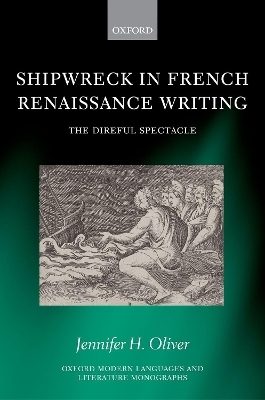
Shipwreck in French Renaissance Writing
Seiten
2019
Oxford University Press (Verlag)
978-0-19-883170-9 (ISBN)
Oxford University Press (Verlag)
978-0-19-883170-9 (ISBN)
Jennifer H. Oliver explores the extent to which depictions of the ship in sixteenth century France are freighted with political, religious, and poetic symbolism. She examines the ways in which the ship and the body are made analogous in Renaissance shipwreck writing.
In the sixteenth century, a period of proliferating transatlantic travel and exploration, and, latterly, religious civil wars in France, the ship is freighted with political and religious, as well as poetic, significance; symbolism that reaches its height when ships--both real and symbolic--are threatened with disaster. The Direful Spectacle argues that, in the French Renaissance, shipwreck functions not only as an emblem or motif within writing, but as a part, or the whole, of a narrative, in which the dynamics of spectatorship and of co-operation are of constant concern. The possibility of ethical distance from shipwreck--imagined through the Lucretian suave mari magno commonplace--is constantly undermined, not least through a sustained focus on the corporeal. This book examines the ways in which the ship and the body are made analogous in Renaissance shipwreck writing; bodies are described and allegorized in nautical terms, and, conversely, ships themselves become animalized and humanized. Secondly, many texts anticipate that the description of shipwreck will have an affect not only on its victims, but on those too of spectators, listeners, and readers. This insistence on the physicality of shipwreck is also reflected in the dynamic of bricolage that informs the production of shipwreck texts in the Renaissance. The dramatic potential of both the disaster and the process of rebuilding is exploited throughout the century, culminating in a shipwreck tragedy. By the late Renaissance, shipwreck is not only the end, but often forms the beginning of a story.
In the sixteenth century, a period of proliferating transatlantic travel and exploration, and, latterly, religious civil wars in France, the ship is freighted with political and religious, as well as poetic, significance; symbolism that reaches its height when ships--both real and symbolic--are threatened with disaster. The Direful Spectacle argues that, in the French Renaissance, shipwreck functions not only as an emblem or motif within writing, but as a part, or the whole, of a narrative, in which the dynamics of spectatorship and of co-operation are of constant concern. The possibility of ethical distance from shipwreck--imagined through the Lucretian suave mari magno commonplace--is constantly undermined, not least through a sustained focus on the corporeal. This book examines the ways in which the ship and the body are made analogous in Renaissance shipwreck writing; bodies are described and allegorized in nautical terms, and, conversely, ships themselves become animalized and humanized. Secondly, many texts anticipate that the description of shipwreck will have an affect not only on its victims, but on those too of spectators, listeners, and readers. This insistence on the physicality of shipwreck is also reflected in the dynamic of bricolage that informs the production of shipwreck texts in the Renaissance. The dramatic potential of both the disaster and the process of rebuilding is exploited throughout the century, culminating in a shipwreck tragedy. By the late Renaissance, shipwreck is not only the end, but often forms the beginning of a story.
Jennifer Oliver is Supernumerary Teaching Fellow in French at St John's College, Oxford. Her research is centred on sixteenth-century French literature, culture, and thought. Her next project examines how French writers of the sixteenth century contemplated the connections and tensions between poetics, technology, and the natural environment.
Introduction
1: 'Le naufrage de ce mortel monde': Shipwreck and the Nef
2: 'À deux doigtz prés de la mort': From shipwreck to storm scene (and back again)
3: 'Cet universel naufrage du monde': Shipwreck in a time of civil war
4: 'Shipwreckful' afterlives: 'Naufrage' and Histoire
Conclusion
Bibliography
Index
| Erscheinungsdatum | 12.10.2019 |
|---|---|
| Reihe/Serie | Oxford Modern Languages and Literature Monographs |
| Verlagsort | Oxford |
| Sprache | englisch |
| Maße | 164 x 241 mm |
| Gewicht | 526 g |
| Themenwelt | Geisteswissenschaften ► Geschichte ► Teilgebiete der Geschichte |
| Geisteswissenschaften ► Sprach- / Literaturwissenschaft ► Anglistik / Amerikanistik | |
| Geisteswissenschaften ► Sprach- / Literaturwissenschaft ► Literaturwissenschaft | |
| ISBN-10 | 0-19-883170-6 / 0198831706 |
| ISBN-13 | 978-0-19-883170-9 / 9780198831709 |
| Zustand | Neuware |
| Informationen gemäß Produktsicherheitsverordnung (GPSR) | |
| Haben Sie eine Frage zum Produkt? |
Mehr entdecken
aus dem Bereich


aus dem Bereich
Mythen und Legenden aus der Seefahrt
Buch | Hardcover (2025)
Regionalia Verlag
CHF 13,90
das bewegte Leben des Aimé Felix Tschiffely
Buch | Hardcover (2025)
Weber Verlag
CHF 49,00


