


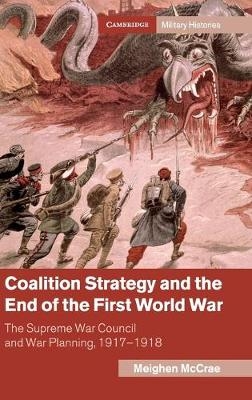
Coalition Strategy and the End of the First World War
The Supreme War Council and War Planning, 1917–1918
Seiten
2019
Cambridge University Press (Verlag)
978-1-108-47530-3 (ISBN)
Cambridge University Press (Verlag)
978-1-108-47530-3 (ISBN)
Allied political and military leadership had been planning for, and expecting, the First World War to continue into 1919. In this exploration of Allied war plans for 1918–1919, Meighen McCrae uncovers how the Supreme War Council became a successful mechanism for coalition war.
When the Germans requested an armistice in October 1918, it was a shock to the Allied political and military leadership. They had been expecting, and planning for, the war to continue into 1919, the year they hoped to achieve a complete military victory over the Central Powers. Meighen McCrae illuminates how, throughout this planning process, the Supreme War Council evolved to become the predominant mechanism for coalition war-making. She analyses the Council's role in the formulation of an Allied strategy for 1918–1919 across the various theatres of war and compares the perspectives of the British, French, Americans and Italians. In doing so we learn how, in an early example of modern alliance warfare, the Supreme War Council had to coordinate national needs with coalition ones.
When the Germans requested an armistice in October 1918, it was a shock to the Allied political and military leadership. They had been expecting, and planning for, the war to continue into 1919, the year they hoped to achieve a complete military victory over the Central Powers. Meighen McCrae illuminates how, throughout this planning process, the Supreme War Council evolved to become the predominant mechanism for coalition war-making. She analyses the Council's role in the formulation of an Allied strategy for 1918–1919 across the various theatres of war and compares the perspectives of the British, French, Americans and Italians. In doing so we learn how, in an early example of modern alliance warfare, the Supreme War Council had to coordinate national needs with coalition ones.
Meighen McCrae is Lecturer in the Strategic and Defence Studies Centre at Australian National University, Canberra.
Introduction; 1. The Supreme War Council; 2. Offensive action in the Balkans?; 3. Eliminate the Ottoman Empire?; 4. Maintaining the Italians – the role of the Italian theatre in creating an Allied strategy; 5. The role of the Franco-Belgian front in determining an Allied policy for 1919; 6. Building a bridge to France: the role of resources in creating an Allied strategy for 1919; Conclusions.
| Erscheinungsdatum | 07.02.2019 |
|---|---|
| Reihe/Serie | Cambridge Military Histories |
| Zusatzinfo | Worked examples or Exercises; 7 Tables, black and white; 4 Maps; 1 Line drawings, black and white |
| Verlagsort | Cambridge |
| Sprache | englisch |
| Maße | 160 x 235 mm |
| Gewicht | 560 g |
| Themenwelt | Geisteswissenschaften ► Geschichte ► Regional- / Ländergeschichte |
| Geschichte ► Teilgebiete der Geschichte ► Militärgeschichte | |
| ISBN-10 | 1-108-47530-2 / 1108475302 |
| ISBN-13 | 978-1-108-47530-3 / 9781108475303 |
| Zustand | Neuware |
| Informationen gemäß Produktsicherheitsverordnung (GPSR) | |
| Haben Sie eine Frage zum Produkt? |
Mehr entdecken
aus dem Bereich

aus dem Bereich
von der Wiederbewaffnung bis zur Zeitenwende
Buch | Softcover (2025)
C.H.Beck (Verlag)
CHF 16,80
Deutschlands großer Volksaufstand
Buch | Softcover (2024)
Propyläen Verlag
CHF 30,80


