


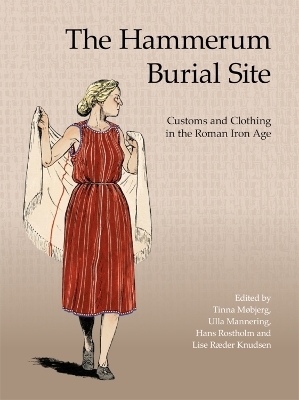
The Hammerum Burial Site
Customs and Clothing in the Roman Iron Age
Seiten
2019
Jysk Arkaeologisk Selskab (Verlag)
978-87-93423-23-7 (ISBN)
Jysk Arkaeologisk Selskab (Verlag)
978-87-93423-23-7 (ISBN)
- Titel nicht im Sortiment
- Artikel merken
An interdisciplinary investigation of an Iron Age burial site near Hammerum unveils a vivid narrative of everyday customs, refined textile craftsmanship, and ritual mourning. Detailed studies of preserved organic remains—from delicate textiles to hair—shed light on intimate cultural practices and pan?European influences.
The book: The Hammerum Burial Site is the story of a burial site told by more than 20 academics; a fascinating combination of different archaeological and scientific studies analyzing individuals, objects and context from different angles. The site was named after the small modern-day town of Hammerum, 5 km east of Herning in the central part of Jutland, Denmark. As early as 1993 the museum investigated this burial site, where seven inhumation graves emerged within a small area, most of which turned out to be empty of finds. Three of the graves did turn out, however, to contain well preserved organic material, so they were removed as block samples in large wooden crates with a view to later excavation. Thanks to a grant in 2009 from the Danish Cultural Agency's special pool for the conservation of objects of unique national importance (the ENB pool) a collaboration between the museum, the Danish National Research Foundation Centre for Textile Research and the Conservation Centre in Vejle began. These analyses show that grave 83 – known as the Hammerum girls grave – was a sensation. All that remain of the deceased was her hair and her dress, but it was the best-preserved Danish Iron Age textile from an inhumation grave. Therefore, it offers an unique opportunity to analyse an object which in most cases has disappeared. The analysis tells us an extraordinarily nuanced archaeological story of daily life and of pan-European 'slow fashion': a dress used in everyday life, produced by carefully choosing fine fibres which, together with the coiffure refers to a style recognizable throughout Europe and worn by a mobile, well-groomed, well-connected Iron Age female. Moreover, the preserved organic material permits us a rare glimpse of the grief of the bereaved. We can see how they carefully wrapped the Hammerum Girl in skin and put blueberry twigs under her head before laying her to rest – an act of compassion and mourning.
The book: The Hammerum Burial Site is the story of a burial site told by more than 20 academics; a fascinating combination of different archaeological and scientific studies analyzing individuals, objects and context from different angles. The site was named after the small modern-day town of Hammerum, 5 km east of Herning in the central part of Jutland, Denmark. As early as 1993 the museum investigated this burial site, where seven inhumation graves emerged within a small area, most of which turned out to be empty of finds. Three of the graves did turn out, however, to contain well preserved organic material, so they were removed as block samples in large wooden crates with a view to later excavation. Thanks to a grant in 2009 from the Danish Cultural Agency's special pool for the conservation of objects of unique national importance (the ENB pool) a collaboration between the museum, the Danish National Research Foundation Centre for Textile Research and the Conservation Centre in Vejle began. These analyses show that grave 83 – known as the Hammerum girls grave – was a sensation. All that remain of the deceased was her hair and her dress, but it was the best-preserved Danish Iron Age textile from an inhumation grave. Therefore, it offers an unique opportunity to analyse an object which in most cases has disappeared. The analysis tells us an extraordinarily nuanced archaeological story of daily life and of pan-European 'slow fashion': a dress used in everyday life, produced by carefully choosing fine fibres which, together with the coiffure refers to a style recognizable throughout Europe and worn by a mobile, well-groomed, well-connected Iron Age female. Moreover, the preserved organic material permits us a rare glimpse of the grief of the bereaved. We can see how they carefully wrapped the Hammerum Girl in skin and put blueberry twigs under her head before laying her to rest – an act of compassion and mourning.
Ulla Mannering is a widely published author with a PhD in prehistoric archaeology from the University of Copenhagen in Denmark. She is one of the initiators of the Danish National Research Foundation’s Centre for Textile Research in Copenhagen and Senior Researcher at the National Museum of Denmark. She is specialized in prehistoric skin and textile production and clothing design in Northern Europe. She has also worked with Roman textiles and clothing. Her current research focuses on resource exploitation and design in Scandinavian Bronze and Early Iron Age societies.
| Erscheinungsdatum | 30.10.2018 |
|---|---|
| Co-Autor | Ida Demant |
| Sprache | englisch |
| Maße | 225 x 300 mm |
| Gewicht | 1225 g |
| Themenwelt | Geisteswissenschaften ► Archäologie |
| Geschichte ► Allgemeine Geschichte ► Altertum / Antike | |
| ISBN-10 | 87-93423-23-3 / 8793423233 |
| ISBN-13 | 978-87-93423-23-7 / 9788793423237 |
| Zustand | Neuware |
| Informationen gemäß Produktsicherheitsverordnung (GPSR) | |
| Haben Sie eine Frage zum Produkt? |
Mehr entdecken
aus dem Bereich


aus dem Bereich
ohne den ganzen langweiligen Kram
Buch | Hardcover (2025)
C.H.Beck (Verlag)
CHF 36,40
von den Anfängen bis zum Untergang
Buch | Hardcover (2025)
Alfred Kröner Verlag
CHF 48,95
von den Anfängen bis zur Gegenwart
Buch | Softcover (2025)
C.H.Beck (Verlag)
CHF 16,80


