Writing with Deleuze in the Academy (eBook)
XII, 212 Seiten
Springer Singapore (Verlag)
978-981-13-2065-1 (ISBN)
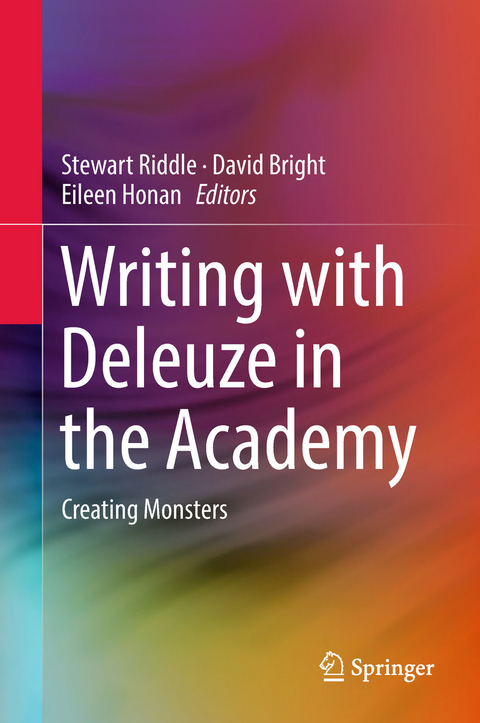
In this book, authors working with Deleuzean theories in educational research in Australia and the United Kingdom grapple with how the academic-writing machine might become less contained and bounded, and instead be used to free impulses to generate different creations and connections. The authors experiment with forms of writing that challenge the boundaries of academic language, moving beyond the strictures of the scientific method that governs and controls what works and what counts to make language vibrate with a new intensity.
The authors construct monstrous creations, full of vitality and fervor, hybrid texts, part academic part creative assemblages, almost-but-perhaps-not-quite recognisable as research. Stories that blur the lines between true and untrue, re-presentation and invention.
The contributors to this book hope that something might happen in its reading; that some new connections might be made, but also acknowledge the contingency of the encounter between text and reader, and the impossibility of presuming to know what may be.
Dr Stewart Riddle is a Senior Lecturer at the School of Teacher Education and Early Childhood at the University of Southern Queensland. His research interests include social justice and equity in education, music-based research practices and research methodologies. He also plays bass in a band called Drawn from Bees.
Dr David Bright is a Lecturer at the Faculty of Education, Monash University, Australia. His research interests include student and teacher identity/difference, post-structural theory, post-qualitative research methodologies, and creative approaches to academic writing. David's PhD study of international schools in Vietnam was awarded a Graduate School Dean's Award for Outstanding Research in a Higher Degree Thesis and the N. V. Varghese Prize for Comparative Education, both presented by the University of Queensland, as well as the 2015 Illinois Qualitative Dissertation Award (Experimental) presented at the 12th International Congress of Qualitative Inquiry. He teaches in the areas of English as an additional language/teaching English to speakers of other languages, Indigenous education, inclusive education, and sociology of education.
Dr Eileen Honan is Professor of Educational Research at Fiji National University, where her work centres on supporting early career academics to develop their research capabilities. She is interested in postqualitative research methods and inquiry and the application of Deleuzean philosophy to the ontology and epistemology of educational research.
In this book, authors working with Deleuzean theories in educational research in Australia and the United Kingdom grapple with how the academic-writing machine might become less contained and bounded, and instead be used to free impulses to generate different creations and connections. The authors experiment with forms of writing that challenge the boundaries of academic language, moving beyond the strictures of the scientific method that governs and controls what works and what counts to make language vibrate with a new intensity.The authors construct monstrous creations, full of vitality and fervor, hybrid texts, part academic part creative assemblages, almost-but-perhaps-not-quite recognisable as research. Stories that blur the lines between true and untrue, re-presentation and invention.The contributors to this book hope that something might happen in its reading; that some new connections might be made, but also acknowledge the contingency of the encounter between text and reader, and the impossibility of presuming to know what may be.
Dr Stewart Riddle is a Senior Lecturer at the School of Teacher Education and Early Childhood at the University of Southern Queensland. His research interests include social justice and equity in education, music-based research practices and research methodologies. He also plays bass in a band called Drawn from Bees.Dr David Bright is a Lecturer at the Faculty of Education, Monash University, Australia. His research interests include student and teacher identity/difference, post-structural theory, post-qualitative research methodologies, and creative approaches to academic writing. David's PhD study of international schools in Vietnam was awarded a Graduate School Dean’s Award for Outstanding Research in a Higher Degree Thesis and the N. V. Varghese Prize for Comparative Education, both presented by the University of Queensland, as well as the 2015 Illinois Qualitative Dissertation Award (Experimental) presented at the 12th International Congress of Qualitative Inquiry. He teaches in the areas of English as an additional language/teaching English to speakers of other languages, Indigenous education, inclusive education, and sociology of education.Dr Eileen Honan is Professor of Educational Research at Fiji National University, where her work centres on supporting early career academics to develop their research capabilities. She is interested in postqualitative research methods and inquiry and the application of Deleuzean philosophy to the ontology and epistemology of educational research.
1 Bringing monsters to life through encounters with writing.- 2 Using pregnant text as a lure for collective writing and its monstrous effects.- 3 Unplugging from the Goldberg machine.- 4 Becoming monstrous: On the limits of the body of a child.- 5 An experiment in writing that flows.- 6 On being and becoming the monstrous subject of measurement.- 7 Signs to be developed: Experiments in writing.- 8 An experiment in writing that flows: Citationality and collaborative writing.- 9 'Terre Chérie - Ed U.K. Shone': A desiring machine for rappin' and extrapolatin' on the monstrosities of academia.- 10 Shifting sands: Writing across time.- 11 Falling in/out of languagings.- 12 Composing with the Chthulucene: Desiring a minor literature.- 13 Learning to fear the monstrous: Klossowski and the Immortal Adolescent.- 14 MmmAfterword: Writing monstrous.
| Erscheint lt. Verlag | 25.9.2018 |
|---|---|
| Zusatzinfo | XII, 212 p. 28 illus., 21 illus. in color. |
| Verlagsort | Singapore |
| Sprache | englisch |
| Themenwelt | Geisteswissenschaften ► Sprach- / Literaturwissenschaft ► Sprachwissenschaft |
| Sozialwissenschaften ► Pädagogik ► Allgemeines / Lexika | |
| Sozialwissenschaften ► Pädagogik ► Bildungstheorie | |
| Sozialwissenschaften ► Pädagogik ► Erwachsenenbildung | |
| Schlagworte | Academic publishing • Academic Writing • Deleuze • Education research • Onto-epistemology • Research Assessment • research as writing • Research policy • research problems • research writing |
| ISBN-10 | 981-13-2065-9 / 9811320659 |
| ISBN-13 | 978-981-13-2065-1 / 9789811320651 |
| Informationen gemäß Produktsicherheitsverordnung (GPSR) | |
| Haben Sie eine Frage zum Produkt? |
 PDF (Wasserzeichen)
DRM: Digitales Wasserzeichen
Dieses eBook enthält ein digitales Wasserzeichen und ist damit für Sie personalisiert. Bei einer missbräuchlichen Weitergabe des eBooks an Dritte ist eine Rückverfolgung an die Quelle möglich.
Dateiformat: PDF (Portable Document Format)
Mit einem festen Seitenlayout eignet sich die PDF besonders für Fachbücher mit Spalten, Tabellen und Abbildungen. Eine PDF kann auf fast allen Geräten angezeigt werden, ist aber für kleine Displays (Smartphone, eReader) nur eingeschränkt geeignet.
Systemvoraussetzungen:
PC/Mac: Mit einem PC oder Mac können Sie dieses eBook lesen. Sie benötigen dafür einen PDF-Viewer - z.B. den Adobe Reader oder Adobe Digital Editions.
eReader: Dieses eBook kann mit (fast) allen eBook-Readern gelesen werden. Mit dem amazon-Kindle ist es aber nicht kompatibel.
Smartphone/Tablet: Egal ob Apple oder Android, dieses eBook können Sie lesen. Sie benötigen dafür einen PDF-Viewer - z.B. die kostenlose Adobe Digital Editions-App.
Buying eBooks from abroad
For tax law reasons we can sell eBooks just within Germany and Switzerland. Regrettably we cannot fulfill eBook-orders from other countries.
aus dem Bereich