


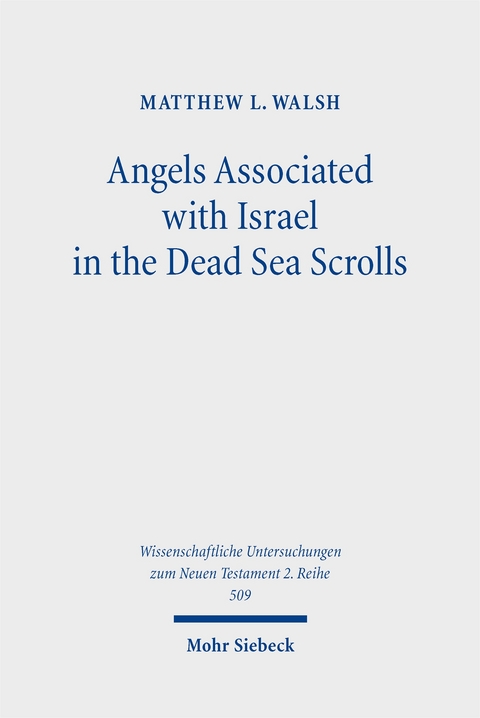
Angels Associated with Israel in the Dead Sea Scrolls
Angelology and Sectarian Identity at Qumran
Seiten
2019
Mohr Siebeck (Verlag)
978-3-16-155303-5 (ISBN)
Mohr Siebeck (Verlag)
978-3-16-155303-5 (ISBN)
Eine wohlbekannte Eigenschaft der konfessionsgebundenen Schriftrollen vom Toten Meer ist deren Behauptung, dass eine Mitgliedschaft in der Qumran-Bewegung gegenwärtige und eschatologische Gemeinschaft mit den Engeln beinhaltete. Um ein besseres Verständnis der Gemeinschaft mit den Engeln in Qumran zu erlangen, wendet Matthew L. Walsh das frühjüdische Konzept an, nach dem bestimmte Engel eng mit Israel assoziiert wurden.
A well-known characteristic of the sectarian Dead Sea Scrolls are their assertions that membership in the Qumran movement included present and eschatological fellowship with the angels, but scholars disagree as to the precise meaning of these claims. To gain a better understanding of angelic fellowship at Qumran, Matthew L. Walsh utilizes the early Jewish concept that certain angels were closely associated with Israel. Moreover, these angels, which included guardians and priests, were envisioned within apocalyptic worldviews that assumed that realities on earth corresponded to those of the heavenly realm. A comparison of non-sectarian texts with sectarian compositions reveals that the Qumran movement's lofty assertions of communion with the guardians and priests of heavenly Israel would have made a significant contribution to their identity as the true Israel.
A well-known characteristic of the sectarian Dead Sea Scrolls are their assertions that membership in the Qumran movement included present and eschatological fellowship with the angels, but scholars disagree as to the precise meaning of these claims. To gain a better understanding of angelic fellowship at Qumran, Matthew L. Walsh utilizes the early Jewish concept that certain angels were closely associated with Israel. Moreover, these angels, which included guardians and priests, were envisioned within apocalyptic worldviews that assumed that realities on earth corresponded to those of the heavenly realm. A comparison of non-sectarian texts with sectarian compositions reveals that the Qumran movement's lofty assertions of communion with the guardians and priests of heavenly Israel would have made a significant contribution to their identity as the true Israel.
Born 1978; 2016 PhD in Religious Studies (Second Temple Period Judaism and Early Christianity) from McMaster University in Hamilton, Ontario, Canada; since 2016 Assistant Professor of Biblical Studies, Acadia Divinity College in Wolfville, Nova Scotia, Canada.
| Erscheinungsdatum | 14.12.2019 |
|---|---|
| Reihe/Serie | Wissenschaftliche Untersuchungen zum Neuen Testament 2. Reihe |
| Verlagsort | Tübingen |
| Sprache | englisch |
| Maße | 159 x 233 mm |
| Gewicht | 554 g |
| Themenwelt | Religion / Theologie ► Christentum ► Bibelausgaben / Bibelkommentare |
| Geisteswissenschaften ► Religion / Theologie ► Judentum | |
| Geisteswissenschaften ► Sprach- / Literaturwissenschaft ► Literaturwissenschaft | |
| Schlagworte | Apocalyptic • Apocalyptic Literature • heavenly • Heavenly realm • Identity • Judaism • Literature • Old • Old Testament • Period • realm • Religious • Religious Identity • Second • Second Temple Period Judaism • Temple • Testament |
| ISBN-10 | 3-16-155303-9 / 3161553039 |
| ISBN-13 | 978-3-16-155303-5 / 9783161553035 |
| Zustand | Neuware |
| Informationen gemäß Produktsicherheitsverordnung (GPSR) | |
| Haben Sie eine Frage zum Produkt? |
Mehr entdecken
aus dem Bereich


aus dem Bereich
Buch | Softcover (2021)
De Gruyter (Verlag)
CHF 44,90


