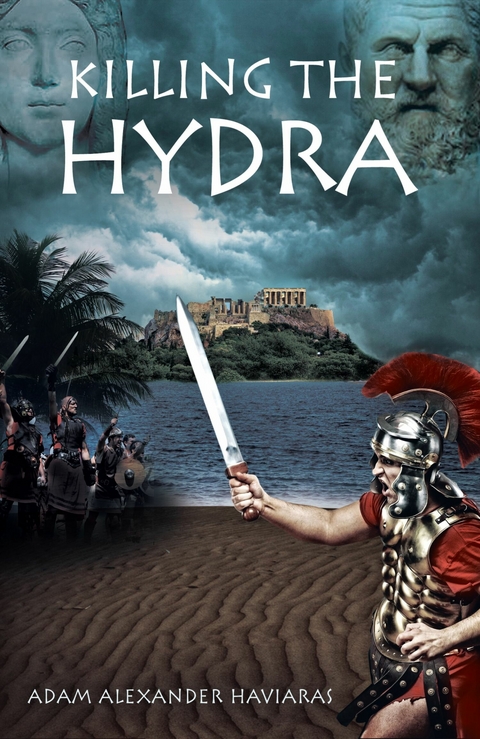
Killing the Hydra (eBook)
733 Seiten
Eagles and Dragons Publishing (Verlag)
978-0-9877624-4-3 (ISBN)
At the peak of Rome's might a dragon is born among eagles, an heir to a line both blessed and cursed by the Gods for ages.
In Killing the Hydra, Lucius Metellus Anguis returns to North Africa, determined to investigate the death of his centurion and root out the treason that has infiltrated the ranks of his cohort. With his wife, Adara, safe in Athens, Lucius finds himself alone on a dangerous road back to the legionary base at Lambaesis. Praetorian spies and other unknown enemies are hunting him, and it is only with help from the Empress, a Punic prostitute, and an ancient group of warriors that Lucius is able to survive.
But the Sibyl's prophecy haunts Lucius's dreams, and he clings desperately to the hope that he is making the right decisions for his men, for himself, and for his family.
As his world is ravaged by pain on all fronts, Lucius Metellus Anguis must decide whether or not to make his move against the enemies that have plagued his family for far too long, including the most powerful man in the Roman Empire.
How far will the Dragon go to protect his family and avenge the spirits of the dead?
Only the Gods know...
Killing the Hydra is the third novel in Adam Alexander Haviaras' ground-breaking Eagles and Dragons historical fantasy series. If you like books by Douglas Jackson, Manda Scott, and Conn Iggulden, or movies like Gladiatorand Pompeii, then you will love this historical series that combines adventure, romance, and the supernatural.
Buy Killing the Hydra today and set off on an adventure that throws you headlong into the Roman Empire!
Here is what readers have to say about Eagles and Dragons:
Historic Novel Society:
'...Haviaras handles it all with smooth skill. The world of third-century Rome-both the city and its African outposts-is colorfully vivid here, and Haviaras manages to invest even his secondary and tertiary characters with believable, three-dimensional humanity.'
Amazon Readers:
'Historical fiction at its best! ... if you like your historical fiction to be an education as well as a fun read, this is the book for you!'
'An outstanding and compelling novel!'
'I would add this author to some of the great historical writers such as Conn Iggulden, Simon Scarrow and David Gemmell. The characters were described in such a way that it was easy to picture them as if they were real and have lived in the past, the book flowed with an ease that any reader, novice to advanced can enjoy and become fully immersed...'
Goodreads:
'... a very entertaining read; Haviaras has both a fluid writing style, and a good eye for historical detail, and explores in far more detail the faith of the average Roman than do most authors.'
At the peak of Rome's might a dragon is born among eagles, an heir to a line both blessed and cursed by the Gods for ages.In Killing the Hydra, Lucius Metellus Anguis returns to North Africa, determined to investigate the death of his centurion and root out the treason that has infiltrated the ranks of his cohort. With his wife, Adara, safe in Athens, Lucius finds himself alone on a dangerous road back to the legionary base at Lambaesis. Praetorian spies and other unknown enemies are hunting him, and it is only with help from the Empress, a Punic prostitute, and an ancient group of warriors that Lucius is able to survive.But the Sibyl s prophecy haunts Lucius s dreams, and he clings desperately to the hope that he is making the right decisions for his men, for himself, and for his family.As his world is ravaged by pain on all fronts, Lucius Metellus Anguis must decide whether or not to make his move against the enemies that have plagued his family for far too long, including the most powerful man in the Roman Empire.How far will the Dragon go to protect his family and avenge the spirits of the dead?Only the Gods know Killing the Hydra is the third novel in Adam Alexander Haviaras ground-breaking Eagles and Dragons historical fantasy series. If you like books by Douglas Jackson, Manda Scott, and Conn Iggulden, or movies like Gladiatorand Pompeii, then you will love this historical series that combines adventure, romance, and the supernatural.Buy Killing the Hydra today and set off on an adventure that throws you headlong into the Roman Empire!Here is what readers have to say about Eagles and Dragons:Historic Novel Society: Haviaras handles it all with smooth skill. The world of third-century Rome both the city and its African outposts is colorfully vivid here, and Haviaras manages to invest even his secondary and tertiary characters with believable, three-dimensional humanity. Amazon Readers: Historical fiction at its best! if you like your historical fiction to be an education as well as a fun read, this is the book for you! An outstanding and compelling novel! I would add this author to some of the great historical writers such as Conn Iggulden, Simon Scarrow and David Gemmell. The characters were described in such a way that it was easy to picture them as if they were real and have lived in the past, the book flowed with an ease that any reader, novice to advanced can enjoy and become fully immersed Goodreads: a very entertaining read; Haviaras has both a fluid writing style, and a good eye for historical detail, and explores in far more detail the faith of the average Roman than do most authors.
I
Leptis Magna
Leptis Magna was the most gifted, blessed city of Africa Proconsularis. In its infancy it had been a prosperous Phoenician colony and as it matured, bowing to Roman control during the reign of Augustus, it flourished. When Trajan made it an official colonia, the settlement grew with the arrival of officials, traders and settlers in search of prosperity from all corners of the empire.
The city came to enjoy all of the comforts and pleasures that Rome had to offer. Leptis Magna had a theatre built by a local merchant, and the old forum had its own curia, a basilica, a Temple of Liber Pater, an Ionic Temple of Hercules and a Temple of Rome and Augustus. Hadrian also favoured the city with a huge bath complex that included a large palaestra where the inhabitants and troops would exercise and wrestle.
Eventually, Leptis Magna became one of the wealthiest metropolises in the Mare Internum with the richness of its exports going to the furthest reaches of the Roman world. Caravans from the desert interior came to the city’s thriving market to sell everything from ivory and precious gems to slaves and exotic animals. The market was also renowned for its local products such as grain, olive oil from surrounding estates, garum and salted fish, local specialties.
When Septimius Severus became emperor, his home town reached a pinnacle of prosperity and sunned itself in the rays of the Emperor’s favouritism. Severus undertook massive building projects throughout the empire but nowhere more so than in Leptis Magna. In front of the Temple of Jupiter that faced the sea, a new circular harbour was built, complete with a large lighthouse and several warehouses where goods were stored before export.
A new forum, overlooked by large, peering Medusa heads, was built as well as a new Basilica of Severus. The latter was ornately decorated with a forest of red granite columns with white marble capitals, reliefs of acanthus, animal protomes and eye-pleasing mythological scenes. Beautiful statuary shone out from the many niches that adorned the walls where the use of different materials created a sense of sublime elegance. Most fantastic of all was the colonnaded road, sixty-five feet wide, that led from the harbour to a clear-sounding nymphaeum outside the baths. This roadway, unlike any other building project, was composed of six-hundred green-streaked marble columns that gleamed in the sun like blades of emerald grass. At the intersection of the main road through the city and the street leading up from the old forum stood a monument to Leptis Magna’s beloved emperor. Locals and traders walked beneath and admired the newly erected, four-sided arch of Septimius Severus. Its friezes of political and religious scenes in honour of the imperial family were carved in a curiously new style that befitted the metropolitan atmosphere.
The weather had been perfect for the crossing, with crisp seas beneath a sunny sky during the day and calm, moonlit depths by night. A crossing that could have taken over a week in bad weather ended up as a journey of only a few days.
Moon and star had been Lucius’ only companions on those lonely nights and the lulling splash of silky dark water against the hull of the ship doubled as the sound of his wife’s breath in his ear. Many passengers had chosen to go below deck during the night, but he had opted to stay out, his cloak wrapped about him. Occasionally, he would walk the perimeter of the enormous deck to ease his cramped legs and clear his head.
That morning, when land finally came within sight, the sun rose from a blazing red sleep in the east. Lucius was one of the first people awake. He rose from his pile of ropes, splashed water from a bucket on his face and rinsed his mouth with wine. He put his helmet on his head, if only to get it out of the way, picked up his belongings and went to the prow of the ship to take in the view.
Sprawled out before him in the distance was Africa Proconsularis. At first, all he could see were smooth sandy beaches stretching along the limitless shore. As the ships drew closer, the land became green in places where settlements were safely nestled. The sun rose higher, brighter, until finally, like a single flashing diamond in neatly groomed garden grass, Leptis Magna appeared directly ahead of the fleet.
Lucius was surprised by the richness of the city as the gleam of white marble from its monuments began to reflect and shimmer like an oasis. Beyond the city was a backdrop of hills, slopes of green and bronze. The ship gently bobbed up and down as it entered the coastal currents. Then he spotted it. A haze beyond and between the mountains, limitless, opaque…and familiar. The city faded and his eyes were drawn to where it was beginning to bake in the waking sun. The desert.
Leptis Magna was hot and dry and the air was filled with all manner of smells; sea water, fish and drying dung from the animal market mingled with incense, spices and the tang of fresh fruit. The rustle of palm trees could be heard as a hot breeze came off the water, competing with exuberant shouts from the markets, the old and new fora.
Inside the circular harbour, the Emperor’s ship, flanked by the two Praetorian vessels, docked directly in front of the Temple of Jupiter. Slaves lined the quay awaiting baggage instructions; the city prefect and other officials came down the temple steps, where a wide path had been cleared, to greet the emperor. The ship for military officials moored next to one of the Praetorian ships and the passengers disembarked to watch the procession.
Clear sounding horns rang out, accompanied by flutes and drums as the emperor, Julia Domna, their imperial sons, Caracalla and Geta and the empress’ sister, Julia Maesa, stepped onto land. Large crowds had gathered to cheer Septimius Severus, and the way was lined with young girls in Punic dress who cast flowers at the feet of the imperial family. Severus looked around and took in a deep breath; the air of his home was pleasingly familiar. After making an offering to Jupiter in a colossal tripod on the temple steps, thanks for a safe journey, the emperor and his entourage made their way up the colonnaded street to their palatial urban villa behind the new forum.
The Emperor’s limp and cough had worsened since his days in Alexandria. This did not, however, affect the way his countrymen perceived him; they loved him. As he hobbled painfully along, head held as high as he could, he showed that he was pleased with the results of the building projects, most of which had not been finished the last time he had come to Leptis Magna. He congratulated the city officials on their work and the procession moved along with an army of servants in the rear.
In the harbour, after the emperor had left, thousands of people, troops, returning locals, guests, merchants and slaves went about in a frenzy trying to get their baggage and move on to their respective lodgings. In front of the temple, Plautianus addressed his officers as to their orders for billeting and the construction of a camp to the south-west of the city where the bulk of the Praetorian Guard would be staying.
Lucius looked around. He found his chest of belongings where four slaves waited but he was not exactly sure where to go in all the chaos.
“Tribune! Tribune!”
“Oh, no,” Lucius muttered to himself. He recognised Gaius’ voice in an instant.
“I thought you’d gone already.”
“No, I’m still here. Just not sure where to go. It’s my first time in Leptis Magna.”
“Well, well, just tell me what you’re looking for. My wife and I live here. We’ve got a villa just outside the city walls.”
Lucius looked at the scroll that contained his orders. “I’m supposed to be staying at an inn called The Camel’s Hump.”
“Tut, tut. That shit hole?”
“Gaius! Be civilized!” his wife shouted from a litter surrounded by their household slaves.
“Be still woman!” he yelled back. “Forgive me, Tribune. She doesn’t listen so well as a century of troops. As I was going to say, you can’t stay in that inn. Rubbish! You must stay with us!”
“Oh, I couldn’t Gaius, really.” Apollo please help me out of this one!
“I insist. No excuses. You’ll be our guest. It’s quiet outside the city walls and you won’t be awoken by the sound of camel farts in the street below your window.”
Lucius delayed an answer as long as he could but Gaius moved in, his garlic breath too close for comfort. “I suppose I could-”
“Tribune!” Drusus walked up to Lucius. He was not wearing his uniform now but a simple white tunic with a blue cloak that hid his sword and dagger.
“Drusus?” Lucius was thankful for the interruption. Gaius huffed and crossed his arms, waiting.
“Tribune, your accommodation has been changed.” He eyed Gaius, saw no threat. “The empress has arranged lodgings for you in a domus belonging to a relative of hers along the main thoroughfare in the south-east corner of the city.”
“Whoa, ho!” Gaius whistled. “Friends in high places, Tribune? I didn’t know that the empress had arranged lodgings for you already. I must go now but I have to insist that you join us for dinner in two days. Our villa is outside the eastern gate along the small road.”
“I look forward to it. Thank you,” Lucius conceded.
“See you then.” Gaius turned as his wife yelled to him again. “I’m coming, I’m coming!”
“Who was that?” Drusus asked as he watched Gaius leave.
“A veteran I met on the ship. War stories,” he sighed.
“I see. Well, now that that’s over, let...
| Erscheint lt. Verlag | 20.9.2018 |
|---|---|
| Reihe/Serie | Eagles and Dragons | Eagles and Dragons |
| Sprache | englisch |
| Themenwelt | Literatur ► Fantasy / Science Fiction ► Fantasy |
| Literatur ► Historische Romane | |
| Literatur ► Märchen / Sagen | |
| Literatur ► Romane / Erzählungen | |
| Geschichte ► Allgemeine Geschichte ► Vor- und Frühgeschichte | |
| Geschichte ► Allgemeine Geschichte ► Altertum / Antike | |
| Geschichte ► Teilgebiete der Geschichte ► Militärgeschichte | |
| Geisteswissenschaften ► Religion / Theologie ► Weitere Religionen | |
| Schlagworte | Ancient history • ancient Rome historical fiction • Greek and Roman Mythology • Historical Fantasy • historical fiction • Roman army fiction • Roman Empire |
| ISBN-10 | 0-9877624-4-3 / 0987762443 |
| ISBN-13 | 978-0-9877624-4-3 / 9780987762443 |
| Informationen gemäß Produktsicherheitsverordnung (GPSR) | |
| Haben Sie eine Frage zum Produkt? |
 EPUB (Ohne DRM)
Digital Rights Management: ohne DRM
Dieses eBook enthält kein DRM oder Kopierschutz. Eine Weitergabe an Dritte ist jedoch rechtlich nicht zulässig, weil Sie beim Kauf nur die Rechte an der persönlichen Nutzung erwerben.
Dateiformat: EPUB (Electronic Publication)
EPUB ist ein offener Standard für eBooks und eignet sich besonders zur Darstellung von Belletristik und Sachbüchern. Der Fließtext wird dynamisch an die Display- und Schriftgröße angepasst. Auch für mobile Lesegeräte ist EPUB daher gut geeignet.
Systemvoraussetzungen:
PC/Mac: Mit einem PC oder Mac können Sie dieses eBook lesen. Sie benötigen dafür die kostenlose Software Adobe Digital Editions.
eReader: Dieses eBook kann mit (fast) allen eBook-Readern gelesen werden. Mit dem amazon-Kindle ist es aber nicht kompatibel.
Smartphone/Tablet: Egal ob Apple oder Android, dieses eBook können Sie lesen. Sie benötigen dafür eine kostenlose App.
Geräteliste und zusätzliche Hinweise
Buying eBooks from abroad
For tax law reasons we can sell eBooks just within Germany and Switzerland. Regrettably we cannot fulfill eBook-orders from other countries.
aus dem Bereich