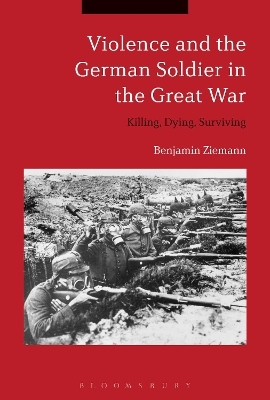
Violence and the German Soldier in the Great War
Bloomsbury Academic (Verlag)
978-1-350-10611-6 (ISBN)
During the Great War, mass killing took place on an unprecedented scale. Violence and the German Soldier in the Great War explores the practice of violence in the German army and demonstrates how he killing of enemy troops, the deaths of German soldiers and their survival were entwined.
As the war reached its climax in 1918, German soldiers refused to continue killing in their droves, and thus made an active contribution to the German defeat and ensuing revolution. Examining the postwar period, the chapters of this book also discuss the contested issue of a ‘brutalization’ of German society as a prerequisite of the Nazi mass movement. Biographical case studies on key figures such as Ernst Jünger demonstrate how the killing of enemy troops by German soldiers followed a complex set of rules.
Benjamin Ziemann makes a wealth of extensive archival work available to an Anglophone audience for the first time, enhancing our understanding of the German army and its practices of violence during the First World War as well as the implications of this brutalization in post-war Germany. This book provides new insights into a crucial topic for students of twentieth-century German history and the First World War.
Benjamin Ziemann is Professor of Modern German History at the University of Sheffield, UK. He is the author of many books and articles on twentieth-century German and European history and a renowned expert in the comparative military and cultural history of the First World War. His books include Contested Commemorations: Republican War Veterans and Weimar Political Culture (2013), War Experiences in Rural Germany, 1914-1923 (2007), and as co-editor, Understanding the Imaginary War: Culture, Thought and Nuclear Conflict, 1945-90 (2016).
List of Figures
Acknowledgements
List of Abbreviations
1. The First World War as a Laboratory of Violence: Introduction
Part I: Practices of Violence
2. Soldiers of the First World War: Killing, Surviving, Discourses of Violence
3. German Soldiers and their Conduct of War in 1914
4. Ernst Jünger: Practitioner and Observer of Killing
II. Refusal of Violence
5. Desertion in the German Army 1914–1918
6. Disillusionment and Collective Exhaustion among German Soldiers on the Western Front: The Path to Revolution in 1918
7. The German Army in Autumn 1918: A Hidden Strike?
III. Processing Violence
8. The Weimar Republic: A Brutalized Society?
9. The Delayed Rejection of Violence: Hermann Schützinger’s Conversion to Pacifism
10. ‘Rear Area Militarism’: Discussing the War in Anti-military Bestsellers in the Weimar Republic
Select Bibliography
Index
| Erscheinungsdatum | 26.04.2019 |
|---|---|
| Zusatzinfo | 7 bw illus |
| Verlagsort | London |
| Sprache | englisch |
| Maße | 154 x 232 mm |
| Gewicht | 460 g |
| Themenwelt | Geschichte ► Allgemeine Geschichte ► Neuzeit (bis 1918) |
| Geisteswissenschaften ► Geschichte ► Regional- / Ländergeschichte | |
| ISBN-10 | 1-350-10611-9 / 1350106119 |
| ISBN-13 | 978-1-350-10611-6 / 9781350106116 |
| Zustand | Neuware |
| Informationen gemäß Produktsicherheitsverordnung (GPSR) | |
| Haben Sie eine Frage zum Produkt? |
aus dem Bereich