


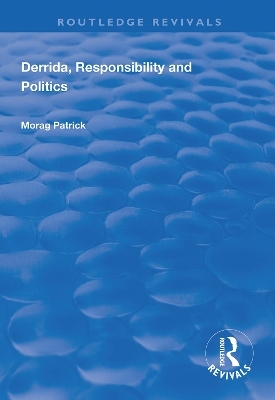
Derrida, Responsibility and Politics
Seiten
2018
Routledge (Verlag)
978-1-138-62422-1 (ISBN)
Routledge (Verlag)
978-1-138-62422-1 (ISBN)
Published in 1997, this book is an evaluation of prominent debates concerning the force and ethico-politico significance of Derrida’s writing.
Published in 1997, Jacques Derrida's ’deconstructive method’ or ’deconstructionism’ is renowned as a species of anarchic free play, an antifoundationalism which can only end in a ruinous irrationalism and thereby the denial of all possibility of discrimination or judgement. In this book, Morag Patrick argues that far from having abandoned critique, Derrida's questioning of Western metaphysics responds to an ethical injunction, to a duty to recall the necessary incalculability of moral and political responsibility. In the first part of the study, Patrick examines the philosophical background to and the basic features of deconstruction. Derrida is located in a tradition of thinkers for whom the question of the possibility of philosophy is fundamental. The deconstructive endeavour is then explained as an attempt to secure a question that would further and transform thinking, a question that would no longer be philosophy's question. Patrick maintains that Derrida's strategy to this end is not anarchic, but rather adheres to strict protocols of reading. Subsequently, the ethical and political implications of this manner of reading are pursued. It is shown that if Derrida undermines the certainty with which we may assume moral and political responsibilities, if he establishes the essential excessiveness of responsibility, he does so in order to effect judgement and not to annul it.
Published in 1997, Jacques Derrida's ’deconstructive method’ or ’deconstructionism’ is renowned as a species of anarchic free play, an antifoundationalism which can only end in a ruinous irrationalism and thereby the denial of all possibility of discrimination or judgement. In this book, Morag Patrick argues that far from having abandoned critique, Derrida's questioning of Western metaphysics responds to an ethical injunction, to a duty to recall the necessary incalculability of moral and political responsibility. In the first part of the study, Patrick examines the philosophical background to and the basic features of deconstruction. Derrida is located in a tradition of thinkers for whom the question of the possibility of philosophy is fundamental. The deconstructive endeavour is then explained as an attempt to secure a question that would further and transform thinking, a question that would no longer be philosophy's question. Patrick maintains that Derrida's strategy to this end is not anarchic, but rather adheres to strict protocols of reading. Subsequently, the ethical and political implications of this manner of reading are pursued. It is shown that if Derrida undermines the certainty with which we may assume moral and political responsibilities, if he establishes the essential excessiveness of responsibility, he does so in order to effect judgement and not to annul it.
Morag Patrick
Part 1: Thinking After Metaphysics 1. The Dialogue of the Question 2. Deconstructive Strategies Part 2: Rewriting Responsibility and Politics 3. The Ethics and Politics of Deconstruction 4. A Question of Significance? 5. Assuming Responsibility.
| Erscheinungsdatum | 24.09.2018 |
|---|---|
| Reihe/Serie | Routledge Revivals |
| Verlagsort | London |
| Sprache | englisch |
| Maße | 152 x 219 mm |
| Gewicht | 500 g |
| Themenwelt | Geisteswissenschaften ► Philosophie ► Philosophie der Neuzeit |
| ISBN-10 | 1-138-62422-5 / 1138624225 |
| ISBN-13 | 978-1-138-62422-1 / 9781138624221 |
| Zustand | Neuware |
| Informationen gemäß Produktsicherheitsverordnung (GPSR) | |
| Haben Sie eine Frage zum Produkt? |
Mehr entdecken
aus dem Bereich


aus dem Bereich
ein Dialog mit Simone Weil
Buch | Softcover (2025)
Matthes & Seitz Berlin (Verlag)
CHF 19,55


