


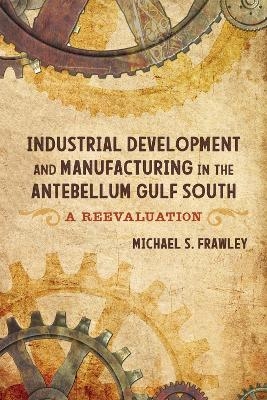
Industrial Development and Manufacturing in the Antebellum Gulf South
A Reevaluation
Seiten
2019
Louisiana State University Press (Verlag)
978-0-8071-7068-7 (ISBN)
Louisiana State University Press (Verlag)
978-0-8071-7068-7 (ISBN)
- Lieferbar (Termin unbekannt)
- Versandkostenfrei
- Auch auf Rechnung
- Artikel merken
Engages a wide variety of sources - including United States census data, which many historians have underutilized when gauging economic growth in the prewar South - to show how industrial development in the region has been systematically minimized by scholars.
In the aftermath of the Civil War, contemporary narratives about the American South pointed to the perceived lack of industrial development in the region to explain why the Confederacy succumbed to the Union. Even after the cliometric revolution of the 1970s, when historians first began applying statistical analysis to reexamine antebellum manufacturing output, the pervasive belief in the region's backward-ness prompted many scholars to view slavery, not industry, as the economic engine of the South.
In Industrial Development and Manufacturing in the Antebellum Gulf South, historian Michael S. Frawley engages a wide variety of sources- including United States census data, which many historians have underutilized when gauging economic growth in the prewar South- to show how industrial development in the region has been systematically minimized by scholars. In doing so, Frawley reconsiders factors related to industrial production in the prewar South, such as the availability of natural resources, transportation, markets, labor, and capital. He contends that the Gulf South was far more industrialized and modern than suggested by census records, economic historians like Fred Bateman and Thomas Weiss, and contemporary travel writers such as Frederick Law Olmsted.
Frawley situates the prewar South firmly in a varied and widespread industrial context, contesting the assumption that slavery inhibited industry in the region and that this lack of economic diversity ultimately prevented the Confederacy from waging a successful war. Though southern manufacturing firms could not match the output of northern states, Industrial Development and Manufacturing in the Antebellum Gulf South proves that such entities had established themselves as vital forces in the southern economy on the eve of the Civil War.
In the aftermath of the Civil War, contemporary narratives about the American South pointed to the perceived lack of industrial development in the region to explain why the Confederacy succumbed to the Union. Even after the cliometric revolution of the 1970s, when historians first began applying statistical analysis to reexamine antebellum manufacturing output, the pervasive belief in the region's backward-ness prompted many scholars to view slavery, not industry, as the economic engine of the South.
In Industrial Development and Manufacturing in the Antebellum Gulf South, historian Michael S. Frawley engages a wide variety of sources- including United States census data, which many historians have underutilized when gauging economic growth in the prewar South- to show how industrial development in the region has been systematically minimized by scholars. In doing so, Frawley reconsiders factors related to industrial production in the prewar South, such as the availability of natural resources, transportation, markets, labor, and capital. He contends that the Gulf South was far more industrialized and modern than suggested by census records, economic historians like Fred Bateman and Thomas Weiss, and contemporary travel writers such as Frederick Law Olmsted.
Frawley situates the prewar South firmly in a varied and widespread industrial context, contesting the assumption that slavery inhibited industry in the region and that this lack of economic diversity ultimately prevented the Confederacy from waging a successful war. Though southern manufacturing firms could not match the output of northern states, Industrial Development and Manufacturing in the Antebellum Gulf South proves that such entities had established themselves as vital forces in the southern economy on the eve of the Civil War.
Michael S. Frawley is assistant professor of history at the University of Texas of the Permian Basin.
| Erscheinungsdatum | 29.10.2018 |
|---|---|
| Verlagsort | Baton Rouge |
| Sprache | englisch |
| Maße | 140 x 216 mm |
| Gewicht | 408 g |
| Themenwelt | Geisteswissenschaften ► Geschichte ► Regional- / Ländergeschichte |
| Geschichte ► Teilgebiete der Geschichte ► Militärgeschichte | |
| Geschichte ► Teilgebiete der Geschichte ► Wirtschaftsgeschichte | |
| Wirtschaft ► Allgemeines / Lexika | |
| Wirtschaft ► Volkswirtschaftslehre | |
| ISBN-10 | 0-8071-7068-2 / 0807170682 |
| ISBN-13 | 978-0-8071-7068-7 / 9780807170687 |
| Zustand | Neuware |
| Informationen gemäß Produktsicherheitsverordnung (GPSR) | |
| Haben Sie eine Frage zum Produkt? |
Mehr entdecken
aus dem Bereich



aus dem Bereich
von der Wiederbewaffnung bis zur Zeitenwende
Buch | Softcover (2025)
C.H.Beck (Verlag)
CHF 16,80
Deutschlands großer Volksaufstand
Buch | Softcover (2024)
Propyläen Verlag
CHF 30,80


