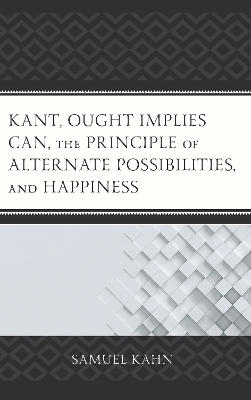
Kant, Ought Implies Can, the Principle of Alternate Possibilities, and Happiness
Lexington Books (Verlag)
978-1-4985-1961-8 (ISBN)
Throughout his corpus, Kant repeatedly and resolutely denies that there is a duty to promote one’s own happiness, and most present-day Kantians seem to agree with him. In Kant, Ought Implies Can, the Principle of Alternate Possibilities, and Happiness, Samuel Kahn argues that this denial rests on two main ideas: (1) a conception of duty that makes the principle of ought implies can (OIC) and the principle of alternate possibilities (PAP) analytic, and (2) the claim that humans necessarily promote their own happiness. This book defends OIC and PAP but nonetheless attacks the second idea, and it supplements this attack with two additional arguments—an interpersonal one and an intrapersonal one—for the claim that a modern day Kantian ethics should affirm a duty to promote one’s own happiness.
Samuel Kahn is associate professor of philosophy at Wuhan University.
Introduction
Part One. Ought implies can in Kantian ethics
Chapter 1. Terminology and Exegesis
Section 1. Terminology
Section 2. Exegesis
Chapter 2. Arguments in Favor of OIC
Section 1. Kant’s argument for OIC
Section 2. The argument from explanation
Section 3. The fairness argument
Section 4. The prescriptivist argument
Section 5. The argument from deontic logic
Chapter 3. Objections to OIC
Section 1. The appeal to alternate traditions
Section 2. The epistemic argument
Section 3. The ordinary language objection
Section 4. The appeal to culpable inability
Section 5. The argument from past obligations
Section 6. The argument from simplicity
Section 7. The argument from excuses
Section 8. The appeal to Hume’s principle
Section 9. The argument from reasons
Section 10. The moral satisfaction objection
Section 11. The appeal to obligations from nowhere
Section 12. The argument from interdependence
Section 13. The argument from epistemic oughts
Section 14. The argument
| Erscheinungsdatum | 10.05.2021 |
|---|---|
| Sprache | englisch |
| Maße | 165 x 231 mm |
| Gewicht | 558 g |
| Themenwelt | Geisteswissenschaften ► Philosophie ► Ethik |
| Geisteswissenschaften ► Philosophie ► Logik | |
| ISBN-10 | 1-4985-1961-X / 149851961X |
| ISBN-13 | 978-1-4985-1961-8 / 9781498519618 |
| Zustand | Neuware |
| Informationen gemäß Produktsicherheitsverordnung (GPSR) | |
| Haben Sie eine Frage zum Produkt? |
aus dem Bereich