


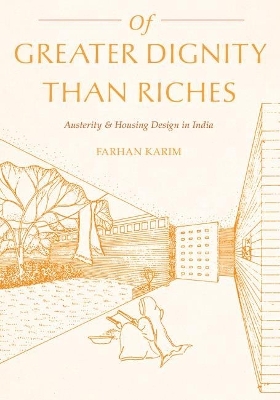
Of Greater Dignity than Riches
Austerity and Housing Design in India
Seiten
2019
University of Pittsburgh Press (Verlag)
978-0-8229-6569-5 (ISBN)
University of Pittsburgh Press (Verlag)
978-0-8229-6569-5 (ISBN)
- Lieferbar (Termin unbekannt)
- Versandkostenfrei
- Auch auf Rechnung
- Artikel merken
Extreme poverty, which intensified in India during colonial rule, peaked in the 1920s—after decades of imperialist exploitation, famine, and disease—a time when architects, engineers, and city authorities proposed a new type of housing for India’s urban poor and industrial workers. As Farhan Karim argues, economic scarcity became a central inspiration for architectural modernism in the subcontinent.
As India moved from colonial rule to independence, the Indian government, business entities, international NGOs, and intergovernmental agencies took major initiatives to modernize housing conditions and the domestic environment of the state’s low-income population. Of Greater Dignity than Riches traces multiple international origins of austerity as an essential ingredient of postcolonial development. By prescribing model villages, communities, and ideal houses for the working class, this project of austerity eventually reduced poverty into a stylized architectural representation. In this rich and original study, Karim explains the postwar and postcolonial history of low-cost housing as an intertwined process of global transferences of knowledge, Cold War cultural politics, postcolonial nationalism, and the politics of economic development.
As India moved from colonial rule to independence, the Indian government, business entities, international NGOs, and intergovernmental agencies took major initiatives to modernize housing conditions and the domestic environment of the state’s low-income population. Of Greater Dignity than Riches traces multiple international origins of austerity as an essential ingredient of postcolonial development. By prescribing model villages, communities, and ideal houses for the working class, this project of austerity eventually reduced poverty into a stylized architectural representation. In this rich and original study, Karim explains the postwar and postcolonial history of low-cost housing as an intertwined process of global transferences of knowledge, Cold War cultural politics, postcolonial nationalism, and the politics of economic development.
Farhan Karim is an assistant professor in the School of Architecture and Design at the University of Kansas. He has worked as an architect, interior designer, and furniture designer in Bangladesh and Australia.
| Erscheinungsdatum | 28.03.2019 |
|---|---|
| Reihe/Serie | Culture Politics & the Built Environment |
| Verlagsort | Pittsburgh PA |
| Sprache | englisch |
| Maße | 178 x 254 mm |
| Themenwelt | Geisteswissenschaften ► Geschichte ► Regional- / Ländergeschichte |
| Technik ► Architektur | |
| ISBN-10 | 0-8229-6569-0 / 0822965690 |
| ISBN-13 | 978-0-8229-6569-5 / 9780822965695 |
| Zustand | Neuware |
| Informationen gemäß Produktsicherheitsverordnung (GPSR) | |
| Haben Sie eine Frage zum Produkt? |
Mehr entdecken
aus dem Bereich


aus dem Bereich
die Geschichte meiner Urgroßmutter
Buch | Hardcover (2025)
C.H.Beck (Verlag)
CHF 32,15
Träume und Macht : eine Biografie
Buch | Hardcover (2025)
C.H.Beck (Verlag)
CHF 61,60


