The Slaveholding Crisis (eBook)
326 Seiten
LSU Press (Verlag)
978-0-8071-6437-2 (ISBN)
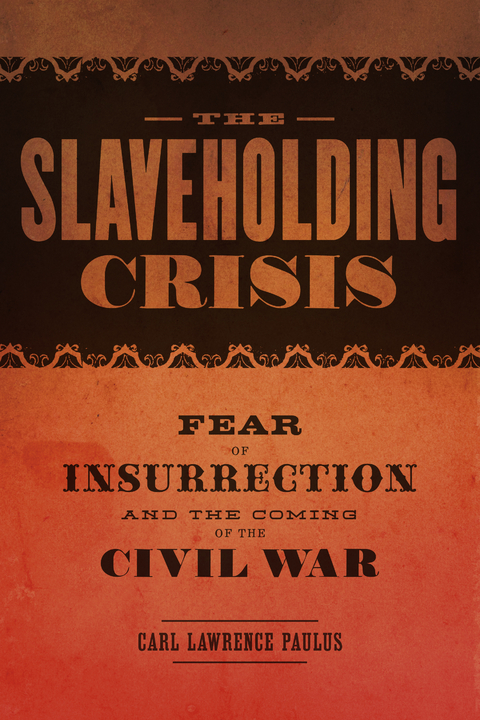
In December 1860, South Carolinians voted to abandon the Union, sparking the deadliest war in American history. Led by a proslavery movement that viewed Abraham Lincoln’s place at the helm of the federal government as a real and present danger to the security of the South, southerners—both slaveholders and nonslaveholders—willingly risked civil war by seceding from the United States. Radical proslavery activists contended that without defending slavery’s westward expansion American planters would, like their former counterparts in the West Indies, become greatly outnumbered by those they enslaved. The result would transform the South into a mere colony within the federal government and make white southerners reliant on antislavery outsiders for protection of their personal safety and wealth. Faith in American exceptionalism played an important role in the reasoning of the antebellum American public, shaping how those in both the free and slave states viewed the world. Questions about who might share the bounty of the exceptional nature of the country became the battleground over which Americans fought, first with words, then with guns.
Carl Lawrence Paulus’s The Slaveholding Crisis examines how, due to the fear of insurrection by the enslaved, southerners created their own version of American exceptionalism—one that placed the perpetuation of slavery at its forefront. Feeling a loss of power in the years before the Civil War, the planter elite no longer saw the Union, as a whole, fulfilling that vision of exceptionalism. As a result, Paulus contends, slaveholders and nonslaveholding southerners believed that the white South could anticipate racial conflict and brutal warfare. This narrative postulated that limiting slavery’s expansion within the Union was a riskier proposition than fighting a war of secession. In the end, Paulus argues, by insisting that the new party in control of the federal government promoted this very insurrection, the planter elite gained enough popular support to create the Confederate States of America. In doing so, they established a thoroughly proslavery, modern state with the military capability to quell massive resistance by the enslaved, expand its territorial borders, and war against the forces of the Atlantic antislavery movement.
CARL LAWRENCE PAULUS has worked as senior staff on Capitol Hill and on political campaigns ranging from local to presidential. Paulus holds a PhD in history from Rice University.
| Erscheint lt. Verlag | 3.1.2017 |
|---|---|
| Reihe/Serie | Conflicting Worlds: New Dimensions of the American Civil War | Conflicting Worlds: New Dimensions of the American Civil War |
| Verlagsort | Baton Rouge |
| Sprache | englisch |
| Themenwelt | Sachbuch/Ratgeber ► Geschichte / Politik ► 20. Jahrhundert bis 1945 |
| Geisteswissenschaften ► Geschichte ► Regional- / Ländergeschichte | |
| Geschichte ► Teilgebiete der Geschichte ► Militärgeschichte | |
| ISBN-10 | 0-8071-6437-2 / 0807164372 |
| ISBN-13 | 978-0-8071-6437-2 / 9780807164372 |
| Informationen gemäß Produktsicherheitsverordnung (GPSR) | |
| Haben Sie eine Frage zum Produkt? |
 EPUB (Adobe DRM)
Kopierschutz: Adobe-DRM
Adobe-DRM ist ein Kopierschutz, der das eBook vor Mißbrauch schützen soll. Dabei wird das eBook bereits beim Download auf Ihre persönliche Adobe-ID autorisiert. Lesen können Sie das eBook dann nur auf den Geräten, welche ebenfalls auf Ihre Adobe-ID registriert sind.
Details zum Adobe-DRM
Dateiformat: EPUB (Electronic Publication)
EPUB ist ein offener Standard für eBooks und eignet sich besonders zur Darstellung von Belletristik und Sachbüchern. Der Fließtext wird dynamisch an die Display- und Schriftgröße angepasst. Auch für mobile Lesegeräte ist EPUB daher gut geeignet.
Systemvoraussetzungen:
PC/Mac: Mit einem PC oder Mac können Sie dieses eBook lesen. Sie benötigen eine
eReader: Dieses eBook kann mit (fast) allen eBook-Readern gelesen werden. Mit dem amazon-Kindle ist es aber nicht kompatibel.
Smartphone/Tablet: Egal ob Apple oder Android, dieses eBook können Sie lesen. Sie benötigen eine
Geräteliste und zusätzliche Hinweise
Buying eBooks from abroad
For tax law reasons we can sell eBooks just within Germany and Switzerland. Regrettably we cannot fulfill eBook-orders from other countries.
aus dem Bereich