


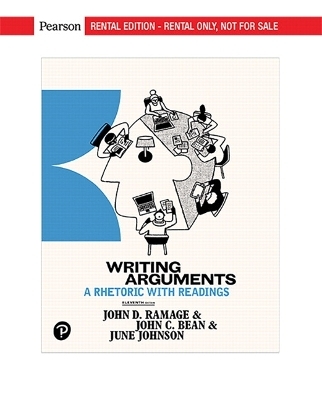
Writing Arguments
Pearson (Verlag)
9780134759746 (ISBN)
- Titel ist leider vergriffen;
keine Neuauflage - Artikel merken
For courses in Argument and Research.
Argument through problem solving
Writing Arguments: A Rhetoric with Readings has sustained its reputation as a leader in argumentation through 10 editions, and that’s no coincidence. Authors Ramage, Bean, and Johnson present argument as a process of inquiry and a means of persuasion — not as a pro/con debate with winners and losers. This, in turn, promotes the essential critical-thinking skills needed for writing effective arguments.
In the 11th Edition, you’ll continue to find all the signature strengths — major assignment chapters that focus on one or two stases; discussion prompts and end-of-chapter writing assignments that reinforce concepts; comprehensive coverage of research and documentation; and a logical, yet flexible, approach. But now, you’ll also find a book that promises to increase understanding of the value of argument and help them negotiate the rhetorical divisiveness in today’s world.
About our authors John Ramage received his BA in philosophy from Whitman College and his PhD in English from Washington State University. He served for over 30 years on the faculties of Montana State University and Arizona State University. In addition to his teaching duties, which included both graduate and undergraduate courses in writing and rhetoric, literary theory and modern literature, Dr. Ramage served as a writing program administrator overseeing writing across the curriculum and composition programs and writing centers. At Arizona State university, he was the founding executive director of the university's Division of Undergraduate Academic Services, responsible for academic support services campus-wide. In addition to The Allyn & Bacon Guide to Writing, Dr. Ramage was the coauthor of the textbooks Form and Surprise in Composition, and Writing Arguments, currently in its 9th edition. He was also the lead author for Argument in Composition, and the sole author of Rhetoric: A User's Guide, and Twentieth Century American Success Rhetoric: How to Construct a Suitable Self. He is currently writing a book about political rhetoric. John C. Bean is an emeritus professor of English at Seattle University, where he held the title of “Consulting Professor of Writing and Assessment.” He has an undergraduate degree from Stanford (1965) and a PhD from the University of Washington (1972). He is the author of an internationally used book on writing across the curriculum, Engaging Ideas: The Professor’s Guide to Writing, Critical Thinking, and Active Learning in the Classroom, 2nd Edition (Jossey-Bass, 2011). He is also the coauthor of The Allyn and Bacon Guide to Writing as well as 2 other influential composition textbooks, Writing Arguments and Reading Rhetorically. He has published numerous articles on writing and writing-across-the-curriculum as well as on literary subjects including Shakespeare and Spenser. His current research interests focus on pedagogical strategies for teaching undergraduate research including quantitative literacy, disciplinary methods of inquiry and argument and the problem of “transfer of learning” as students move through and across a curriculum. A concomitant research interest is the development of institutional assessment strategies that promote productive faculty conversations about teaching and learning. In 2001, he presented a keynote address at the first annual conference of the European Association of Teachers of Academic Writing at the University of Groningen. He has delivered lectures and conducted workshops on writing-across-the-curriculum throughout the United States and Canada as well as for universities in Germany, Bangladesh, Ghana and Zambia. In 2010 his article “Messy Problems and Lay Audiences: Teaching Critical Thinking within the Finance Curriculum” (coauthored with colleagues from finance and economics) won the 2009 McGraw-Hill, Magna Publications Award for the year’s best “scholarly work on teaching and learning.” June Johnson is an associate professor of English, Director of Writing Studies, and Writing Consultant to the University Core at Seattle University. She has a BA in English and an MA in Education from Stanford and an MA in English from Mills College. After chairing the English department of a preparatory school in Los Angeles and working as a development editor in educational publishing, she earned her PhD from the University of Washington. At Seattle University, she supervises the teaching of first-year academic writing seminars as well as teaches these courses and advanced argument and composition theory in the Writing Studies minor. Her research areas include global studies, reflective writing, first-year composition, writing transfer, argumentation and Rogerian communication, subjects on which she conducts workshops at Seattle University and at institutions around the country. She has published articles in American Studies on women’s writing about the West in the 19th century. She is the coauthor (with John Bean) of The Allyn and Bacon Guide to Writing, a text known for its foundation in writing-across-the-curriculum pedagogy and its useful introduction to academic writing, and coauthor (also with John Bean) of Writing Arguments. She also authored Global Issues, Local Arguments, 3rd Edition (Pearson, 2014), an argument reader and rhetoric with a civic literacy focus that provides a cross-curricular introduction to global problems.
Table of Contents I. PRINCIPLES OF ARGUMENT
Argument: An Introduction
What Do We Mean by Argument?
Argument Is Not a Fight or a Quarrel
Argument Is Not Pro-Con Debate
Arguments Can Be Explicit or Implicit
An Explicit Argument Opposing Legalization of Marijuana
For Writing and Discussion: Implicit and Explicit Arguments
The Defining Features of Argument
Argument Requires Justification of Its Claims
Argument Is Both a Process and a Product
Argument Combines Truth-Seeking and Persuasion
Argument and the Problem of Truth in the 21st Century
For Writing and Discussion: Role-Playing Arguments
Conclusion
The Core of an Argument: A Claim with Reason
The Classical Structure of Argument
Classical Appeals and the Rhetorical Triangle
Issue Questions as the Origins of Argument
Difference between an Issue Question and an Information Question
How to Identify an Issue Question
For Writing and Discussion: Information Questions Versus Issue Questions
Difference between a Genuine Argument and a Pseudo-Argument
For Writing and Discussion: Reasonable Arguments Versus Pseudo-Arguments
Frame of an Argument: A Claim Supported by Reasons
What Is a Reason?
For Writing and Discussion: Using Images to Support an Argument
Expressing Reasons in Because Clauses
For Writing and Discussion: Developing Claims and Reasons
Conclusion
Writing Assignment: An Issue Question and Working Thesis Statements 0
The Logical Structure of Arguments: Logos
An Overview of Logos: What Do We Mean by the “Logical Structure” of an Argument?
Formal Logic Versus Real-World Logic
The Role of Assumptions
The Core of an Argument: The Enthymeme
The Power of Audience-Based Reasons
For Writing and Discussion: Identifying Underlying Assumptions and Choosing Audience-Based Reasons
Adopting a Language for Describing Arguments: The Toulmin System
For Writing and Discussion: Developing Enthymemes with the Toulmin Schema
Using Toulmin’s Schema to Plan and Test Your Argument
Hypothetical Example: Cheerleaders as Athletes
First Part of Chandale’s Argument
Continuation of Chandale’s Argument
Extended Student Example: Girls and Violent Video Games
Carmen Tieu (Student Essay), Why Violent Video Games Are Good for Girls
The Thesis-Governed “Self-Announcing” Structure of Classical Argument
For Writing and Discussion: Reasons, Warrants, and Conditions of Rebuttal
Conclusion
A Note on the Informal Fallacies
Writing Assignment: Plan of an Argument’s Details
Using Evidence Effectively
Kinds of Evidence
The Persuasive Use of Evidence
Apply the STAR Criteria to Evidence
Establish a Trustworthy Ethos
Be Mindful of a Source’s Distance from Original Data
Rhetorical Understanding of Evidence
Angle of Vision and the Selection and Framing of Evidence
For Writing and Discussion: Creating Contrasting Angles of Vision
Examining Visual Arguments: Angle of Vision
Rhetorical Strategies for Framing Evidence
Strategies for Framing Statistical Evidence
For Writing and Discussion: Using Strategies to Frame Statistical Evidence
Creating a Plan for Gathering Evidence
Conclusion
Writing Assignment: A Supporting-Reasons Argument
Moving Your Audience: Ethos, Pathos, and Kairos
Logos, Ethos, and Pathos as Persuasive Appeals: An Overview
How to Create an Effective Ethos: The Appeal to Credibility
How to Create Pathos: The Appeal to Beliefs and Emotions
Use Concrete Language
Use Specific Examples and Illustrations
Use Narratives
Use Words, Metaphors, and Analogies with Appropriate Connotations
For Writing and Discussion: Incorporating Appeals to Pathos
Kairos: The Timeliness and Fitness of Arguments
For Writing and Discussion: Analyzing an Argument from the Perspectives of Logos, Ethos, Pathos, and Kairos
Using Images to Appeal to Logos, Ethos, Pathos, and Kairos
For Writing and Discussion: Analyzing Images as Appeals to Pathos
Examining Visual Arguments: Logos, Ethos, Pathos, and Kairos
How Audience-Based Reasons Appeal to Logos, Ethos, Pathos, and Kairos
For Writing and Discussion: Planning an Audience-Based Argumentative Strategy
Conclusion
Writing Assignment: Revising a Draft for Ethos, Pathos, and Audience-Based Reasons
Responding to Objections and Alternative Views
One-Sided, Multisided, and Delayed-Thesis Arguments
Determining Your Audience’s Resistance to Your Views
Appealing to a Supportive Audience: One-Sided Argument
Appealing to a Neutral or Undecided Audience: Classical Argument
Summarizing Opposing Views
For Writing and Discussion: Distinguishing Fair from Unfair Summaries
Refuting Opposing Views
Strategies for Rebutting Evidence
Conceding to Opposing Views
Example of a Student Essay Using Refutation Strategy
Trudie Makens (Student Essay), Bringing Dignity to Workers: Make the Minimum Wage a Living Wage
For Writing and Discussion: Refutation Strategies
Appealing to a Resistant Audience: Delayed-Thesis Argument
ALEXANDER CHANCELLOR, Oh, How I Will Miss the Plastic Bag
Writing a Delayed-Thesis Argument
Conclusion
Writing Assignment: A Classical Argument or a Delayed Thesis Argument
Reading
Lauren Shinozuka (Student Essay), The Dangers of Digital Distractedness
II. ENTERING AN ARGUMENTATIVE CONVERSATION
Analyzing Arguments Rhetorically
Thinking Rhetorically about a Text
Reconstructing a Text’s Rhetorical Context
Author, Motivating Occasion, and Purpose
Audience
Genre
Angle of Vision
Asking Questions That Promote Rhetorical Thinking
For Writing and Discussion: Practicing Rhetorical Analysis
Conducting a Rhetorical Analysis of a Source Text
KATHRYN JEAN LOPEZ, Egg Heads
For Writing and Discussion: Identifying Rhetorical Features
Our Own Rhetorical Analysis of “Egg Heads”
Conclusion
Writing Assignment: A Rhetorical Analysis
Readings
ELLEN GOODMAN, Womb for Rent
Critiquing “Womb for Rent”
Zachary Stumps (Student Essay), A Rhetorical Analysis Of Ellen Goodman’s “Womb For Rent”
Argument as Inquiry: Reading, Summarizing, and Speaking Back
Finding Issues to Explore
Do Some Initial Brainstorming
Be Open to the Issues All Around You
Explore Ideas by Freewriting
For Writing and Discussion: Responding to Visual Arguments About a Living Wage
Explore Ideas by Idea Mapping
Explore Ideas by Playing the Believing and Doubting Game
For Writing and Discussion: Playing the Believing and Doubting Game
Summarizing a Stakeholder’s Argument
JAMES SUROWIECKI, The Pay Is Too Damn Low
Thinking Steps for Writing a Summary
For Writing and Discussion: Does/Says Statements
Examples of Summaries
Responding to a Stakeholder’s Argument
Practicing Believing: Willing Your Own Acceptance of the Writer’s Views
Practicing Doubting: Willing Your Own Resistance to the Writer’s Views
For Writing and Discussion: Raising Doubts About Surowiecki’s Argument
Thinking Dialectically
For Writing and Discussion: Practicing Dialectic Thinking with Two Articles
MICHAEL SALTSMAN, To Help the Poor, Move Beyond “Minimum” Gestures
Three Ways to Foster Dialectic Thinking
Conclusion
Writing Assignment: An Argument Summary or a Formal Exploratory Essay
Reading
Trudie Makens (Student Essay), Should Fast-Food Workers Be Paid $15 per Hour?
III. EXPANDING OUR UNDERSTANDING OF ARGUMENT
Making Visual and Multimodal Arguments
Understanding Visual Design Elements in Multimodal Argument
Use of Type
Use of Space and Layout
Use of Color
Use of Images and Graphics
For Writing and Discussion: Analyzing an Advocacy Ad
The Compositional Features of Photographs and Drawings
Compositional Features to Examine in Photos and Drawings
An Analysis of a Multimedia Video Argument Using Words, Images, and Music
For Writing and Discussion: Thinking Rhetorically about Photos
The Genres of Multimodal Argument
Posters and Fliers
Public Affairs Advocacy Advertisements
Cartoons
For Writing and Discussion: Analyzing Posters Rhetorically
For Writing and Discussion: Analyzing Cartoons
Websites
Advocacy Videos
Constructing Your Own Multimodal Arguments
Guidelines for Creating the Visual Elements in Posters, Fliers, and Advocacy Ads
Guidelines for Creating Video Arguments
For Writing and Discussion: Developing Ideas for an Advocacy Ad or Poster Argument
Using Information Graphics in Arguments
How Tables Contain a Variety of Stories
Using a Graph to Tell a Story
Incorporating Graphics into Your Argument
A Note on How Graphics Frame Data Rhetorically
Conclusion
Writing Assignment: A Visual Argument Rhetorical Analysis, a Visual Argument, or a Short Argument Using Quantitative Data
An Alternative to Argument: Collaborative Rhetoric
The Appropriateness and Usefulness of Collaborative Rhetoric
The Principles of Collaborative Rhetoric
Practicing Nonjudgmental Listening
Identifying Values, Emotions, and Identities
Seeking Common Ground
Promoting Openness to Ongoing Communication and Change
For Writing and Discussion: Listening Empathically and Seeking Common Ground
Preparing for Collaborative Rhetoric Through Reflective Writing and Discussion
Preparing for Collaborative Rhetoric Through Reflective Writing
Practicing Collaborative Rhetoric in Discussion
For Writing and Discussion: Conducting a Collaborative Rhetoric Discussion
Writing an Open Letter as Collaborative Rhetoric
Colleen Fontana (Student Essay), An Open Letter to Robert Levy in Response to His Article “They Never Learn”
Conclusion
Writing Assignment: An Open Letter as Collaborative Rhetoric
Reading
Monica Allen (Student Essay), An Open Letter to Christopher Eide in Response to His Article “High-Performing Charter Schools Can Close the Opportunity Gap”
IV. ARGUMENTS IN DEPTH: TYPES OF CLAIMS
An Introduction to the Types of Claims
The Types of Claims and Their Typical Patterns of Development
For Writing and Discussion: Identifying Types of Claims
Using Claim Types to Focus an Argument and Generate Ideas: An Example
Writer 1: Ban E-Cigarettes
Writer 2: Promote E-Cigarettes as a Preferred Alternative to Real Cigarettes
Writer 3: Place No Restrictions on E-Cigarettes
Hybrid Arguments: How Claim Types Work Together in Arguments
Some Examples of Hybrid Arguments
For Writing and Discussion: Exploring Different Claim Types and Audiences
An Extended Example of a Hybrid Argument
ALEX HUTCHINSON, Your Daily Multivitamin May Be Hurting You
Definition and Resemblance Arguments
What Is at Stake in an Argument about Definition and Resemblance?
Consequences Resulting from Categorical Claims
The Rule of Justice: Things in the Same Category Should Be Treated the Same Way
For Writing and Discussion: Applying the Rule of Justice
Types of Categorical Arguments
Simple Categorical Arguments
For Writing and Discussion: Supporting and Rebutting Simple Categorical Claims
Definition Arguments
Resemblance Argument Using Analogy
For Writing and Discussion: Developing Analogies
Resemblance Arguments Using Precedent
For Writing and Discussion: Using Claims of Precedent
Examining Visual Arguments: Claim about Category (Definition)
The Criteria-Match Structure of Definition Arguments
Overview of Criteria-Match Structure
Toulmin Framework for a Definition Argument
For Writing and Discussion: Identifying Criteria and Match Issues
Creating Criteria Using Aristotelian Definition
Strategy 1: Research How Others Have Defined the Term
Strategy 2: Create Your Own Extended Definition
For Writing and Discussion: Developing a Definition
Writing Assignment: A Definition Argument
Exploring Ideas
Identifying Your Audience and Determining What’s at Stake
Organizing a Definition Argument
Questioning and Critiquing a Definition Argument
Readings
Arthur Knopf (Student Essay), Is Milk a Health Food?
Alex Mullen (Student Essay), A Pirate But Not a Thief: What Does “Stealing” Mean in a Digital Environment?
MARK OPPENHEIMER, How Do We Define Adulthood?
Causal Arguments
An Overview of Causal Arguments
Kinds of Causal Arguments
Toulmin Framework for a Causal Argument
For Writing and Discussion: Developing Causal Chains
Two Methods for Arguing That One Event Causes Another
First Method: Explain the Causal Mechanism Directly
Second Method: Infer Causal Links Using Inductive Reasoning
For Writing and Discussion: Developing Plausible Causal Chains Based on Correlations
Examining Visual Arguments: A Causal Claim
Key Terms and Inductive Fallacies in Causal Arguments
A Glossary of Key Terms
Avoiding Common Inductive Fallacies That Can Lead to Wrong Conclusions
For Writing and Discussion: Brainstorming Causes and Constraints
Writing Assignment: A Causal Argument
Exploring Ideas
Identifying Your Audience and Determining What’s at Stake
Organizing a Causal Argument
Questioning and Critiquing a Causal Argument
Readings
Jesse Goncalves (Student Essay), What Causes Math Anxiety?
KRIS SAKNUSSEMM, Mirror, Mirror on the Wall, Are We Really Here at All? Can We Tell?
Carlos Macias (Student Essay), “The Credit Card Company Made Me Do It!”–The Credit Card Industry’s Role in Causing Student Debt
Evaluation and Ethical Arguments
An Overview of Categorical and Ethical Evaluation Arguments
Constructing a Categorical Evaluation Argument
Criteria-Match Structure of Categorical Evaluations
Developing Your Criteria
Making Your Match Argument
Examining Visual Arguments: An Evaluation Claim
For Writing and Discussion: Developing Criteria and Match Arguments
Constructing an Ethical Evaluation Argument
Consequences as the Base of Ethics
Principles as the Base of Ethics
Example Ethical Arguments Examining Capital Punishment
For Writing and Discussion: Developing an Ethical Argument
Common Problems in Making Evaluation Arguments
Writing Assignment: An Evaluation or Ethical Argument
Exploring Ideas
Identifying Your Audience and Determining What’s at Stake
Organizing an Evaluation Argument
Questioning and Critiquing a Categorical Evaluation Argument
Critiquing an Ethical Argument
Readings
Lorena Mendoza-Flores (Student Essay), Silenced and Invisible: Problems of Hispanic Students at Valley High School
Hadley Reeder (Student Essay), A Defective and Detrimental Dress Code
JUDITH DAAR AND EREZ ALONI, Three Genetic Parents–For One Healthy Baby
SAMUEL AQUILA, The “Therapeutic Cloning” of Human Embryos
Proposal Arguments
The Special Features and Concerns of Proposal Arguments
Practical Proposals Versus Policy Proposals
Toulmin Framework for a Proposal Argument
Special Concerns for Proposal Arguments
Developing a Proposal Argument
Examining Visual Arguments: A Proposal Claim
Convincing Your Readers That a Problem Exists
Explaining the Proposed Solution: Showing the Specifics of Your Proposal
Offering a Justification: Convincing Your Readers That the Benefits of Your Proposal Outweigh the Costs
Using Heuristic Strategies to Develop Supporting Reasons for Your Proposal
The Claim Types Strategy
The Stock Issues Strategy
For Writing and Discussion: Generating Ideas Using the Claim Types Strategy
For Writing and Discussion: Brainstorming Ideas for a Proposal
Proposal Arguments as Advocacy Posters or Advertisements
Writing Assignment: A Proposal Argument
Exploring Ideas
Identifying Your Audience and Determining What’s at Stake
Organizing a Proposal Argument
Designing a One-Page Advocacy Poster or Advertisement
Designing PowerPoint Slides or Other Visual Aids for a Speech
Questioning and Critiquing a Proposal Argument
Readings
Megan Johnson (Student Essay), A Practical Proposal
Ivan Snook (Student Essay), Flirting with Disaster: An Argument against Integrating Women into the Combat Arms
Sandy Wainscott (Student Essay), Why McDonald’s Should Sell Meat and Veggie Pies: A Proposal to End Subsidies for Cheap Meat
MARCEL DICKE AND ARNOLD VAN HUIS, The Six-Legged Meat of the Future
V. THE RESEARCHED ARGUMENT
Finding and Evaluating Sources
Formulating a Research Question Instead of a Topic
Thinking Rhetorically About Kinds of Sources
Identifying Kinds of Sources Relevant to Your Question
Approaching Sources Rhetorically
For Writing and Discussion: Identifying Types of Sources
Finding Sources
Conducting Interviews
Gathering Source Data from Surveys or Questionnaires
Finding Books and Reference Sources
Using Licensed Databases to Find Articles in Scholarly Journals, Magazines, and News Sources
Finding Cyberspace Sources: Searching the World Wide Web
Selecting and Evaluating Your Sources and Taking Purposeful Notes
Reading with Rhetorical Awareness
Evaluating Sources
Criteria for Evaluating a Web Source
For Writing and Discussion: Analyzing the Rhetorical Elements of Two Websites
Taking Purposeful Notes
Conclusion
Incorporating Sources into Your Own Argument
Using Sources for Your Own Purposes
Writer 1: A Causal Argument Showing Alternative Approaches to Reducing Risk of Alcoholism
Writer 2: A Proposal Argument Advocating Vegetarianism
Writer 3: An Evaluation Argument Looking Skeptically at Vegetarianism
For Writing And Discussion: Using a Source for Different Purposes
Using Summary, Paraphrase, and Quotation
Summarizing
Paraphrasing
Quoting
Punctuating Quotations Correctly
Quoting a Complete Sentence
Quoting Words and Phrases
Modifying a Quotation
Omitting Something from a Quoted Passage
Quoting Something That Contains a Quotation
Using a Block Quotation for a Long Passage
Creating Rhetorically Effective Attributive Tags
Attributive Tags versus Parenthetical Citations
Creating Attributive Tags to Shape Reader Response
Avoiding Plagiarism
Why Some Kinds of Plagiarism May Occur Unwittingly
Strategies for Avoiding Plagiarism
For Writing And Discussion: Avoiding Plagiarism
Conclusion
Citing and Documenting Sources
The Correspondence between In-Text Citations and the End-of-Paper List of Cited Works
MLA Style
In-Text Citations in MLA Style
Works Cited List in MLA Style
MLA Works Cited Citation Models
MLA-Style Research Paper
APA Style
In-Text Citations in APA Style
References List in APA Style
APA References Citation Models
APA-Style Research Paper
Conclusion
APPENDIX: INFORMAL FALLACIES
The Difference Between Formal and Informal Logic
| Erscheinungsdatum | 04.09.2018 |
|---|---|
| Sprache | englisch |
| Themenwelt | Geisteswissenschaften ► Sprach- / Literaturwissenschaft ► Sprachwissenschaft |
| ISBN-13 | 9780134759746 / 9780134759746 |
| Zustand | Neuware |
| Informationen gemäß Produktsicherheitsverordnung (GPSR) | |
| Haben Sie eine Frage zum Produkt? |
aus dem Bereich


