


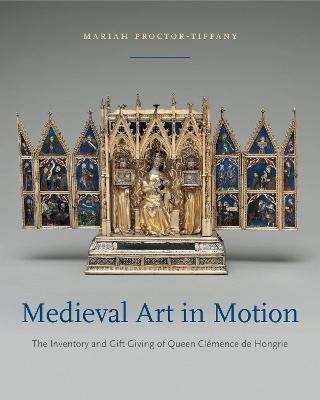
Medieval Art in Motion
The Inventory and Gift Giving of Queen Clémence de Hongrie
Seiten
2019
Pennsylvania State University Press (Verlag)
978-0-271-08112-0 (ISBN)
Pennsylvania State University Press (Verlag)
978-0-271-08112-0 (ISBN)
Reconstructs the art collection and material culture around the fourteenth-century French queen Clémence de Hongrie. Examines how she moved her objects in a deliberate strategy to build her identity and create a lasting legacy for herself and her family in medieval Paris.
In this visually rich volume, Mariah Proctor-Tiffany reconstructs the art collection and material culture of the fourteenth-century French queen Clémence de Hongrie, illuminating the way the royal widow gave objects as part of a deliberate strategy to create a lasting legacy for herself and her family in medieval Paris.
After the sudden death of her husband, King Louis X, and the loss of her promised income, young Clémence fought for her high social status by harnessing the visual power of possessions, displaying them, and offering her luxurious objects as gifts. Clémence adeptly performed the role of queen, making a powerful argument for her place at court and her income as she adorned her body, the altars of her chapels, and her dining tables with sculptures, paintings, extravagant textiles, manuscripts, and jewelry—the exclusive accoutrements of royalty. Proctor-Tiffany analyzes the queen’s collection, maps the geographic trajectories of her gifts of art, and interprets Clémence’s generosity using anthropological theories of exchange and gift giving.
Engaging with the art inventory of a medieval French woman, this lavishly illustrated microhistory sheds light on the material and social culture of the late Middle Ages. Scholars and students of medieval art, women’s studies, digital mapping, and the anthropology of ritual and gift giving especially will welcome Proctor-Tiffany’s meticulous research.
In this visually rich volume, Mariah Proctor-Tiffany reconstructs the art collection and material culture of the fourteenth-century French queen Clémence de Hongrie, illuminating the way the royal widow gave objects as part of a deliberate strategy to create a lasting legacy for herself and her family in medieval Paris.
After the sudden death of her husband, King Louis X, and the loss of her promised income, young Clémence fought for her high social status by harnessing the visual power of possessions, displaying them, and offering her luxurious objects as gifts. Clémence adeptly performed the role of queen, making a powerful argument for her place at court and her income as she adorned her body, the altars of her chapels, and her dining tables with sculptures, paintings, extravagant textiles, manuscripts, and jewelry—the exclusive accoutrements of royalty. Proctor-Tiffany analyzes the queen’s collection, maps the geographic trajectories of her gifts of art, and interprets Clémence’s generosity using anthropological theories of exchange and gift giving.
Engaging with the art inventory of a medieval French woman, this lavishly illustrated microhistory sheds light on the material and social culture of the late Middle Ages. Scholars and students of medieval art, women’s studies, digital mapping, and the anthropology of ritual and gift giving especially will welcome Proctor-Tiffany’s meticulous research.
Mariah Proctor-Tiffany is Associate Professor of Art History at California State University, Long Beach.
List of Illustrations
Acknowledgments
A Note on Terminology and Nomenclature
Introduction
1 The Life, Times, and Art of an International Queen
2 Systems of Exchange: Moving Art and Material Culture
3 The Body, the Altar, and the Table: Possessions and Sites of Identity Proclamation
4 The Queen’s Manuscripts and Identity
5 Gift Giving in the Gothic World
6 The Queen and Ritual Gift Giving
7 Gifts to Individuals, Near and Far
Conclusion: Good and Glorious Exchange
Appendix 1: The Testament of Clémence de Hongrie
Appendix 2: The Inventory of Clémence de Hongrie
Appendix 3: Glossary
Notes
Bibliography
Index
| Erscheinungsdatum | 13.03.2019 |
|---|---|
| Zusatzinfo | 3 Charts; 5 Maps; 28 Halftones, color; 30 Halftones, black and white |
| Verlagsort | University Park |
| Sprache | englisch |
| Maße | 203 x 254 mm |
| Gewicht | 1134 g |
| Themenwelt | Kunst / Musik / Theater ► Kunstgeschichte / Kunststile |
| Geschichte ► Allgemeine Geschichte ► Mittelalter | |
| Geisteswissenschaften ► Geschichte ► Regional- / Ländergeschichte | |
| ISBN-10 | 0-271-08112-0 / 0271081120 |
| ISBN-13 | 978-0-271-08112-0 / 9780271081120 |
| Zustand | Neuware |
| Informationen gemäß Produktsicherheitsverordnung (GPSR) | |
| Haben Sie eine Frage zum Produkt? |
Mehr entdecken
aus dem Bereich


aus dem Bereich
Geschichte einer Augsburger Familie (1367-1650)
Buch | Softcover (2024)
Kohlhammer (Verlag)
CHF 47,60
der epische Kampf um das Heilige Land
Buch | Hardcover (2025)
C.H.Beck (Verlag)
CHF 49,95


