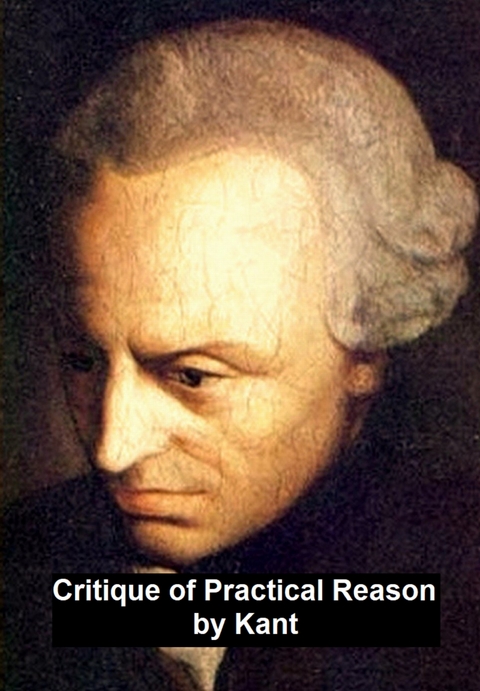
Critique of Practical Reason (eBook)
161 Seiten
Seltzer Books (Verlag)
978-1-4553-2298-5 (ISBN)
According to Wikipedia: 'Immanuel Kant (22 April 1724 - 12 February 1804) was an 18th-century German philosopher from the Prussian city of Königsberg (now Kaliningrad, Russia). He is regarded as one of the most influential thinkers of modern Europe and of the late Enlightenment. Kant created a new widespread perspective in philosophy which is influencing enlightened philosophy until the 21st Century. He published important works of epistemology as also scripts in coherence to religion, law and history. His most important work is the Critique of Pure Reason, an investigation into the limitations and structure of reason itself. It encompasses an attack on traditional metaphysics and epistemology, and highlights Kant's own contribution to these areas. The other main works of his maturity are the Critique of Practical Reason, which concentrates on ethics, and the Critique of Judgment, which investigates aesthetics and teleology.'
According to Wikipedia: "e;Immanuel Kant (22 April 1724 - 12 February 1804) was an 18th-century German philosopher from the Prussian city of Konigsberg (now Kaliningrad, Russia). He is regarded as one of the most influential thinkers of modern Europe and of the late Enlightenment. Kant created a new widespread perspective in philosophy which is influencing enlightened philosophy until the 21st Century. He published important works of epistemology as also scripts in coherence to religion, law and history. His most important work is the Critique of Pure Reason, an investigation into the limitations and structure of reason itself. It encompasses an attack on traditional metaphysics and epistemology, and highlights Kant's own contribution to these areas. The other main works of his maturity are the Critique of Practical Reason, which concentrates on ethics, and the Critique of Judgment, which investigates aesthetics and teleology."e;
CHAPTER I. Of a Dialectic of Pure Practical Reason Generally.
Pure reason always has its dialetic, whether it is considered in its speculative or its practical employment; for it requires the absolute totality of the 'conditions of what is given conditioned, and this can only be found in things in themselves. But as all conceptions of things in themselves must be referred to intuitions, and with us men these can never be other than sensible and hence can never enable us to know objects as things in themselves but only as appearances, and since the unconditioned can never be found in this chain of appearances which consists only of conditioned and conditions; thus from applying this rational idea of the totality of the conditions (in other words of the unconditioned) to appearances, there arises an inevitable illusion, as if these latter were things in themselves (for in the absence of a warning critique they are always regarded as such). This illusion would never be noticed as delusive if it did not betray itself by a conflict of reason with itself, when it applies to appearances its fundamental principle of presupposing the unconditioned to everything conditioned. By this, however, reason is compelled to trace this illusion to its source, and search how it can be removed, and this can only be done by a complete critical examination of the whole pure faculty of reason; so that the antinomy of the pure reason which is manifest in its dialectic is in fact the most beneficial error into which human reason could ever have fallen, since it at last drives us to search for the key to escape from this labyrinth; and when this key is found, it further discovers that which we did not seek but yet had need of, namely, a view into a higher and an immutable order of things, in which we even now are, and in which we are thereby enabled by definite precepts to continue to live according to the highest dictates of reason.
It may be seen in detail in the Critique of Pure Reason how in its speculative employment this natural dialectic is to be solved, and how the error which arises from a very natural illusion may be guarded against. But reason in its practical use is not a whit better off. As pure practical reason, it likewise seeks to find the unconditioned for the practically conditioned (which rests on inclinations and natural wants), and this is not as the determining principle of the will, but even when this is given (in the moral law) it seeks the unconditioned totality of the object of pure practical reason under the name of the summum bonum.
To define this idea practically, i.e., sufficiently for the maxims of our rational conduct, is the business of practical wisdom, and this again as a science is philosophy, in the sense in which the word was understood by the ancients, with whom it meant instruction in the conception in which the summum bonum was to be placed, and the conduct by which it was to be obtained. It would be well to leave this word in its ancient signification as a doctrine of the summum bonum, so far as reason endeavours to make this into a science. For on the one band the restriction annexed would suit the Greek expression (which signifies the love of wisdom), and yet at the same time would be sufficient to embrace under the name of philosophy the love of science: that is to say, of all speculative rational knowledge, so far as it is serviceable to reason, both for that conception and also for the practical principle determining our conduct, without letting out of sight the main end, on account of which alone it can be called a doctrine of practical wisdom. On the other hand, it would be no harm to deter the self-conceit of one who ventures to claim the title of philosopher by holding before him in the very definition a standard of self-estimation which would very much lower his pretensions. For a teacher of wisdom would mean something more than a scholar who has not come so far as to guide himself, much less to guide others, with certain expectation of attaining so high an end: it would mean a master in the knowledge of wisdom, which implies more than a modest man would claim for himself. Thus philosophy as well as wisdom would always remain an ideal, which objectively is presented complete in reason alone, while subjectively for the person it is only the goal of his unceasing endeavours; and no one would be justified in professing to be in possession of it so as to assume the name of philosopher who could not also show its infallible effects in his own person as an example (in his self-mastery and the unquestioned interest that he takes pre-eminently in the general good), and this the ancients also required as a condition of deserving that honourable title.
We have another preliminary remark to make respecting the dialectic of the pure practical reason, on the point of the definition of the summum bonum (a successful solution of which dialectic would lead us to expect, as in case of that of the theoretical reason, the most beneficial effects, inasmuch as the self-contradictions of pure practical reason honestly stated, and not concealed, force us to undertake a complete critique of this faculty).
The moral law is the sole determining principle of a pure will. But since this is merely formal (viz., as prescribing only the form of the maxim as universally legislative), it abstracts as a determining principle from all matter that is to say, from every object of volition. Hence, though the summum bonum may be the whole object of a pure practical reason, i.e., a pure will, yet it is not on that account to be regarded as its determining principle; and the moral law alone must be regarded as the principle on which that and its realization or promotion are aimed at. This remark is important in so delicate a case as the determination of moral principles, where the slightest misinterpretation perverts men's minds. For it will have been seen from the Analytic that, if we assume any object under the name of a good as a determining principle of the will prior to the moral law and then deduce from it the supreme practical principle, this would always introduce heteronomy and crush out the moral principle.
It is, however, evident that if the notion of the summum bonum includes that of the moral law as its supreme condition, then the summum bonum would not merely be an object, but the notion of it and the conception of its existence as possible by our own practical reason would likewise be the determining principle of the will, since in that case the will is in fact determined by the moral law which is already included in this conception, and by no other object, as the principle of autonomy requires. This order of the conceptions of determination of the will must not be lost sight of, as otherwise we should misunderstand ourselves and think we had fallen into a contradiction, while everything remains in perfect harmony.
CHAPTER II. Of the Dialectic of Pure Reason in defining the Conception of the "Summum Bonum".
The conception of the summum itself contains an ambiguity which might occasion needless disputes if we did not attend to it. The summum may mean either the supreme (supremum) or the perfect (consummatum). The former is that condition which is itself unconditioned, i.e., is not subordinate to any other (originarium); the second is that whole which is not a part of a greater whole of the same kind (perfectissimum). It has been shown in the Analytic that virtue (as worthiness to be happy) is the supreme condition of all that can appear to us desirable, and consequently of all our pursuit of happiness, and is therefore the supreme good. But it does not follow that it is the whole and perfect good as the object of the desires of rational finite beings; for this requires happiness also, and that not merely in the partial eyes of the person who makes himself an end, but even in the judgement of an impartial reason, which regards persons in general as ends in themselves. For to need happiness, to deserve it, and yet at the same time not to participate in it, cannot be consistent with the perfect volition of a rational being possessed at the same time of all power, if, for the sake of experiment, we conceive such a being. Now inasmuch as virtue and happiness together constitute the possession of the summum bonum in a person, and the distribution of happiness in exact proportion to morality (which is the worth of the person, and his worthiness to be happy) constitutes the summum bonum of a possible world; hence this summum bonum expresses the whole, the perfect good, in which, however, virtue as the condition is always the supreme good, since it has no condition above it; whereas happiness, while it is pleasant to the possessor of it, is not of itself absolutely and in all respects good, but always presupposes morally right behaviour as its condition.
When two elements are necessarily united in one concept, they must be connected as reason and consequence, and this either so that their unity is considered as analytical (logical connection), or as synthetical (real connection) the former following the law of identity, the latter that of causality. The connection of virtue and happiness may therefore be understood in two ways: either the endeavour to be virtuous and the rational pursuit of happiness are not two distinct actions, but absolutely identical, in which case no maxim need be made the principle of the former, other than what serves for the latter; or the connection consists in this, that virtue produces happiness as something distinct from the consciousness of virtue, as a cause produces an effect.
The ancient Greek schools were, properly speaking, only two,...
| Erscheint lt. Verlag | 1.3.2018 |
|---|---|
| Sprache | englisch |
| Themenwelt | Geisteswissenschaften ► Philosophie ► Allgemeines / Lexika |
| ISBN-10 | 1-4553-2298-9 / 1455322989 |
| ISBN-13 | 978-1-4553-2298-5 / 9781455322985 |
| Informationen gemäß Produktsicherheitsverordnung (GPSR) | |
| Haben Sie eine Frage zum Produkt? |
 EPUB (Adobe DRM)
Größe: 322 KB
Kopierschutz: Adobe-DRM
Adobe-DRM ist ein Kopierschutz, der das eBook vor Mißbrauch schützen soll. Dabei wird das eBook bereits beim Download auf Ihre persönliche Adobe-ID autorisiert. Lesen können Sie das eBook dann nur auf den Geräten, welche ebenfalls auf Ihre Adobe-ID registriert sind.
Details zum Adobe-DRM
Dateiformat: EPUB (Electronic Publication)
EPUB ist ein offener Standard für eBooks und eignet sich besonders zur Darstellung von Belletristik und Sachbüchern. Der Fließtext wird dynamisch an die Display- und Schriftgröße angepasst. Auch für mobile Lesegeräte ist EPUB daher gut geeignet.
Systemvoraussetzungen:
PC/Mac: Mit einem PC oder Mac können Sie dieses eBook lesen. Sie benötigen eine
eReader: Dieses eBook kann mit (fast) allen eBook-Readern gelesen werden. Mit dem amazon-Kindle ist es aber nicht kompatibel.
Smartphone/Tablet: Egal ob Apple oder Android, dieses eBook können Sie lesen. Sie benötigen eine
Geräteliste und zusätzliche Hinweise
Buying eBooks from abroad
For tax law reasons we can sell eBooks just within Germany and Switzerland. Regrettably we cannot fulfill eBook-orders from other countries.
EPUB (Ohne DRM)Digital Rights Management: ohne DRM
Dieses eBook enthält kein DRM oder Kopierschutz. Eine Weitergabe an Dritte ist jedoch rechtlich nicht zulässig, weil Sie beim Kauf nur die Rechte an der persönlichen Nutzung erwerben.
Dateiformat: EPUB (Electronic Publication)
EPUB ist ein offener Standard für eBooks und eignet sich besonders zur Darstellung von Belletristik und Sachbüchern. Der Fließtext wird dynamisch an die Display- und Schriftgröße angepasst. Auch für mobile Lesegeräte ist EPUB daher gut geeignet.
Systemvoraussetzungen:
PC/Mac: Mit einem PC oder Mac können Sie dieses eBook lesen. Sie benötigen dafür die kostenlose Software Adobe Digital Editions.
eReader: Dieses eBook kann mit (fast) allen eBook-Readern gelesen werden. Mit dem amazon-Kindle ist es aber nicht kompatibel.
Smartphone/Tablet: Egal ob Apple oder Android, dieses eBook können Sie lesen. Sie benötigen dafür eine kostenlose App.
Geräteliste und zusätzliche Hinweise
Buying eBooks from abroad
For tax law reasons we can sell eBooks just within Germany and Switzerland. Regrettably we cannot fulfill eBook-orders from other countries.
aus dem Bereich